The Essential Communication Methods to Know When Communicating with Dementia and Alzheimer's Patients consist of complementary approaches such as using short and simple sentences, speaking slowly, making eye contact, responding to emotions, and relying on body language when speech diminishes. Because these diseases affect memory, language, and attention functions, conventional ways of speaking often prove insufficient. The caregiver's real decision lies in the choice between "making the patient accept reality" and "prioritizing making the patient feel safe and understood"; the path that reduces conflict in daily life is largely the latter.
Contents
Why dementia and Alzheimer's make communication difficult
Dementia and Alzheimer's cause impairments in cognitive functions such as memory, attention, language, and orientation. A person may struggle to learn new information, understand complex sentences, and find words; for this reason, traditional forms of communication are often inadequate. The source of the problem is usually not "unwillingness," but rather a change in the brain's capacity to process information.
In the advanced stages of the disease, verbal communication may decrease; nonverbal cues such as facial expressions, gestures, and touch become more decisive. This situation calls for an approach that prioritizes making the patient feel safe and understood rather than seeking a "right or wrong answer" in communication. The methods below are also practical principles aimed at adapting to this clinical reality.
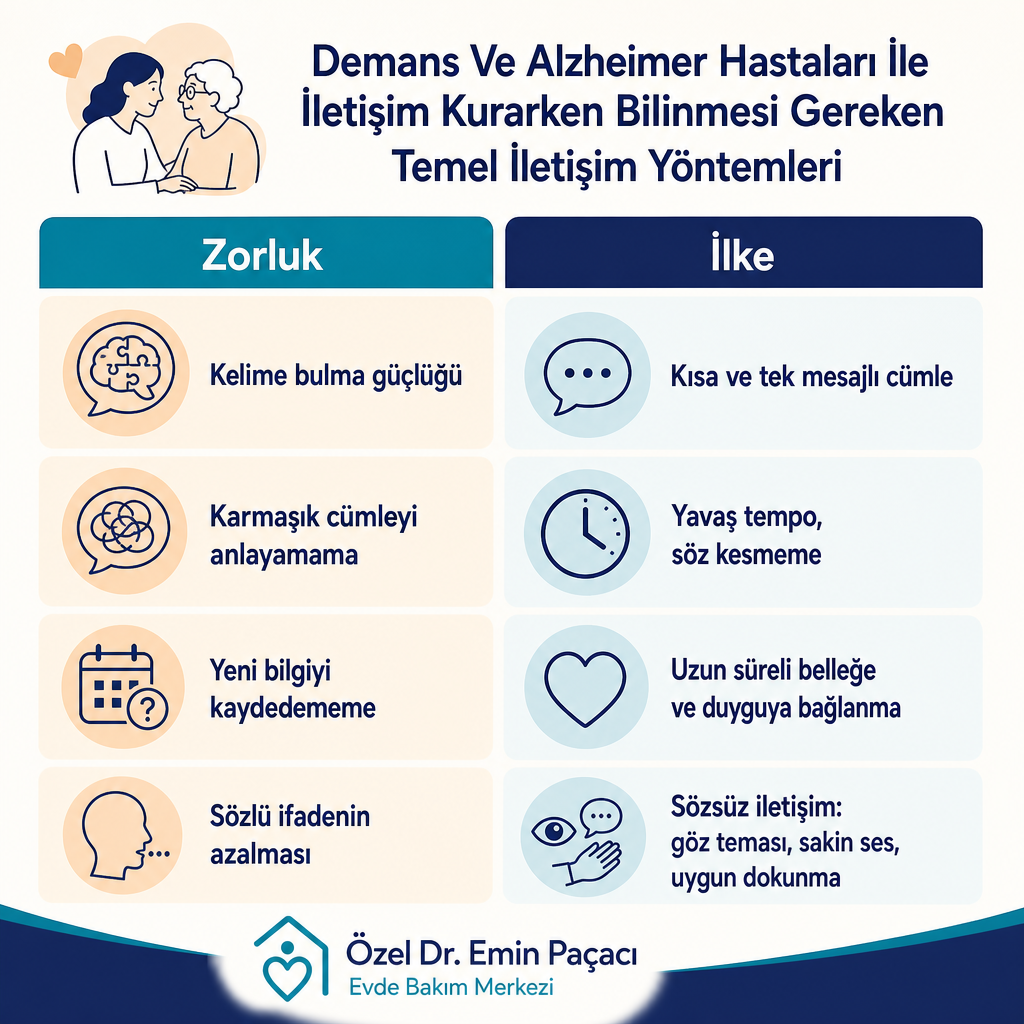 Key principles that facilitate communication
Essential communication methods and the reasoning behind them
These methods are not rules to be kept in mind separately, but parts of a mutually supporting approach. The common goal is to make it easier for the patient to process information and to reduce anxiety.
Simple, slow, and clear speech
It is recommended to use short, understandable sentences that contain a single message. Expressing only one idea or request at a time makes it easier for the patient to follow the conversation. Keeping the pace of speech slow, allowing time to form an answer, and not interrupting reduces tension. An environment free of noise supports understanding what is said; turning off the television or radio during conversation may therefore be helpful. A soft and calm tone of voice and avoiding a commanding manner strengthen the sense of trust.
Eye contact and positive body language
Beginning the conversation by saying the patient's name and looking directly at them at eye level clarifies the start of communication. Eye contact conveys to the patient the message that they are being attended to at that moment and helps them focus their attention. Positive body language cues such as gentle facial expressions, light touch if appropriate, and nodding in agreement support what is said and increase the sense of calm. Harsh facial expressions, impatience, or physically moving away, on the other hand, may create anxiety and resistance; this is why it is important for the caregiver to be aware of their own body language.
Simplifying questions and instructions
Questions that can be answered with "yes" or "no" are generally more understandable. Instead of asking multiple questions at once, asking a single question and waiting for an answer keeps communication orderly. When giving an instruction, first saying what to do in short sentences and then, if needed, demonstrating with a gesture (for example, pointing to the glass) makes the task understandable step by step. Referring to a daily routine that the person remembers from the past can also place the instruction in a familiar context.
Using long-term memory and emotions
While recording new information becomes difficult, memories from the past may be relatively better preserved. For this reason, talking about old photographs, familiar songs, and past events can increase engagement. In most cases, focusing on understanding the emotion being expressed is more useful than trying to correct the logical content of every sentence spoken. For example, a person saying "I want to go home" may actually mean "I don't feel safe"; in this case, offering reassurance and stating that you are with them is more soothing than arguing over reality.
Making use of the power of nonverbal communication
As the disease progresses, verbal communication may become limited. During this period, smiling, gently holding the person's hand to the extent they are not uncomfortable, and displaying a calm posture can be more effective than words. Showing the task to be done through body language during daily care — for example, indicating that it is time to brush teeth by showing the toothbrush — reduces confusion. When it becomes difficult to sustain the conversation, taking a short break and trying again later can prevent communication from breaking off completely.
Using respectful, adult-focused language
Dementia and Alzheimer's patients maintain their adult identity and need for dignity despite their cognitive losses. For this reason, it is recommended to avoid expressions directed at children and to address the patient as an adult individual. Beginning the sentence by introducing yourself ("I am …, I am with you right now") and speaking by using their name supports both the sense of identity and trust. Instead of commanding sentences, a requesting, explanatory language ("let's now do … together") is often met with less resistance.
Simplifying the environment and daily routine
Removing unnecessary items from the environment that could cause confusion may help the person direct their attention to essential daily tasks. Adding simple labels to photographs or frequently used items can make recognition easier. Maintaining as predictable a routine as possible instead of making numerous changes throughout the day reduces anxiety; keeping conversations short is also in harmony with this simplified arrangement.
Adapting methods to the individual and making decisions
Symptoms and communication difficulties vary from person to person; the needs of two people with the same diagnosis can be very different from each other. Therefore, the principles above provide a general framework, but which method should be applied to which person and to what extent should be determined according to clinical assessment.
The main factors that affect the form of communication include the stage of the disease, accompanying physical illnesses, hearing and vision status, previous personality traits, and cultural habits. For example, in a person with hearing difficulty, speaking at face level in a way that facilitates lip-reading becomes important; in a person with vision difficulty, touch and tone of voice become more central. This variability shows that a single pattern will not yield the same result in everyone.
In cases where symptoms affect daily life, safety, or the care process, it is recommended to consult a physician for assessment and a care plan. Treatment and care decisions are made by the physician monitoring the patient, in light of the person's general health condition and current scientific evidence. Because symptoms vary from person to person, it is again the physician's assessment that can determine whether there is a correctable factor underlying the communication difficulty (for example, a hearing problem or the effect of a medication).
Communication at home and professional support
Monitoring dementia and Alzheimer's patients at home is a practically and emotionally preferred option for many families. Communication in home care should be viewed not only as moments of conversation, but as an area encompassing all daily interactions such as personal care, nutrition, mobility, and medication administration. In other words, communication is not a task confined to certain moments of the day, but an attitude that spreads across every step of care.
Physicians, nurses, and physiotherapists who are part of home health teams work with medical knowledge and experience regarding the home monitoring of chronic illnesses; they can also address the communication approach within the care plan. Among our center's services are frequently sought applications for chronic patients such as private home medical care, private home nursing, and home physiotherapy. You can view the scope of these services together on our services page.
In the home monitoring of dementia and Alzheimer's patients, sharing communication methods between the family and the care team and reassessing them when necessary is a natural part of the process. For families just starting the process, our home care service application guide, where we explain the application steps, summarizes the general flow. In this way, the communication approach can be addressed not as a topic separate from the patient's overall care plan, but as an integrated component of the plan.
Frequently Asked Questions
What mistakes should be avoided when talking with dementia and Alzheimer's patients?
Giving too much information at once, speaking in fast and complex sentences, frequently interrupting the person, and constantly trying to correct their mistakes can make communication difficult. Using a commanding, harsh tone and addressing the patient like a child can also create resistance and distress.
How should one approach when the patient misperceives reality?
Instead of trying to correct reality every time, focusing on understanding the emotion the patient expresses may be more appropriate in most cases. For example, interpreting the phrase "I want to go home" as "I don't feel safe" and responding with reassuring sentences can soften communication.
How can communication be maintained with a patient who refuses to talk?
At certain times, patients may be reluctant to talk; in this case, it is recommended to take a short break, use nonverbal communication (smiling, calm posture, appropriate touch), and try again later. Rather than insistent attitudes, taking advantage of moments when the person feels ready may be more effective.
What should be considered when verbal communication decreases significantly?
When verbal communication decreases, nonverbal cues such as body language, facial expressions, and touch become more important. Making eye contact, using short sentences with a calm tone of voice, and demonstrating with movements during daily care can support mutual understanding.
When should a physician be contacted during the home care process?
When communication difficulties begin to significantly hinder the patient's safety, nutrition, mobility, or daily care, it is appropriate to consult a physician for assessment. The physician can determine the care plan, communication methods, and, if necessary, additional medical support requirements on an individualized basis.