Home care considerations for patients receiving enteral nutrition (tube/PEG feeding) center around correctly implementing the nutrition plan, protecting the tube insertion site, early recognition of warning signs, and regular follow-up by a physician and nurse. This form of care means continuing treatment initiated in the hospital within the home environment, and it requires trained caregivers and nursing support. Enteral nutrition is medical support in which nutrition is provided through a tube for patients who cannot be fed safely and adequately by mouth even though their digestive system is functioning; the choice of product, feeding rate, and monitoring criteria are determined by a team consisting of a physician, dietitian, and nurse. In this article, we address in an informative framework which matters families can observe at home, which decisions belong to the healthcare team, and which symptoms require prompt evaluation without delay.
Contents
What does enteral nutrition (tube/PEG) mean?
Enteral nutrition is a feeding method used when adequate and safe oral nutrition is not possible but the digestive system continues to function. Nutrition can be provided through a nasogastric tube extending from the nose to the stomach, a gastrostomy (PEG) opening directly into the stomach, or different tubes placed in the small intestine. Which route is chosen varies according to factors such as how long the feeding will continue and the patient's clinical condition.
This treatment is not merely a single application; it is a process carried out jointly by a physician, dietitian, and nurse. Determining the product, the daily amount, the feeding rate, and laboratory monitoring are the responsibility of the professional team. Home enteral nutrition means continuing this plan in the residential environment, and it requires caregivers to undergo certain training and for nursing support to continue. The family's role is to provide daily observation and support within the limits taught to them and to share unexpected changes with the healthcare team.
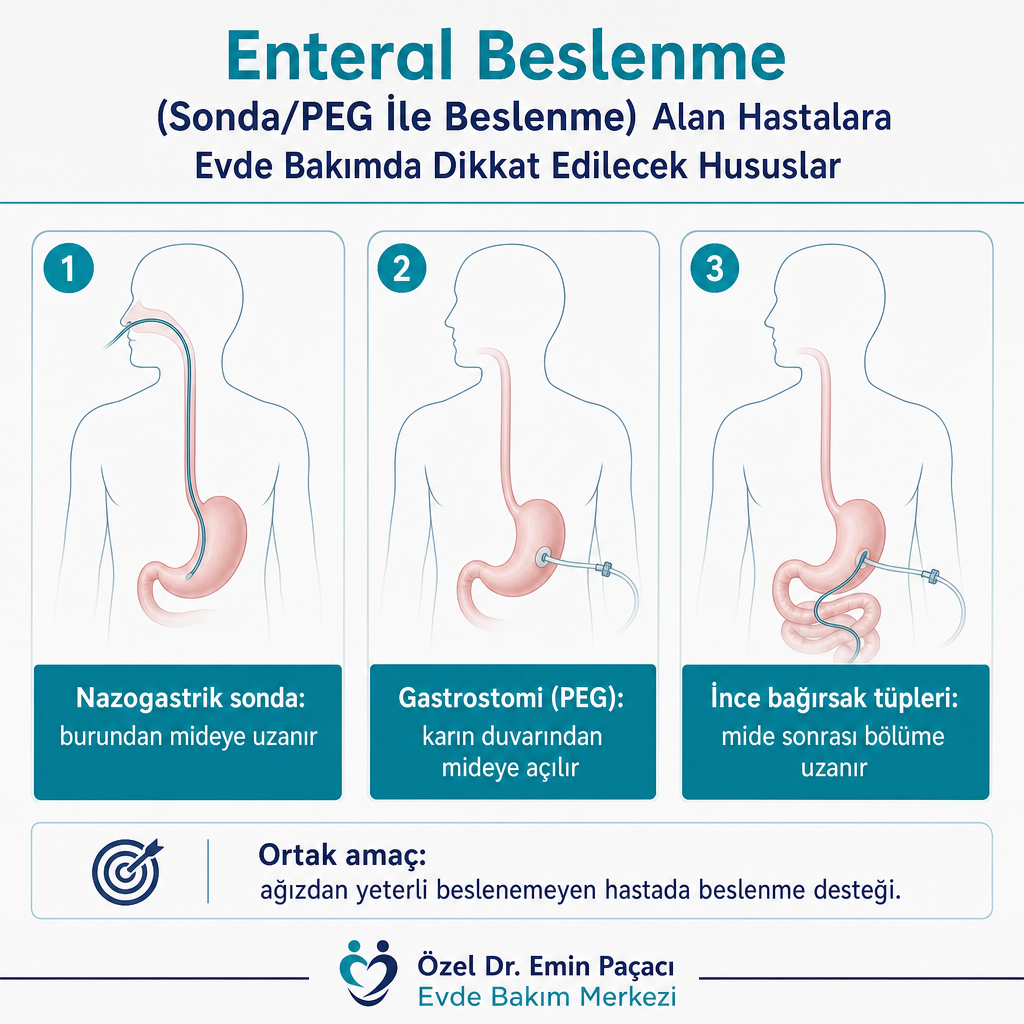 Enteral nutrition tube types
Basic principles and decision areas in home care
The main goals of care in a patient receiving home enteral nutrition can be summarized as follows: maintaining adequate nutrition and fluid intake, preserving the safety of the tube, recognizing complications early, and attending to the patient's comfort. Clinical guidelines highlight regular checking of the tube's placement, monitoring tolerance to feeding, and recording the applications performed as standard elements of care.
For families, the point of greatest uncertainty is who is responsible for what. For this reason, keeping the decision areas clear is helpful:
- When to seek help: Knowing in advance which symptoms warrant consulting a physician and in which situations to contact emergency health services directly.
- Who does what: The boundary between the tasks the family undertakes in routine observation and daily care and the technical applications carried out by the nurse.
- When a change is needed: When to consult a physician in situations requiring a change in feeding rate, amount, or product.
Within this framework, an important principle is that the nutrition plan and the technical management of the tube are changed by the medical decision of the physician and relevant specialists. It is not recommended for family members to independently change the dose, rate, or product; such adjustments are based on clinical evaluation. For those wondering how this process works in Istanbul, our article explaining how home care service works in Istanbul conveys the general framework.
Hygiene and skin care in the tube/PEG area
The skin around the tube or PEG insertion site is sensitive to infection and irritation. Clinical sources recommend keeping this area clean and dry, protecting it from irritation, and appropriately securing the tube against pulling or kinking. Securing helps both to reduce mechanical strain at the insertion site and to prevent unwanted displacement of the tube.
The main findings to watch for in daily observation are as follows:
- Redness, swelling, or a local increase in temperature
- Discharge, foul odor, or bleeding
- Severe pain or sudden displacement of the tube
These findings may indicate infection, skin irritation, or dislodgement of the tube. Clinical guidelines recommend medical evaluation in such situations and that interventions targeting the tube be planned by healthcare professionals. In cases of persistent or recurring problems in the area, sharing the observation with the healthcare team contributes to addressing the problem before it grows.
Considerations during feeding
One of the most emphasized topics in enteral nutrition is reducing aspiration (the leakage of stomach contents into the airways) and the side effects related to the digestive system. Many guidelines recommend that the patient's head be kept above stomach level, generally in a semi-seated position, during and after feeding. This position helps reduce the risk of reflux and aspiration.
Giving nutrients close to room temperature, slowly, and at a controlled rate may reduce the likelihood of complaints such as nausea, vomiting, abdominal cramps, and diarrhea. Clinical protocols also emphasize checking the patency of the tube appropriately with water before and after feeding, and not attempting to clear blockages with forceful methods.
Among the frequently observed complaints are nausea, vomiting, abdominal distension, diarrhea, and constipation. These findings may be related to the feeding rate, product content, or the underlying disease condition. When complaints persist, evaluation by a physician and dietitian is recommended to reorganize the nutrition plan.
In situations where medications need to be given through the tube, the decision also belongs to the physician. Which medication is given in which form and how is addressed separately in guidelines; because some medications may increase the risk of tube blockage, interaction with nutrients, or side effects. For this reason, medication administration is carried out not by independent decision at home but within the framework determined by the healthcare team.
Possible complications and warning signs
When enteral nutrition is continued at home, various complications may occur, and some of these require urgent medical evaluation. Recognizing complications in groups makes the family's observation more organized.
| Complication group |
Common situations |
| Mechanical |
Tube blockage, tube displacement or dislodgement, local infection or bleeding around the tube |
| Gastrointestinal |
Nausea, vomiting, diarrhea, constipation, abdominal pain, distension, reflux |
| Metabolic |
Dehydration, blood sugar fluctuations, electrolyte imbalances |
Studies related to home enteral nutrition report that aspiration pneumonia, tube blockage, and constipation are among the frequently observed problems. These conditions can be recognized earlier with regular observation and timely shared information.
The following findings are generally considered warning signs that require urgent evaluation:
- Sudden shortness of breath, coughing, and respiratory distress during feeding
- Severe, persistent abdominal pain or hardening of the abdomen
- Fever, chills, deterioration in general condition
- Complete dislodgement of the tube or suspicion that it has moved
- Recurrent, uncontrollable vomiting
- Change in consciousness, drowsiness, or excessive sleepiness
These symptoms may indicate a significant change in the patient's condition. Clinical guidelines recommend prompt physician evaluation or contacting emergency health services in such situations. Since symptoms can vary from person to person, when in doubt, leaving the evaluation to a healthcare professional is an appropriate approach.
The role of home healthcare services and professional care
National and international guidelines emphasize that enteral nutrition is a multidisciplinary process carried out jointly by a physician, dietitian, and nurse. This division of labor also remains valid in home care. The physician plans the nutrition indication, product selection, rate and amount adjustment, laboratory checks, and complication management. Nurses, on the other hand, take part in areas such as tube care, administration of feeding, skin and infection monitoring, caregiver training, and record keeping.
In Istanbul, licensed home care teams can offer services such as physician examinations, nursing care, intravenous treatment, wound care, and chronic disease monitoring in patients' own homes. For patients receiving enteral nutrition, these teams contribute to the care process in terms of daily checking of the tube, monitoring compliance with feeding, and sharing newly emerging symptoms with the physician. Within the scope of our services, home private medicine and home private nursing constitute the two components of this follow-up; and when it comes to preserving mobility capacity, home physiotherapy services can be planned according to individual evaluation.
Since each patient's clinical condition, accompanying illnesses, and functional level are different, the decision for home enteral nutrition and the frequency of follow-up are determined individually by the relevant physician. This individual approach helps to jointly attend to both meeting nutritional goals and monitoring the risk of complications.
Frequently asked questions
What symptoms may require urgent evaluation in a patient receiving enteral nutrition?
Findings such as sudden shortness of breath, marked respiratory distress, severe abdominal pain, high fever, change in consciousness, recurrent uncontrollable vomiting, and complete dislodgement of the tube are among the situations requiring urgent evaluation. When such symptoms arise, it is recommended to contact a physician or emergency health services without delay.
Who should be responsible in home enteral nutrition?
The physician is responsible for the medical planning and monitoring of the nutrition; nurses take part in tube care, administration of feeding, and family training. Family members or caregivers provide daily observation and support within the limits taught to them by the professional team and report unexpected changes to the healthcare team.
Is oral care necessary in patients fed through a tube/PEG?
Even in the absence of oral feeding, maintaining oral hygiene may help reduce the risk of infection and prevent bad breath and discomfort. Guidelines emphasize that oral care is an integral part of the patient's overall care.
Can family members change the feeding rate or amount on their own decision?
The feeding rate, total daily amount, and product selection are determined by the physician and dietitian according to the patient's medical condition, laboratory values, and clinical course. When complaints arise or when there are changes in weight, hydration, or blood values, it is recommended to consult a physician to review the plan; it is not appropriate for family members to change the rate or amount on their own.
What should be done at home if the tube becomes blocked?
Blockages may be due to reasons such as the accumulation of food residues, medications given in an unsuitable form, or kinking of the tube. Clinical sources recommend not forcefully pushing the tube, not attempting to clear it with sudden and high pressure, and notifying healthcare professionals when the blockage persists. Caregivers can apply the simple checking and observation steps taught to them; in persistent blockage, evaluation by a physician or nurse is required.