The application for home care service involves three separate paths that most families encounter for the first time and often confuse with one another: the Ministry of Health's home health service, the Ministry of Family and Social Services' home care assistance, and licensed private home care institutions. Choosing the right channel from the outset makes the process—which can range from a few days to a few weeks depending on the completion of document preparation and assessment steps—more predictable. In this step-by-step guide, we place the three options side by side so you can see which application to make, where, and with which documents; and we address the path to the physician assessment in a clear sequence.
Table of Contents
The three main paths of home care and which one suits you
Before starting the application, determining which need is the priority shortens all subsequent steps. In Turkey, there are three distinct structures under the heading of "home care":
- Ministry of Health home health service: Covers medical practices such as examination, treatment, and monitoring carried out by physicians and healthcare teams in the home environment.
- Home care assistance: A social assistance program in the form of regular payments directed at the person providing care for disabled individuals in need of care; it does not include medical services.
- Licensed private home care and health services: Enables licensed physicians, nurses, and physiotherapists to provide assessment, care, and rehabilitation in the home environment.
The first distinction becomes clear with this question: Is the need for medical monitoring and practice, or is it social support directed at the person providing care? For clinical needs such as intravenous access, wound dressing, and physician monitoring, the home health or private home care paths come to the fore. If you are seeking regular social assistance based on severe disability and household income criteria, home care assistance is a separate application. These three paths are not mutually exclusive; depending on an individual's situation, more than one may be evaluated simultaneously. You can also refer to our Üsküdar home care center guide for the general workflow of the process.
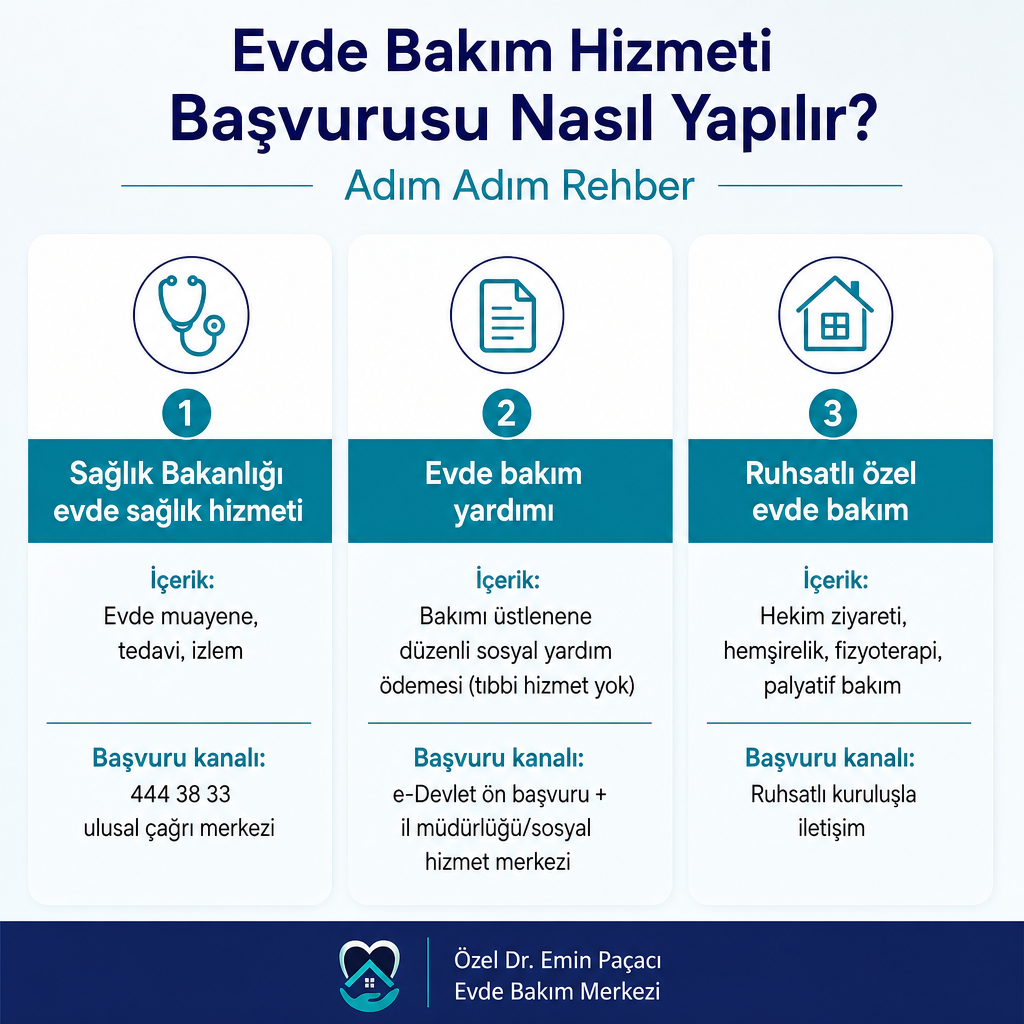 The three main paths of home care
Pre-application preparation checklist
Completing both medical and administrative documents before applying largely prevents delays caused by requests for additional documents. For public services, the following are typically kept ready:
- The patient's identity and contact information (T.R. identity number, address, phone)
- Reports and epicrises showing the current medical condition
- A current Disability Health Board Report for home care assistance (indicating the severe disability status)
- Documents related to household income (SGK, Retirement Fund, Bağ-Kur, and other income declarations)
- If necessary, the court decision on the appointment of a guardian and title deed registration information
- Informed consent forms and application petitions (standard forms requested by the provincial directorate or social service center)
For home health service, keeping information such as medication lists, diagnoses, and previous hospital reports ready—so that the patient's condition can be evaluated by a physician—also speeds up registration and planning. Documents being current and verifiable in the system prevents repeated information collection.
Ministry of Health home health service application step by step
For home health services provided by the Ministry of Health and its affiliated institutions, the application is carried out through the national call center and the relevant forms.
Step 1: Calling the national call center
Patients or family members who wish to receive home health service can apply by calling the national call center 444 38 33 within the Ministry of Health. This line accepts applications from all over Turkey within the scope of the Home Health Services Communication Center (ESHİM).
Step 2: Application registration and initial assessment
During the call, the patient's identity information, address, basic health status, and current diagnoses are recorded in the system. The call center forwards the application information to the relevant provincial coordination center via the Home Health Services System (ESYS).
In some cases, the Annex-3 "Home Health Service Application Form" must be filled out and forwarded to the home health unit associated with the Provincial Health Directorate. The form includes sections such as the patient's medical history and family physician assessment; the relevant parts are expected to be filled out by the family physician.
Step 4: Home visit by physician and team
After the registration is completed, the home health unit in the province plans a home visit according to the patient's condition. During the visit, the physician evaluates the medical history, current findings, and the home environment, and determines the scope of services that can be provided at home.
Step 5: Creating the service plan
After the assessment, the scope and frequency of the home health services to be provided (examination, testing, treatment, follow-up visits) are planned and the family is informed. The process is recorded via ESYS and reported to the coordination units.
Step 6: Monitoring and reassessment
During the treatment and care process, the plan may be revised according to the patient's clinical condition; the scope of the service is changed when necessary. When there is a significant change in the condition, it is recommended to update the information by consulting the family physician or the home health team.
Home care assistance application step by step
Home care assistance is a social assistance program carried out by the Ministry of Family and Social Services for disabled individuals in need of care. The process includes both an e-Government pre-application and an application to the provincial directorate or social service center.
Step 1: Reviewing the conditions and disability status
The application is made to the provincial directorate or social service center in the place of residence where the disabled individual is registered in the population registration system. The expression "severely disabled" in the Disability Health Board Report and the household income being below the per-person limit set by legislation are among the main criteria.
Step 2: Pre-application via e-Government
The "Pre-Application for Home Care Requests of Disabled Individuals in Need of Care" service is available through the e-Government gateway. Access to the system is made with an e-Government password or one of the accepted identity verification methods. The pre-application serves as preliminary information for the in-person procedures.
Step 3: In-person application to the provincial directorate or social service center
The main application is made in person and in writing by the disabled individual themselves, the person requesting to provide care, a relative, or a guardian. At this stage, the disability health board report, income declaration documents, guardian decisions if any, title deed records, application petition, and passport-style photos are submitted.
Step 4: Social examination and home visit
After the documents are submitted, the care need and household conditions are evaluated within the scope of a social examination; a home visit is made in cases deemed necessary. The board evaluates daily living activities, the care need, and the person who will actually undertake the care within the household.
Step 5: Decision-making and notification
The decision is made by considering the health report, income status, and social examination findings together, and is notified to the applicant in writing. For accepted applications, the assistance is granted according to the principles in the legislation and is maintained regularly.
Step 6: Objection in case of rejection
If the application is rejected, the decision can be appealed; the objection is concluded by a second board that did not participate in the initial assessment. The objection period and procedure are determined according to current legislation; obtaining information from the provincial directorate or social service center is recommended.
Applying for licensed private home care service
Licensed private home care and home health institutions subject to Ministry of Health supervision can provide practices such as home physician visits, nursing, physiotherapy, and palliative care. As a center, we carry out the process in general terms as follows:
- Clarifying the need: Current diagnoses, conditions affecting daily life such as mobility restriction or loss of strength, and specific requirements such as physician monitoring, medication administration, wound dressing, or rehabilitation are determined.
- Gathering information: Information such as the services offered, team structure, and working hours is shared. You can review the scope on our services page.
- Initial contact and preliminary assessment: The patient's basic medical information, home environment, caregivers, and information on the required service frequency are evaluated.
- Physician assessment and care plan: As a result of the physician assessment, the scope and frequency of services to be provided at home are determined; home private physician, nursing, and physiotherapy visits are planned.
- Information and scheduling appointments: The patient and their relatives are informed, and the planned services are scheduled.
- Regular monitoring and review of the plan: The service content is updated according to the patient's condition; the care plan is revised in line with the physician's decision.
For rehabilitation-focused needs, home physiotherapy, and for conditions requiring intensive clinical follow-up, home private nursing can be evaluated as part of the plan. In private home care, the content is determined according to visit frequency, service type, team composition, and monitoring duration.
Common mistakes that prolong the process
The most common confusions in applications lead to loss of time and delays:
- Confusing home health service with home care assistance. Home health service covers medical care and physician-nurse services; home care assistance is a regular payment program in the nature of social assistance and does not include medical services. The channel and documents for the two applications are separate.
- Applying with an incomplete or outdated health report. In home care assistance, the last health report registered in the Ministry of Health's electronic database is essential. For reports that cannot be verified in the system, the original or a copy approved by the chief physician's office is requested; the absence of these documents prolongs the process.
- Submitting income declaration and household information incompletely. In home care assistance, all incomes of individuals living in the household must be declared. Incomplete declaration leads to requests for additional documents and delay.
- Trying to go directly to the unit without applying to the call center. In Ministry of Health home health services, it is essential that applications be received through the national call center (444 38 33). A telephone pre-application is a fundamental step for directing to the correct unit and for registration.
Clarifying which type of service is needed before applying—medical home health, social assistance, or private home care—and using the relevant channel makes the process more predictable.
Is family support or professional support needed?
One aspect of home care is the daily support provided by family and relatives; the other aspect is medical and professional care. In the following situations, physician assessment and professional healthcare service become especially important:
- Chronic diseases requiring continuous medical monitoring
- Clinical practices such as intravenous access, injection, wound dressing, and pressure sore monitoring
- Conditions with significantly reduced mobility, high fall risk, or requiring intensive rehabilitation
- Individuals with observed changes in basic vital functions such as respiration, nutrition, or level of consciousness
Symptoms may vary from person to person; for this reason, obtaining a physician assessment for individuals in need of home care is accepted as a fundamental step in determining medical requirements and the appropriate level of care. Determining at what point the support provided by the family diverges from professional care is often made possible through this assessment.
Frequently Asked Questions
What is the difference between home health service and home care assistance?
Home health service is a medical service provided by the Ministry of Health and its affiliated institutions, in which physicians, nurses, and other healthcare personnel carry out examination, treatment, and monitoring in the home environment. Home care assistance, on the other hand, is a social assistance program carried out by the Ministry of Family and Social Services, directed at the person who undertakes the care of a disabled individual in need of care.
Who can call the 444 38 33 line?
Patients or family members who wish to receive home health service can apply by calling the national call center 444 38 33. In addition, physicians and persons working in the healthcare field can submit home health requests through designated software.
Where do you need to go for a home care assistance application?
The application is made to the Family and Social Services provincial directorate or social service center in the place of residence where the disabled individual is registered in the population registration system. The pre-application can be carried out via e-Government with the "Pre-Application for Home Care Requests of Disabled Individuals in Need of Care" service.
What basic documents are required for home care assistance?
The Disability Health Board Report, passport-style photos of the disabled person, household income declaration documents, guardian decisions if necessary, and title deed registration information are among the basic documents required in the application. The provincial directorate or social service center may request additional documents according to current legislation.
How long does the application process take?
In home health service, after registration is taken by telephone, the home visit is planned according to the patient's condition and the workload of the provincial coordination center. In home care assistance, the submission of documents, social examination, and board decision are evaluated together; the duration may vary according to legislation and workload.