The short answer to the question of what home care service is: it is a health service model, defined and regulated by legislation, in which individuals with health and care needs are provided with medical care, follow-up, and rehabilitation in their own environment, in accordance with physician recommendations. In other words, it is not merely the auxiliary support provided by a family member; it is a form of care carried out by licensed institutions and professional practitioners, requiring planning, teamwork, and record-keeping. In this article, we present, within a neutral framework, the definition of home care, how it differs from similar concepts, its legal framework, its scope, for whom it may be relevant, and the topics that may be considered in the decision-making process.
Table of Contents
Home care service: Basic definition
Home care service, in Turkish legislation, is defined as the provision of health, care, and follow-up services to patients—in accordance with physicians' recommendations—in the environment where they live with their families, in a way that meets their medical needs, including rehabilitation, physiotherapy, and psychological support, delivered by a health team. This definition is found in the text of the Regulation on the Provision of Home Care Services.
In academic sources, home care is explained as the provision of health and social services—at a professional level or by family members—in the person's own home or living environment, with the aim of protecting, improving, and supporting the individual's recovery of health. In the informational texts of public hospitals as well, home care is described as a form of service provision that can replace institutional care, reduces the need for stays in health institutions, and is based on home visits.
Within this framework, home care is a professional health and care model carried out in accordance with specific planning, teamwork, and legislation. Two elements are at the center of the definition: that the service is based on a physician evaluation, and that it is sustained in the individual's own living environment.
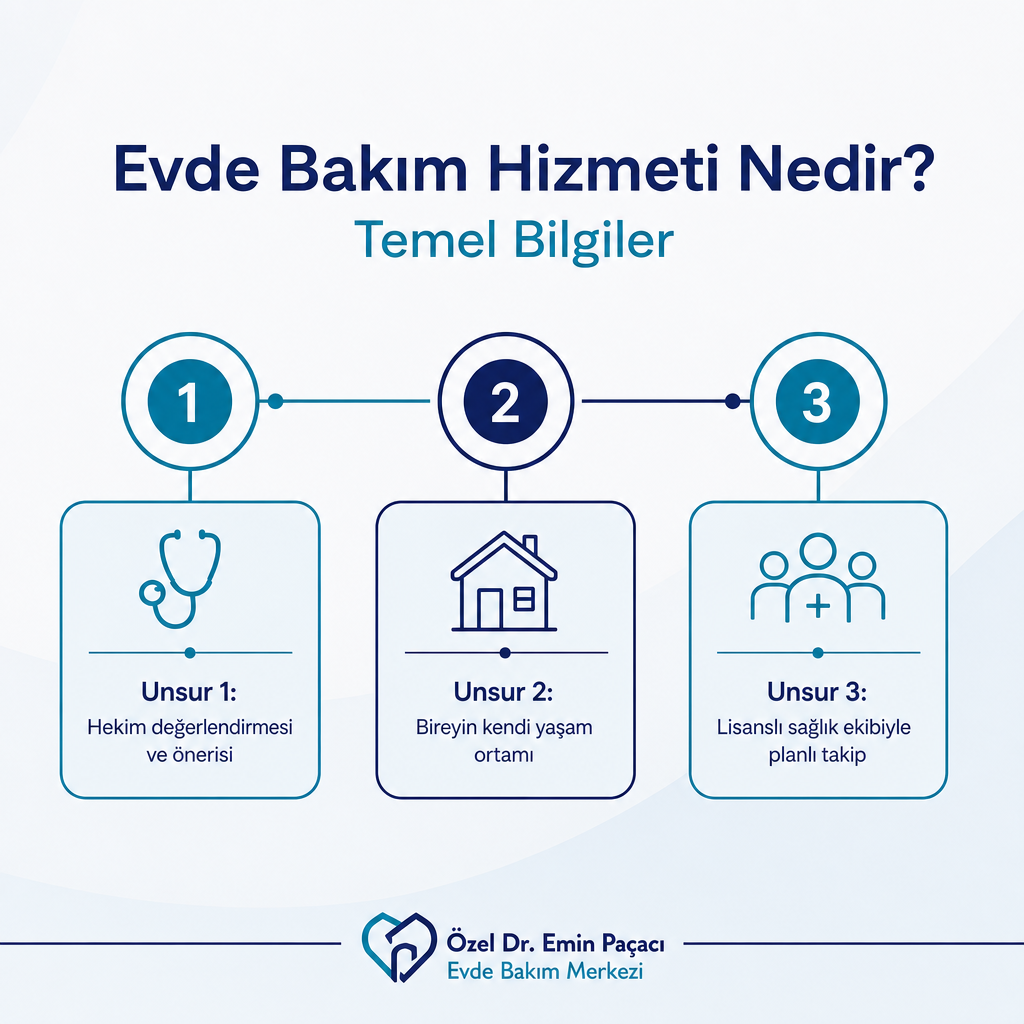 The three core elements of home care service
Differences between home care, home health, and palliative care
Three concepts that appear similar in legal regulations differ in terms of scope. Knowing this distinction makes it easier to understand which service corresponds to which need.
| Concept |
Prominent scope |
| Home health service |
Provision of examination, testing, analysis, treatment, medical care, follow-up, and rehabilitation, along with social and psychological counseling, at home |
| Home care service |
A broader model that, in addition to medical care and rehabilitation, includes the dimensions of long-term care, daily living support, and monitoring |
| Palliative care |
A more specific framework focused on symptom control and quality of life in chronic, progressive, or life-threatening illnesses |
Home health service primarily defines the continuation of medical procedures in the home environment. Home care service, on the other hand, is a more inclusive model that adds long-term care and daily living support to this medical process. Palliative care is separately defined in the regulation concerning the provision and coordination of home health and palliative care services; for this reason, it is regarded as an area that can be part of home care but whose purpose and scope are more distinct. For more detailed information on the scope of palliative care, our home palliative care guide is a useful resource.
Legal framework in Turkey
The provision of home care services in Turkey is regulated by a special regulation. According to the official text of the relevant regulation, the purpose of the regulation is to determine the procedures and principles governing the opening, operation, and inspection of health institutions providing home care services—in order to protect the health of individuals and society—as well as the rules that the natural and legal persons operating these institutions must comply with.
The regulation covers health institutions opened to provide home care services either as independent workplaces or within medical centers, specialty centers, polyclinics, and private hospitals, as well as the owners and operators of these institutions and home care activities. This scope demonstrates that home care is a licensed and inspected area of health service.
New regulations concerning home health and palliative care services separately define the coordination and service standards of home health services and palliative care services provided in public institutions. Thus, standards have been established to enable services provided at home to be planned as time-limited (for example, following hospital discharge) and open-ended (long-term care). In short, this is a framework in which both the institution providing the service and the care provided are bound by certain rules.
The scope and core components of home care
Legislation and academic publications indicate that home care consists of more than one component. When these components are planned together, it becomes possible to sustain medical monitoring and daily living support in the home environment.
- Medical evaluation and examination: The clinical evaluation performed by the physician, the continuation of the diagnostic process in the home environment, and the creation of the treatment plan are at the center of home care. This dimension is embodied in the topics of home private medical practice and physician visits.
- Medical care and follow-up: Monitoring chronic illnesses, administering medications in accordance with physician recommendations, monitoring vital signs, and evaluating response to treatment are counted within this scope.
- Nursing services: Areas such as wound care, injection administration, serum and intravenous treatments, nutritional support, and daily care support can be carried out within the scope of home private nursing.
- Physiotherapy and rehabilitation: Programs planned to increase functional capacity and support independence after surgery, neurological illnesses, or musculoskeletal system problems are addressed within the home physiotherapy service.
- Psychosocial support: Supporting the psychological condition of the individual and their family, monitoring the adaptation process, and providing counseling when needed are included in the definitions.
- Care and daily living support: Self-care, mobilization, and environmental adjustment needs are emphasized in most sources as an important component of home care.
On the home care pages of private health institutions, topics such as home physician visits, home private nursing, home physiotherapy, and palliative care are presented together; it is stated that these are planned according to an appointment system and carried out by licensed professionals such as physicians, nurses, and physiotherapists. These topics are also presented within a holistic framework on our services page.
For whom might home care become relevant?
Explanations regarding who can benefit from home care appear both in legislative texts and in the informational content of health institutions. The following groups are frequently emphasized; however, not every situation on the list automatically requires home care—suitability always depends on clinical evaluation.
- Elderly individuals: Home care frequently comes up for people with reduced mobility who find it difficult to travel regularly to a health institution.
- Those with chronic illnesses: For people with cardiovascular, respiratory, neurological, or metabolic chronic illnesses who require regular medical monitoring, home care can support the treatment and follow-up process.
- Bedridden patients: Individuals experiencing long-term bed dependency, mobility restrictions, or serious neurological conditions may need examination, nursing care, and rehabilitation to be sustained in the home environment.
- Postoperative period: Rehabilitation and nursing support after orthopedic surgery, prosthesis applications, or major surgical interventions can be addressed within the scope of home care. Our guide on things to pay attention to at home after orthopedic surgery and prosthesis is a detailed resource for this process.
- Individuals with special needs: For individuals with disabilities or special needs, home care is defined as a model that enables medical follow-up and daily living support to be planned together.
Symptoms, the course of the illness, and care needs vary from person to person. The suitability and scope of home care are always determined through physician evaluation; for evaluation, it is recommended to consult the individual's registered physician or a physician working in the relevant field of specialization.
The operation and mechanisms of home care
The operation of home care is based on a framework where legislation, clinical practice, and institutional processes come together. We separately address approaches concerning the importance of the home environment in certain processes such as neurological rehabilitation in our article on the importance of the home environment in neurological rehabilitation.
- Physician recommendation and medical decision: Home care is generally a process recommended following a physician evaluation and carried out in line with the diagnosis and treatment plan. The physician determines the boundaries of the services to be provided at home, taking into account the patient's clinical condition, functional capacity, and home conditions.
- Multidisciplinary team: Legislation and academic sources state that home care is based on the collaboration of physicians, nurses, physiotherapists, and, when needed, other health professionals. This team visits the patient at home in accordance with the established plan, provides care and treatment, and conducts regular follow-up.
- Planning and monitoring: In home care, planning according to an appointment system, regular monitoring visits, and updating the plan when necessary are common forms of practice. Changes in the patient's condition are communicated to the physician evaluation, and the treatment and care plan is reviewed again.
- Record-keeping and documentation: Institutions providing home care are obliged to record the procedures performed, observations, and findings as required by legislation and to keep them ready for inspection. These records are important in terms of the continuity of the service, quality control, and legal responsibilities.
When these mechanisms are evaluated together, it becomes evident that home care is not a practice limited to home visits, but a process consisting of physician decision, teamwork, monitoring, and documentation.
Topics to consider in the decision-making process
When deciding whether to receive home care, legislation, clinical guidelines, and the informational content of health institutions draw attention to a few key topics. These topics can help make the consultation families will have with the physician more productive.
- Medical need: The type, severity, chronicity, and complication risk of the illness are decisive in terms of the scope of home care. In chronic illnesses requiring frequent medical monitoring, home care can support the examination and follow-up processes.
- Functional status and mobility: Factors such as the patient's level of independent mobility, bed dependency, walking capacity, and fall risk are important in evaluating the suitability of the home environment for care.
- Home environment and care support: The physical conditions of the living environment, whether a care-providing family member or professional support is available, and hygiene and safety facilities are taken into account in planning.
- Access to health institutions: Difficulty in transportation, the need for frequent check-ups, and accompanying social factors can play a role in determining the scope of the services to be provided at home.
- Physician evaluation: The final decision is made by the physician following the patient; the scope, frequency, and duration of home care are determined according to clinical need.
In the decision-making process, the expectations of family members, the patient's preferences, and the observations of the care team are also evaluated holistically by the physician. Most of these topics carry different weight for each individual patient; therefore, individualized evaluation is essential rather than a general rule.
Frequently Asked Questions
Are home care service and home health service the same?
Home health service mostly refers to the provision of medical procedures such as examination, testing, analysis, treatment, and rehabilitation at home. Home care, on the other hand, is a broader model that, in addition to this medical process, also includes long-term care, daily living support, and a social dimension.
Who provides home care service?
According to legislation, home care is provided—in accordance with physicians' recommendations—by teams consisting of physicians, nurses, physiotherapists, and other health professionals. The opening, operation, and inspection conditions of the institutions providing the service are determined by the relevant regulation.
What medical procedures can be included in home care service?
In the sources, procedures such as home physician examination, nursing care, medication and serum administration, wound care, physiotherapy and rehabilitation, palliative care applications, and psychosocial support are counted within the scope of home care. Which procedures will be applied depends on the physician's plan.
Is there a specific legal criterion for benefiting from home care service?
The opening, operation, and inspection conditions for institutions providing home care are regulated in the relevant regulation. The conditions under which patients can benefit are determined clinically within the framework of physician evaluation and institutional policies.
Does home care service replace emergency situations?
Home care is a model that covers regular follow-up and planned care processes. In sudden-onset, life-threatening emergencies, resorting to emergency health services is part of the general medical approach; the evaluation of such situations belongs to emergency physicians and relevant specialists.