The question of which documents are required for home care actually cannot be tied to a single list; it varies depending on where the application is made. For the same patient, the home care assistance application submitted to the Ministry of Family and Social Services, the request made to a public hospital's home health unit, and the process of receiving service from a private home care center each require different sets of documents. When you prepare your file in advance according to the correct groups, the evaluation process proceeds without delay and the likelihood of the application being put on hold due to missing documents decreases. In this article, we have compiled the most frequently requested document groups for elderly, disabled, or chronically ill individuals and their relatives, separated by application type.
Contents
Who uses this document list
Elderly, disabled, or chronically ill individuals in need of home care and their relatives want to see in advance which documents may be requested when applying to different institutions. Here you will find the document requirements of three separate processes together: social-purpose home care assistance, public home health services, and private home care services. Since each of these three paths is evaluated according to its own legislation and internal regulations, the requested documents also differ from one another. Clarifying which institution you are applying to is the first step in preparing the correct document group.
Main checklist: which document groups exist
The most frequently encountered document types in home care processes can be grouped under a few main categories. The list below summarizes the groups that will most likely appear in your file, regardless of the application type:
- Identity and civil registry documents
- Medical board report and other medical documents
- Household income and asset declaration and social assistance application documents
- Legal documents (such as guardianship ruling, divorce ruling)
- Photograph, student certificate, and other additional documents
- Explicit consent and assent forms regarding personal data
- The institution's own application and service agreement forms
The document set to be requested for each application type may vary according to the institution's current practice. Since missing or incorrect documents can prolong the evaluation process or make the application impossible to process, collecting and verifying the file early makes a difference.
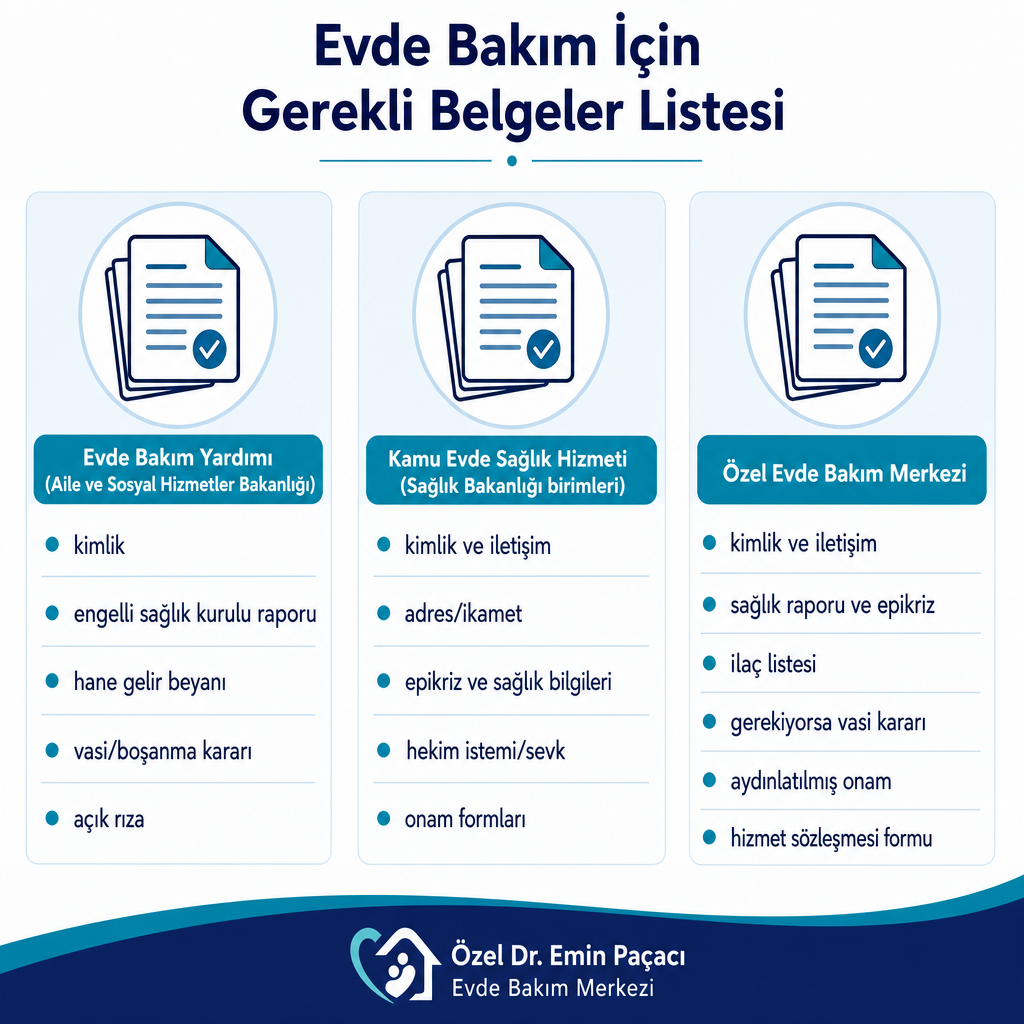 Document groups by application type
Documents for home care assistance (home care allowance)
Home care assistance is a social support provided under the Ministry of Family and Social Services' Home Care Assistance Regulation, and the documents requested in the application are defined in this regulation. Provincial and district Directorates of Family and Social Services generally request the following documents to evaluate the application:
- T.C. identity number and identity document: The identity information of the person in need of care and the caregiver is requested; for foreign nationals, a residence permit and foreign identity number are required.
- Disabled medical board report / health report: A disabled medical board report showing that the person in need of care is fully dependent is required; for children, a ÇÖZGER report may be used.
- Household income and asset declaration: Salary slips of those living in the household, rental income declarations, and documents showing assets are submitted with a written declaration and, when necessary, with documentation.
- Guardianship ruling or distribution form (if any): For individuals with an appointed legal guardian, the court's guardianship and guardian appointment ruling or the relevant distribution form may be requested.
- Explicit consent form: The form regarding the processing and sharing of personal data is prepared as part of the application file.
- Civil registry copy and residence document: Documents showing who lives in the household and address information may be used to determine the family structure and residence.
- Photograph: Some provincial/district directorates request a passport-sized photograph of the person in need of care; this practice may vary by province.
- Divorce ruling and other legal documents (where required): If there is a divorce process or ruling in the household, the relevant court documents may be requested.
- Student certificate (where required): If there is an individual continuing their education in the household, a student certificate or copy thereof may be requested.
- Other documents required by the institution: The regulation states that other documents deemed necessary for determining the household, income, and health status may also be requested; therefore, the list may expand depending on the file's situation.
In some practices, the requested documents are expected to be submitted within a certain period from the application date; detailed timeframes and procedures vary according to the practice of the provincial/district directorate. Therefore, it is useful to find out the current timeframe from the relevant directorate at the time of application.
Documents for home health service from public institutions
Home health and palliative care services provided by the Ministry of Health and affiliated organizations are regulated under the relevant regulation. The regulation contains provisions regarding the establishment, operating principles, inspection, and coordination of the service; the details of the documents to be requested for patient admission become clear through the internal practices of the institutions. Since home health units record patient data through the Home Health Services Module, they require a data set containing identity, address, and health information.
In practice, the home health units of public hospitals may often request the following document groups:
- Identity and contact information: The patient's T.C. identity number, identity document, and the patient's relative's contact information are recorded.
- Address and residence information: Residence information showing at which address the service will be provided is necessary for planning the visit.
- Health information and epicrisis: The epicrisis prepared by the hospital or family physician, diagnosis and treatment summaries, and current health status are examined to determine the scope of the service to be provided.
- Physician request or referral information: Referral may be made by the relevant physician or health institution; the referral justification and service request form are prepared according to the institution's internal procedure.
- Consent and personal data forms: Informed consent signed by the patient or legal representative and forms regarding the processing of personal data are included in the patient file.
The complete list of these documents and the application method should be verified through the current information texts of the affiliated family medicine practice, hospital, or provincial health directorate. The legislation determines the framework; document requests in practice may differ by institution.
Documents for private home care and home health service
Private home care centers and organizations providing private home health services request both the documents required by legislation and those needed for internal operations at patient admission. Since there is no single national document list regulating the patient admission processes of private organizations, it is appropriate to consider the following items as a general preparation framework; the exact list is shaped according to the current practice of the center applied to.
As a home care center, in order to properly conduct clinical and administrative evaluation at patient admission, we generally work with the following documents:
- Identity and contact information: The identity information, phone numbers of the patient and primary relatives, and persons to be contacted in emergencies are recorded; this information is fundamental for the home visit plan and information processes.
- Medical board report and existing medical documents: The disabled medical board report, chronic illness reports, hospital epicrises, test results, and current treatment plan help the teams accurately understand the clinical situation.
- Medication list and care needs summary: Regularly used medications, dosage information, and special care requirements are evaluated by the physician and nurse; this information is mostly prepared by the patient's relative.
- Legal status documents (if necessary): If the patient's decision-making capacity is limited, court documents such as a guardianship ruling may be requested; this clarifies who the authorized person is in consent processes.
- Informed consent and explicit consent forms: Forms regarding the provision of health service and the processing of personal data are standard parts of the patient file.
- Service agreement and application forms: Filling out forms explaining the scope of the service and responsibilities is required; the content is determined according to the institution's operation.
The preparation of these documents creates a fundamental file for planning the service and the clinical evaluation to be performed by the physician. To see which medical documents stand out depending on the service type, you can review the content of our private home nursing and private home physician services, and you can follow the process in general from our article What Is Home Care Service? Basic Information.
Documents that vary by situation
In addition to the standard documents, some additional documents may come up depending on the person's legal and social situation. These variable documents are added to the file on a case-specific basis, and which one is necessary becomes clear through the examination of the institution applied to.
| Situation |
Document that may be requested |
In which process it comes up |
| Legal guardianship or power of attorney |
Guardianship ruling or power of attorney |
Social assistance and health service applications |
| Divorce and custody |
Court rulings on matters such as custody and alimony |
Home care assistance application |
| Student status |
Student certificate |
Household income and social status assessment |
| Foreign nationality |
Residence permit, foreign identity number, residence documents |
Both social assistance and health service processes |
If one of these documents applies to your situation, completing the file together with the relevant document before applying reduces the need for follow-up and reapplication later.
Things to consider when preparing documents
Paying attention to a few practical points when collecting documents contributes to a more orderly progression of the process:
- Documents with current dates and legible: Ensuring that identity photocopies, health reports, and income documents are current and legible reduces misunderstandings during the evaluation stage.
- Distinction between original document and certified photocopy: Some institutions request the original of the health report, others a certified photocopy; this distinction needs to be verified with the relevant institution before applying.
- Documents supporting the declaration: Since documents such as salary slips, rental contracts, or title deeds may be requested alongside the income declaration, it is appropriate to also add documents supporting the declaration to the file.
- Verifying documents on an institution basis: Regulations determine the framework, but each institution creates a list according to its own internal regulations; finding out the current list from the relevant social service unit or health institution prevents delays caused by missing documents.
The scope and duration of the home care service are determined by the physician and the relevant board after the examination of the documents; documents are the fundamental data source for clinical and social evaluation. If you would like to clarify which documents you need to complete your file, when you convey the patient's current health status and care needs to us, we can review together the document framework suitable for you. To see the order of the application steps, you can also take a look at our article How to Apply for Home Care Service? Step-by-Step Guide.
Frequently Asked Questions
What documents are required for home care?
Generally, identity information, a medical board report or health report, household income and asset declaration, guardianship and divorce rulings if necessary, a photograph and student certificate, and the institution's own application and consent forms are requested. The exact list varies according to the application type and institution.
Is the document list for home care allowance fixed?
The Home Care Assistance Regulation determines the basic document groups; however, since other documents deemed necessary for determining the household, income, and health status may also be requested, provincial/district directorates may request additional documents depending on the file's situation.
Is a health report always required for public home health service?
The provision of the service is regulated by the relevant regulation; the type of health report and medical documents to be requested in the application is determined according to the internal practice of the hospital or unit providing the service. It is recommended to verify the current information from the relevant unit.
Which documents do private home care centers request?
Private centers generally request identity and contact information, existing health reports and epicrises, a medication list, a guardianship ruling if necessary, informed consent and personal data forms, and a service agreement and application form. The detailed list is determined by the patient admission unit of the relevant center.
How do missing documents affect the application?
Missing or incorrect documents may cause the evaluation of the file to be postponed, the request to be delayed, or the application to be returned with a request for it to be re-arranged. Therefore, it is important to complete the file according to the institution's current list.