The short answer to the question of what a home doctor examination is: it is a type of healthcare service in which the physician comes to the patient's home or current address to perform a medical evaluation, examination and, when necessary, a treatment plan. This service allows the health assessment of individuals, especially those with mobility limitations, chronic illnesses, or those undergoing home care, to be carried out in their own living environment. Below, we discuss how this service is defined, what elements it consists of, in which situations it comes into consideration, and what is taken into account when making a decision, within an informative framework.
Contents
What does a home doctor examination mean
In Turkey, home health and home care services are defined as the provision of practices such as examination, testing, analysis, treatment, medical care, follow-up and rehabilitation at the home or family environment of individuals in need of healthcare. Within this framework, a home doctor examination is a physician-focused service that includes the physician visiting the patient at home to listen to complaints and medical history (anamnesis), perform a physical examination, request tests when deemed necessary or evaluate existing tests, and create a treatment and follow-up plan according to the patient's general condition.
In other words, the basic stages of a classic outpatient examination are moved to the home environment. The physician's clinical decisions are individualized according to the patient's current condition, age, accompanying illnesses and home conditions. For this reason, the content of an examination performed for the same reason for admission and the follow-up recommended afterwards may differ between two different patients.
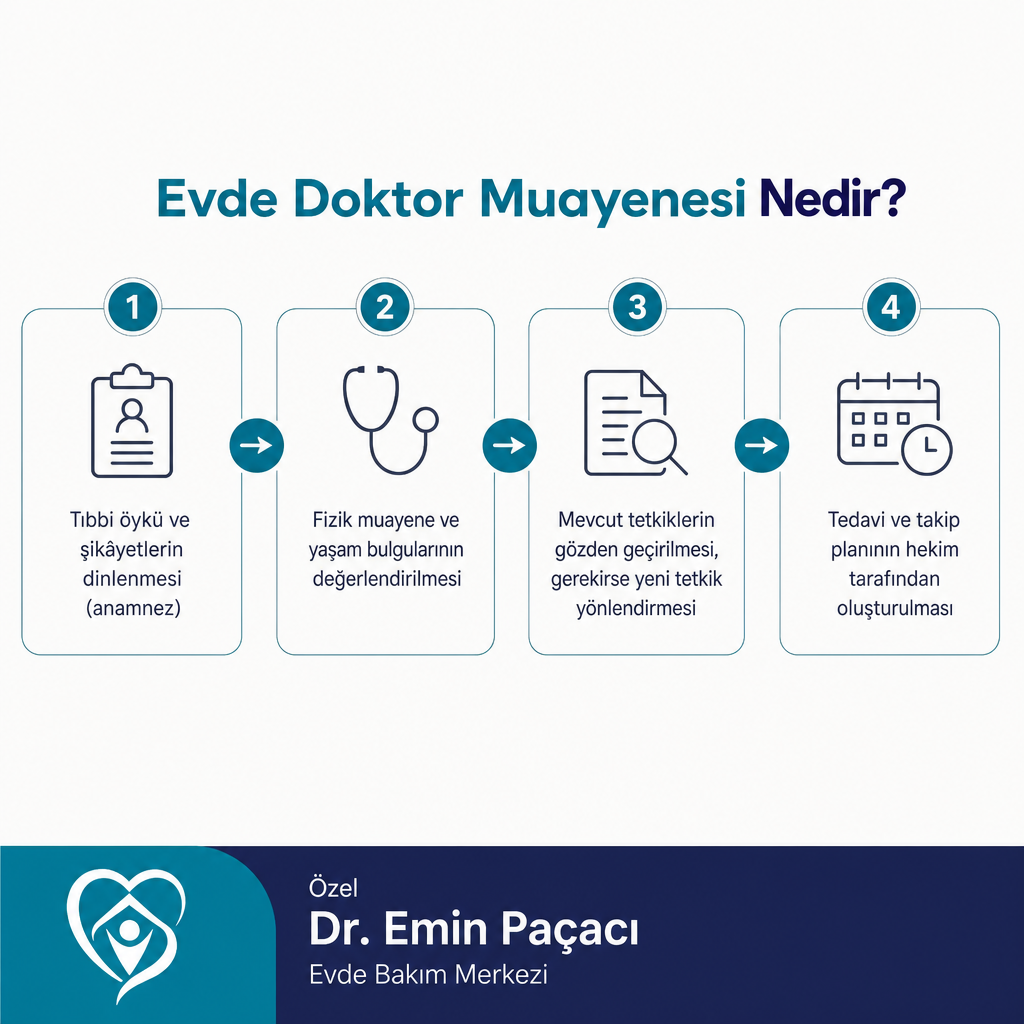 Home doctor examination process
Legal framework in Turkey and the place of the service
Services in the field of home care and home health are regulated by the Regulation on the Provision of Home Care Services and the Regulation on the Provision of Home Health Services. In this legislation, home health service is defined as a whole covering medical procedures such as examination, testing, analysis, treatment, medical care, follow-up and rehabilitation. Furthermore, it is stipulated that the service be provided according to the procedures and principles determined by public and private healthcare institutions licensed by the Ministry of Health.
A home doctor examination can be evaluated as a component focused on the physician's home visit and examination within this broad framework. Private healthcare institutions may plan home visit services in which physicians perform examinations and follow-ups at the patient's home, within the scope of their licenses. Public home health units and the home care services of private institutions are carried out according to separate licenses and operating principles; both structures can be evaluated by the physician according to the patient's condition and access possibilities.
Basic elements of home doctor examination
The content of the examination varies according to the physician's clinical approach and the patient's needs; however, in general there are a few common elements. These elements show that the assessment performed in the home environment preserves the logic of an outpatient examination.
- Evaluation of medical history and complaints: The physician inquires about current complaints, chronic illnesses, medications used, and recent health events.
- Physical examination: General condition, level of consciousness, respiration, circulation and the examination of relevant organ systems are performed; the depth of the examination may vary according to the physician's field of expertise and the reason for admission.
- Measurement of vital signs: The evaluation of pulse, blood pressure, body temperature, respiratory rate and, if necessary, oxygen saturation can be part of the examination according to the physician's decision.
- Diagnostic evaluation and test plan: The physician evaluates the examination findings together with existing laboratory and imaging results; when deemed necessary, they may refer to healthcare institutions for new tests.
- Treatment and follow-up plan: Whether there is a need for additional services such as chronic disease management, medication regulation and home private nursing and home physiotherapy is determined by the physician.
In this process, decisions are made by the physician in accordance with medical standards and relevant legislation; the opinions of the patient and their relatives can be included in the planning. For a more detailed look at how the process works, you can review our article explaining the operation of the home doctor service.
In which situations may it come up
A home doctor examination is not recommended for every individual for the same reasons; suitability depends on clinical evaluation. The following situations exemplify the scenarios in which this service frequently comes up.
- Advanced age and mobility limitation: In people with difficulty walking, bed dependency or wheelchair use, home evaluation may be preferred in cases where reaching a healthcare institution is difficult.
- Chronic illness and care process: In conditions requiring long-term follow-up such as heart failure, COPD, neurological diseases or advanced-stage dementia, home examination and care planning may come up.
- Palliative care and advanced-stage illnesses: During the end-of-life period or palliative care process, a home physician visit can be made for at-home management of symptoms and comfort-focused evaluation.
- Intensive post-surgical care period: In patients with continued mobility limitation after major surgical interventions, wound control, complication monitoring and medication regulation can be planned with a home physician examination. For practical topics regarding this period, our article on things to watch out for at home after orthopedic surgery can be a guide.
These examples are general; the suitability of a home doctor examination for each individual is decided through a clinical evaluation to be made by the physician.
Points considered when making a decision
When planning a home doctor examination, some topics are considered together by the physician and the patient and their family. These topics determine both the suitability of the service and whether it can be carried out safely.
- Clinical condition and urgency: Emergency findings such as sudden-onset chest pain, severe shortness of breath or loss of consciousness generally require emergency evaluation in hospital conditions; in such cases, the 112 Emergency Call System remains the primary route of admission.
- Suitability of the home environment: For the physician to be able to examine the patient safely, providing adequate lighting, privacy and basic hygiene conditions is important.
- Need for testing and intervention: Clinical scenarios requiring advanced imaging, intensive care monitoring or complex surgical intervention may exceed the scope of home examination; in these cases, admission to a healthcare institution is planned in line with the physician's evaluation.
- Patient and family preferences: The patient's desire to be evaluated at home, the participation of family members in the care process and the level of support are among the factors affecting the decision for home examination.
Symptoms and needs vary from person to person; consulting a physician is recommended for the suitability and scope of a home doctor examination. For families who want to increase safety during the home care process, the topic of methods to reduce balance loss and fall risk in the elderly can also complement this evaluation.
Possible limitations
A home doctor examination can be a practical way of evaluation in many situations; however, it is not sufficient on its own for every clinical scenario. Knowing these limitations helps families choose the right route of admission at the right time.
- Emergency and life-threatening situations: Sudden-onset severe clinical scenarios may require emergency medical intervention before a home visit; in the presence of life-threatening findings, direct access to emergency health services is a priority.
- Situations requiring advanced technical equipment: Some diagnostic procedures (for example, advanced imaging) and treatments (for example, intensive care monitoring) cannot be applied in the home environment; in this case, home examination can be an evaluation step supporting the decision to refer to a healthcare institution.
- Infection control: Compliance with infection control programs and basic hygiene rules for home health and care services is a requirement also emphasized within the scope of legislation.
These limitations show that a home doctor examination must be evaluated within a physician's clinical decision-making process at every stage.
Home physician approach at our center
As Private Dr. Emin Paçacı Home Care Center, within the framework of a private healthcare institution licensed by the Ministry of Health, we provide home care and health services with a team of physicians, nurses and physiotherapists. Our home private physician service is defined within a framework in which the physician goes to the patient's address to perform an examination and clinical evaluation, and coordinates with other home care services when necessary.
Within the scope of the home physician visit, the patient's medical condition is evaluated in the home environment. When deemed necessary, a care plan can be created together with services such as home nursing, physiotherapy and palliative care; the follow-up process is reorganized by the physician according to the patient's clinical needs. Evaluation and treatment decisions are made within the medical responsibility of the relevant physician and the framework of current legislation.
Frequently Asked Questions
Are a home doctor examination and a family physician's home visit the same?
A home doctor examination refers to physician visits planned by licensed public or private healthcare institutions. Family physicians' home visit practices, on the other hand, are shaped according to separate legislation and working arrangements.
Is a home doctor examination sufficient in emergency situations?
Life-threatening emergency scenarios most often require emergency intervention in hospital conditions. A home doctor examination is not an alternative to emergency health services; it is a complementary evaluation option in suitable patients.
What tests can be performed during a home doctor examination?
The physician evaluates clinical findings during the examination; reviews existing laboratory and imaging results, and may refer to a healthcare institution for new tests when deemed necessary. The tests that can be performed at home vary depending on the equipment of the service provider institution and the legislation.
What kind of relationship is there between the home health provided by the public sector and private home doctor examination?
Public home health units provide home health services to certain groups of society within the scope defined by legislation. Private institutions' home doctor examination and home care services, on the other hand, are carried out according to separate licenses and operating principles. Both structures can be evaluated by the physician according to the patient's condition and access possibilities.
Who determines the follow-up plan after a home doctor examination?
The frequency of follow-up and where and how the monitoring will continue (at home, with the family physician, or at the hospital outpatient clinic) differs in each patient. This plan is created in line with the clinical decision of the physician performing the examination and the patient's needs.