The planned preparations you make at home before a doctor's examination facilitate the physician's assessment and help tailor home healthcare to the individual's medical condition. The checklist for preparing for a home doctor's examination in this article is intended for elderly or mobility-restricted individuals, people recovering from surgery or being monitored for chronic illnesses, and families planning professional home care. Our aim is to lay the groundwork for a smooth examination by ensuring that documents, the home environment, and contact details are well organized before the visit. Since documentation and consent processes may vary depending on the type of service, the institution's license, and current legislation, we recommend always clarifying the exact requirements with the physician team planning the service.
Table of Contents
Main preparation checklist before the examination
Preparing for a home doctor's examination can be organized into a few headings that reduce scattered paperwork and last-minute rushing. The list below gathers the elements that are helpful to have on hand before the visit.
- Having the identity document and, if available, cards related to health insurance ready.
- Gathering recent discharge summaries, discharge reports, medical reports, and test results (laboratory, imaging) into a single file.
- Making a short list of the medications, nutritional supplements, and medical devices used; presenting the details to the physician through official prescriptions and documents.
- Noting how long current complaints have persisted, what increases or decreases them, and the questions you would like to ask the physician.
- Preparing the area designated for the examination to be well-lit, as quiet, and as clean as possible.
- Arranging items in the room such as slippery rugs, cables, and objects that may create obstacles to allow safe movement.
- Planning for pets to be in another room during the examination and ensuring there is no cigarette smoke in the environment.
- Writing down details in advance that will make it easier to enter the building and locate the apartment, such as door codes and floor information.
- Planning for the patient's legal representative or first-degree relative to be present during the examination or reachable by phone.
- Preparing any special requests the physician has communicated in advance (such as blood pressure records, blood sugar measurements, device lists).
This basic list can be adapted to different age groups and illness situations in line with the requirement groups detailed below.
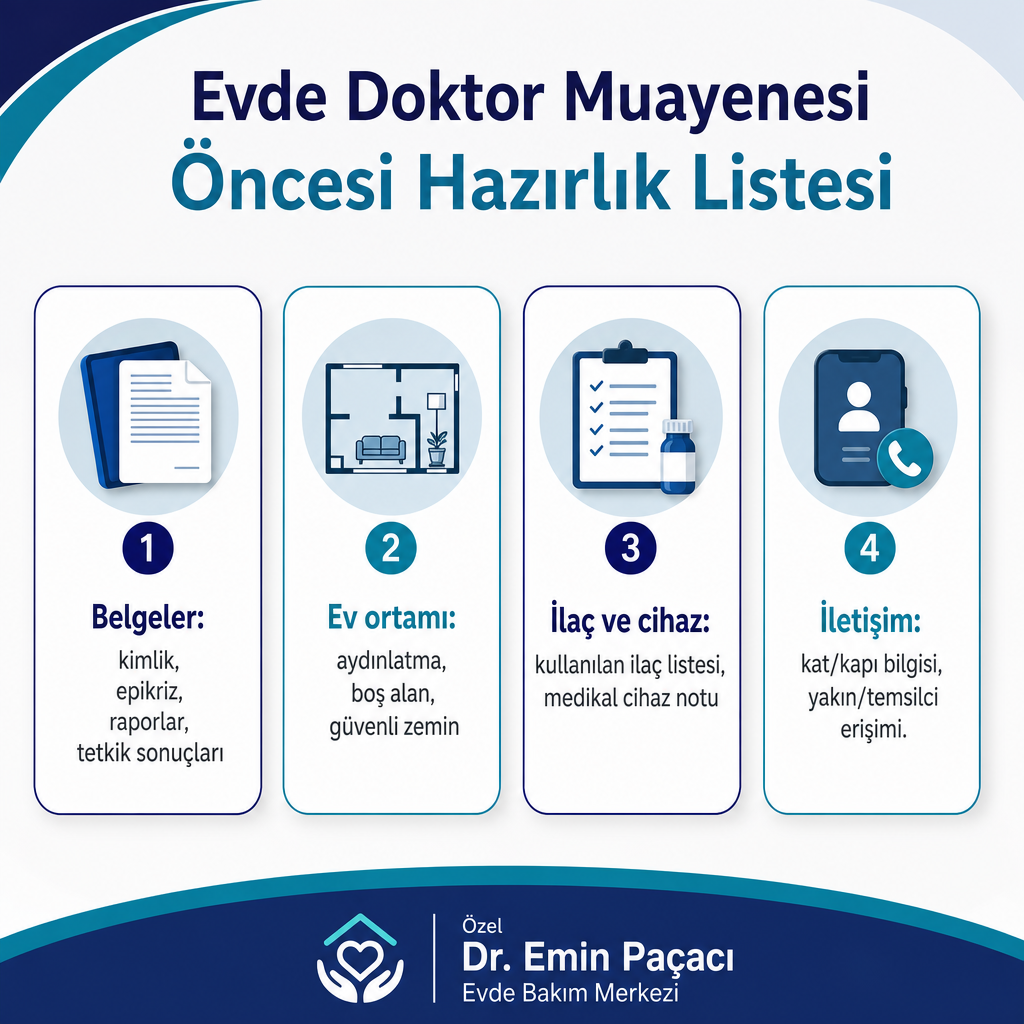 Preparation groups before a home doctor's examination
Legal and administrative framework: identity, consent, and documents
Before moving on to document preparation, it is useful to know within which rules home healthcare services are conducted. In Turkey, home healthcare and home care services are provided within a framework defined by regulations issued by the Ministry of Health and related institutions. Under the regulation on the provision of home healthcare services published for public home healthcare services, the procedures and principles regarding the provision of examination, testing, treatment, medical care, and rehabilitation in the home environment have been established.
In the regulations concerning the Provision and Coordination of Home Health and Palliative Care Services, it is stipulated that individuals receiving services be informed and that consent be recorded by filling out an "Information and Consent Form." The Regulation on the Provision of Home Care Services, on the other hand, determines the licensing, registration, and implementation principles of healthcare institutions providing home care services; it covers the recording of patient information and the completion of medical documentation.
When preparing in line with this administrative framework, the following points stand out:
- Ensuring the patient's identity information (Turkish ID number, address, contact information) is accurate and up to date.
- Being able to communicate the information of the legal representative or authorized proxy to the physician in cases where the patient cannot make their own decisions.
- Filling out the forms required by the relevant coordination centers in public applications; and in private institutions, completing the information and consent processes in accordance with the institution's own procedures.
Since documentation and consent processes may differ depending on the type of service (public/private), the institution's license, and current legislation, the exact document list should always be clarified by the institution providing the service. For this reason, the headings in this section indicate the general framework; individual requirements should be confirmed separately.
Organizing the home environment and safety
In order for the physician to assess the patient at home, the environment is expected to be suitable for medical evaluation. What is meant here is not the physician's clinical decisions, but the practical arrangements that affect the comfortable and uninterrupted conduct of the examination.
- Examination area: It is recommended to leave enough open space for the physician to move around, near a chair or bed where the patient can comfortably lie down or sit. When there is insufficient space, the examination may be limited or some maneuvers may be postponed.
- Lighting: Adequate lighting is important, especially in examinations where skin, joints, or wound areas will be assessed. Insufficient lighting may prolong the examination duration or require additional assessment.
- Safety: For elderly or mobility-restricted patients at risk of falling, it is appropriate to temporarily remove obstacles such as slippery flooring, small rugs, cables, and low coffee tables. Failing to take these precautions may make it difficult for the patient to change position during the examination.
- Pets and smoking: For the safety of the team and the protection of sterile materials, keeping pets in a separate room during the examination and refraining from smoking in the environment supports the assessment, especially in people with respiratory illness.
Since these arrangements directly affect the flow of the visit in terms of time and comfort, this is a part of the preparation list that should not be neglected.
Medical information, medications, and documents
The physician's ability to access the clinical information needed systematically improves the quality of the assessment. An archive compiled into a single file, rather than scattered documents, reduces time lost during the examination.
Discharge summaries and reports. It is useful to have the discharge summary and discharge report from the most recent hospital stay, as well as medical board or specialist physician reports concerning chronic illnesses, in the file.
Test results. Filing the written reports of recent basic laboratory and imaging results (such as blood tests, radiological image reports) may reduce the need for repeated testing.
Medication and device list. It is recommended to make a short list of regularly used medications and medical devices used at home (such as blood pressure monitors, glucometers, oxygen systems); and to present medication names and doses to the physician through official documents and prescriptions. Our content addressing the clinical importance of sterilization in home injection and IV applications explains why such applications are carried out subject to the decision of the physician and nurse.
Complaint and question list. Writing down in advance when the observed symptoms started and how they affect daily life, as well as the questions you would like to ask the physician (such as whether a follow-up is needed, how the treatment plan will be monitored), prevents points that might be forgotten during the consultation.
When such filing is not done, the physician may have to spend more time gathering additional information during the examination or may postpone certain decisions until test results are available.
Communication, accompaniment, and the decision-making process
In home doctor examinations, the communication the physician establishes with the patient, their family, and, when necessary, relevant institutions is decisive in terms of planning the service. When the appointment schedule, visit frequency, and the course to follow in emergencies are clarified in advance, the process proceeds more predictably.
According to information available in public sources, visits are generally planned through an appointment system; the frequency of visits is determined by the physician according to the patient's condition. When the physician deems it appropriate, some follow-ups may be carried out through remote healthcare services (such as telehealth), subject to the provisions of relevant legislation. While applications in public home healthcare services are received through coordination centers and call lines, in private institutions the application and planning methods may differ according to the institution's internal regulations.
The following are recommended for preparation in the area of communication:
- Sharing the appointment information (date, time, estimated duration) with family members.
- Organizing matters so that the patient's first-degree relative or legal representative can participate in the decision-making processes.
- Keeping in mind that in sudden and life-threatening situations, the national emergency call system (112) should be used; and that home healthcare services are essentially conducted with a focus on planned care and follow-up.
Since symptoms vary from person to person, the assessment of emergency or urgent situations is within the authority of the physician and the emergency healthcare system; this preparation list is not intended to guide any medical assessment.
Preparations that vary by condition
Home health and palliative care legislation states that the scope of service may change according to the patient's clinical condition. For this reason, the preparation list may include additional elements depending on the patient's situation.
Chronic illness monitoring. In conditions such as hypertension and diabetes, it is useful to note the blood pressure, blood sugar, or similar records kept at home to show the physician. Filing the reports and follow-up dates of long-term treatments makes monitoring easier. You can find detailed information on why regular measurements are valuable in our content titled the importance of regular vital sign monitoring in chronic illnesses.
Palliative care (advanced-stage illnesses). Within the scope of the relevant regulation, physician examinations for comfort-oriented support and symptom management can be planned according to the patient's general condition. Keeping short daily notes for common symptoms such as changes in appetite, sleep patterns, or fluctuations in pain intensity can assist the physician's assessment. For comfort-supporting approaches during this process, you can review our content on supportive approaches to increasing patient comfort at home in palliative care.
Wound care and injection/IV applications. If such procedures are involved, listing the records of previously performed applications and the materials used facilitates the physician's risk assessment in terms of infection and sterilization. The planning of technical details should be left to the clinical decision of the physician and nurse team; procedures should not be undertaken independently at home. We address the hygiene framework in our content on basic hygiene rules for preventing infection risk in home wound care.
Physiotherapy and rehabilitation. For home physiotherapy assessments, it is useful to have ready the reports of previously received sessions and the summaries of recommended exercises. Information about simple equipment that may be used (such as mats, support pillows) can be provided by the physiotherapist or physician during the examination.
These variables become clear after the physician's initial assessment, and the list can be updated with personalized recommendations.
Clarifying individual preparations before the physician's visit
As the Private Dr. Emin Paçacı Home Care Center, we provide home physician visits, home private nursing, home physiotherapy, palliative care, wound care, and applied treatment services with our team of licensed physicians, nurses, and physiotherapists. Within this framework, we prioritize clarifying the preparation process on an individual basis.
Before a home physician visit, we can provide preliminary information on which documents and preparations are necessary, taking into account the patient's general condition and the type of service requested. During the first examination, the physician assesses the patient's medical condition, home environment, and care needs, and may share personalized preparation recommendations for subsequent visits (such as having certain test reports available, recording daily measurements). In our home private physician process, we organize our internal procedures in a manner compliant with current home care and home health legislation; and we structure information and consent processes according to the nature of the service.
Assessment and treatment decisions belong to the physician; this list aims to systematize pre-examination preparations. Once the patient's condition and the planned service become clear, you can contact us to review the preparation list together.
Frequently Asked Questions
What documents other than identity should be ready for a home doctor's examination?
While the identity document is essential, it is useful to have recent discharge summaries, reports, test results, and official documents showing the medications used in a single file. The exact document list is shaped according to the information provided by the institution delivering the service.
Must a family member necessarily attend the home doctor's examination?
For the information and consent processes to proceed properly, the patient themselves should be present in cases where they can make decisions; in cases where they cannot, the legal representative or first-degree relative should be present or reachable by phone.
Is it necessary to prepare special medical equipment for the examination?
The need for medical equipment is determined by the physician's assessment according to the patient's condition and the planned procedure. In general, it is considered sufficient for the examination area to be well-lit, safe, and tidy.
What are the preparation differences between a home doctor's examination and public home healthcare service?
In public home healthcare services, applications are made through the coordination center and call lines; information and consent forms are defined in the annexes of the relevant regulation. In licensed private home care institutions, on the other hand, application and documentation processes are planned according to the institution's license and internal procedures.
If an emergency symptom develops, is it appropriate to wait for the home doctor's appointment?
Public sources state that in sudden and life-threatening situations (such as loss of consciousness, severe bleeding), the national emergency call system (112) should be used. Home healthcare services are essentially conducted within the framework of planned care and follow-up.