Common misconceptions and safe movement guidance for home-based exercise often come down to a single question: Is the home environment really as safe as it looks? Regular movement can support muscle strength, balance, and the ability to maintain daily living activities; however, certain frequently repeated mistakes—especially in elderly people, those with chronic illnesses, or those who have recently had surgery—can increase the risk of falls, worsening pain, and injury. Below, we address, in an informative framework, who can make the decision to exercise at home and under what conditions, the most commonly encountered misconceptions, the fundamental mechanisms that safe movement relies on, and the situations that require professional evaluation.
Contents
The decision to exercise at home: For whom, under what conditions?
Exercise in the home environment is a frequently preferred option for building a regular movement habit, supporting muscle strength and balance, and making it easier to maintain daily living activities. However, as age advances, conditions such as chronic cardiovascular diseases, diabetes, osteoporosis, joint problems, or neurological illnesses increase the precautions that must be taken during exercise.
For this reason, the decision to exercise should be made based on the person's current health status, not merely on the assumption that "moving is good." A few key points stand out:
- Before starting a new exercise program, evaluation by a physician is recommended; existing illnesses, medications used, and functional capacity should be reviewed.
- Although international guidelines recommend certain weekly durations of aerobic and muscle-strengthening activity for adults, these durations need to be adapted according to the person's age, accompanying illnesses, and physical capacity.
- In elderly individuals, starting with light activities such as brisk but short walks and gradually increasing the duration according to the individual is a commonly used approach.
In most cases, the decision is shaped in a person-specific way under the supervision of a physician and, when necessary, a physiotherapist. Rather than a general program, a plan tailored to the individual's medical history supports both safety and sustainability.
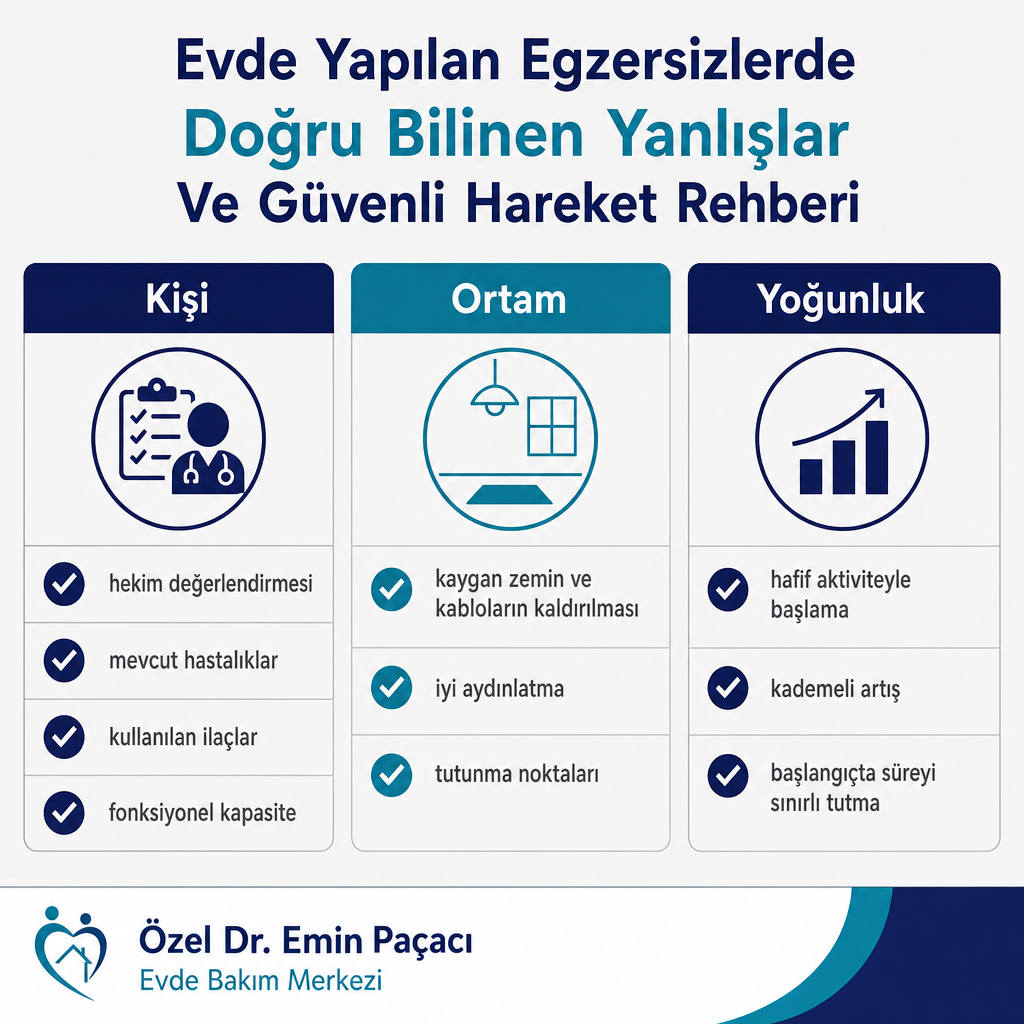 Safety checklist before home exercise
Common misconceptions about home-based exercise
Some of the common beliefs about home exercise can be misleading in terms of safety. The following headings gather together the misconceptions that are frequently corrected in the literature.
"Every exercise done at home is safe"
Although the home environment is assumed to be safe, elements such as slippery floors, carpet edges, cables, and low lighting can increase the risk of falls. During balance and strengthening exercises done at home by elderly people, arranging the floor and removing environmental obstacles is one of the fundamental safety steps in physical therapy practices.
Resources describing home physical therapy practices emphasize clearing the exercise area of slippery floors, ensuring good lighting, removing obstacles, and, if necessary, preparing handholds.
The assumption that something is "automatically safe because it's at home" is not correct; both the environment and the person must be evaluated together.
"Feeling pain shows that the exercise is working"
Some people consider the pain felt during exercise a sign of "effective work"; however, a mild sensation of strain in the muscles is different from pain originating in a joint, tendon, or nerve. Exercise guides state that if pain or swelling develops in a joint, exercise should be stopped, straining should not be continued, and expert evaluation is recommended if complaints persist.
Examples of misinterpreted pain that require attention:
- Sharp pain in the knee, hip, lower back, or shoulder during a balance or strength exercise
- Marked swelling or restriction of movement lasting for hours after exercise
These findings are treated not as "I did a good workout" but as a sign that the movement should be technically reviewed.
"Warm-up and cool-down are a waste of time"
That exercise programs should consist of warm-up, the main exercise, and cool-down/stretching sections is a fundamental principle in sports medicine and cardiology guidelines. Dynamic warm-up movements help prepare the muscles and joints for load; cool-down and stretching help reduce the risk of a sudden drop in heart rate, muscle stiffness, and injury.
Resources describing home exercise also recommend including about 5–10 minutes of light warm-up before each workout and stretching movements afterward. Skipping the warm-up can increase the risk of injury, especially in people who have not exercised regularly for a long time.
"The harder, the better"
A sudden transition to high-intensity exercise by people who have been sedentary for a long time can increase the risk of muscle-tendon injuries and of cardiovascular problems. Home exercise recommendations emphasize avoiding overly intense and demanding programs at first, and increasing duration and intensity gradually. Among the frequently repeated safety recommendations are not keeping the exercise duration long during the initial period, not repeating the same type of exercise for long periods, and starting at a lighter intensity in people with a long history of inactivity.
"Exercise must be done on an empty stomach"
One of the common beliefs is that exercise must be done on an empty stomach. However, informative content states that neither a completely empty nor a completely full stomach is recommended, and that it is generally more appropriate to exercise about 2–3 hours after eating. Being too full or too hungry can increase dizziness, weakness, or stomach discomfort.
"Home exercise is enough for the elderly, no professional support is needed"
Light exercises can be beneficial for some elderly individuals; however, poorly chosen types of exercise, incorrect posture, and inadequate environmental precautions can increase complaints. Resources describing home physical therapy for the elderly present, as the fundamental approach, that balance, strengthening, and range-of-motion exercises should be planned according to the individual's condition by a licensed physiotherapist and accompanied by environmental adjustments. Especially in elderly people with multiple illnesses, the proposition that "exercise done alone at home does not require professional evaluation" is not considered correct.
Key mechanisms and options for safe movement
There are several concrete mechanisms behind safe exercise: arranging the environment, appropriate equipment, and setting the intensity correctly. Each of these reduces risk from a different angle.
Environmental safety
An important part of home exercise safety relies on arranging the space:
- Floor: Slippery carpets, wet surfaces, and cables should be removed.
- Lighting: Low lighting, especially during nighttime hours, increases the risk of falls.
- Support points: Stable supports such as a chair, railing, or wall can be helpful during balance exercises.
These arrangements are described among the fundamental components of the home safety assessment carried out before exercise in physiotherapy practices.
Equipment and clothing
Although special devices are not always mandatory for home exercise, choosing appropriate footwear and clothing reduces the risk of injury. For exercises involving prolonged standing, jumping, or a walking focus, sports shoes with an appropriate sole help reduce foot and ankle problems. Comfortable clothing that does not restrict movement contributes to reducing loss of balance and the likelihood of falls.
Adjusting intensity and duration
Exercise intensity is assessed based on heart rate, the sensation of shortness of breath, and muscle fatigue. Although moderate-intensity activities such as walking at a measured pace are considered suitable for many adults in cardiovascular exercise guidelines, it is emphasized that even this level needs to be adapted according to the individual in elderly people and those with chronic illnesses.
Among the examples that support daily life recommended under professional evaluation in home exercise content prepared for the elderly are short walks, functional movements such as controlled standing up and sitting down from a chair, and carrying activities with light weights. The common feature of such movements is that they safely strengthen skills that are already used in daily life.
Decision criteria: When is a physician or physiotherapist evaluation needed?
When deciding about home exercise, certain situations are generally treated as criteria requiring professional evaluation:
| Situation category |
Notable findings |
| Recent medical history |
Recently experienced heart attack, stroke, or major surgery |
| Cardiovascular condition |
Uncontrolled hypertension, advanced heart failure, serious rhythm disorders |
| Musculoskeletal risk |
Advanced joint deformity, severe osteoporosis, or a history of frequent falls |
| Warnings during exercise |
Chest pain, marked shortness of breath, dizziness, feeling of fainting |
| Post-exercise findings |
Persistent severe muscle-joint pain, swelling, or restriction of movement |
Resources describing the rules of home exercise particularly emphasize that if pain and swelling develop in the joints during or after exercise, the exercise should be stopped and, if the complaint persists, an expert should be consulted. Home physical therapy guides for the elderly, on the other hand, highlight the systematic evaluation of fall risk, balance problems, and environmental obstacles. Symptoms vary from person to person; therefore, evaluation should be carried out by a physician or the relevant specialist.
The relationship between home exercise and movement and institutional care
As the Private Dr. Emin Paçacı Home Care Center, we are an Üsküdar-based home health organization licensed by the Ministry of Health; with our teams of physicians, nurses, and physiotherapists, we provide care and follow-up services in the home environment. Within this framework, we treat home exercise not as a topic separate from the person's overall care plan, but as part of it.
- In individuals with chronic illnesses, limited mobility, or in the post-surgical recovery process, exercise can be planned with physician and physiotherapist evaluation. The evaluation conducted within the scope of home private medicine establishes a framework in terms of existing illnesses and functional capacity.
- Home physiotherapy services can help tailor balance, muscle-strengthening, and mobility exercises to the individual, identify environmental risks, and determine the appropriate exercise intensity.
- Home private nursing services can contribute to monitoring medical findings that may arise during the exercise process (for example, changes in pulse or blood pressure, complaints of pain) and, when necessary, reviewing the care plan again.
Home movement and exercise can be evaluated more systematically when considered together with institutional home care services. Determining an approach suitable to the person's condition relies on the evaluation of the physician and relevant specialists.
Frequently Asked Questions
How should an elderly individual start exercising at home?
Home exercise guides for the elderly generally recommend starting with activities that support daily life, such as short walks, controlled standing up and sitting down from a chair, and light balance exercises. The starting level is determined by the physician and physiotherapist according to the person's medical history and functional condition.
What should be reviewed to reduce the risk of falls while exercising at home?
Physical therapy resources list, as fundamental precautions, clearing the exercise area of slippery floors, smoothing carpet edges, gathering cables, ensuring good lighting, and, if necessary, creating handholds. In people with balance problems, taking support from a sturdy piece of furniture during movement is a commonly used practice.
What should be done if pain is felt during exercise?
Exercise guides emphasize that when pain or swelling is felt in a joint, the exercise should be stopped and straining should not be continued. If the pain does not go away in a short time or gradually increases, evaluation by a health professional is recommended.
Can someone who has been sedentary for a long time start high-intensity exercises at home?
Sports and physical therapy content highlights that people who have been sedentary for a long time should not start with overly intense and demanding exercises, that intensity should be increased gradually, and that duration should be kept limited at first. For this group, a controlled program planned with physician and physiotherapist evaluation is preferred.
Can home exercise replace treatment on its own?
Physiotherapy and sports medicine resources state that home exercise can be a component of the treatment plan in suitable individuals, but that it can increase complaints when applied incorrectly. Exercise does not replace the decision on diagnosis and treatment; medical evaluation and follow-up belong to the physician and relevant specialists.