The clinical importance of sterilization in home-based injection and serum applications can be briefly explained by its role in reducing the passage of microorganisms into the bloodstream, thereby preventing local and systemic infections, lowering the risk of complications, and enabling treatment to continue safely. These parenteral applications—which come into play for chronic disease management, postoperative processes, palliative care, and individuals with limited mobility to continue treatment—reach the expected level of safety only when carried out in patients deemed appropriate following physician evaluation and by health professionals trained in aseptic technique. This article addresses, within an informative framework, why sterilization is clinically critical, the mechanisms of infection, the fundamental components, and the role of physician evaluation.
Contents
The place of injection and serum applications in the home setting
In patients receiving home healthcare, injections (such as intramuscular or subcutaneous) and intravenous serum applications may come into play in various clinical situations in order to maintain the continuity of treatment. Chronic disease management, the postoperative period, palliative care processes, and individuals with limited mobility are the groups in which these applications are most frequently considered.
Since such procedures are a form of healthcare service, carrying them out at home in situations where transporting the patient to the hospital is difficult can contribute to the uninterrupted continuation of the treatment plan. As a home healthcare organization, we too plan and carry out physician examination, private home nursing, and various treatment applications together. However, the sole determining factor here is not where the procedure is performed, but by whom and according to what principles it is carried out. Physicians decide on the feasibility of performing injection and serum applications at home by evaluating the patient's general condition, comorbidities, medication use, allergy history, and the suitability of the home environment.
What do sterilization and aseptic technique mean?
Although sterilization and aseptic technique are used interchangeably in everyday language, they are two distinct concepts from a clinical standpoint. Sterilization is the general name for processes aimed at removing all microorganisms and spores from the environment; the sterility of drugs, solutions, syringes, needles, and sets used in injection and intravenous treatments is a fundamental component of infection control.
Aseptic technique, on the other hand, refers to the set of rules aimed at preventing the contamination of sterile materials and areas. When preparing and administering a drug, specific hygiene and asepsis principles are observed for the preparation surfaces, hands, materials used, and application site. In other words, sterilization defines the condition of the material, while aseptic technique defines the set of behaviors that ensure that material is used without becoming contaminated.
In scientific guidelines, the fundamental elements of aseptic technique include the use of sterile syringes and needles, wiping the rubber caps of drug vials with antiseptic, using infusion sets on a single patient, and maintaining the sterile field throughout the procedure. Errors made during the preparation and administration of intravenous infusion solutions can lead to contaminated solutions entering the circulation and to serious infection conditions such as bacteremia; for this reason, aseptic technique is considered critical in both clinical and home settings.
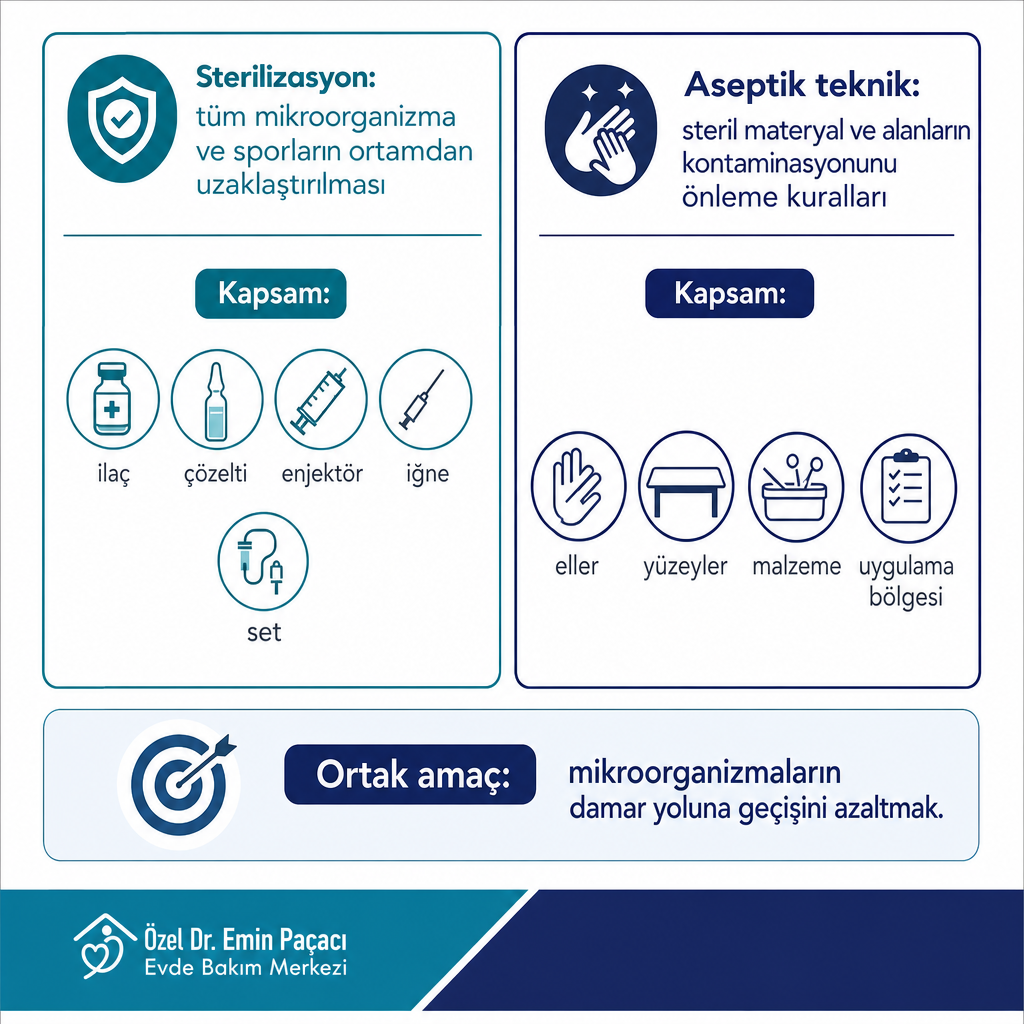 The difference between sterilization and aseptic technique
How does infection risk arise in the home setting?
The mechanisms that determine the risk of infection in injection and serum applications take shape through multiple pathways by which microorganisms can reach the vascular system. The main routes of transmission are as follows:
- From the hands or skin flora of the healthcare worker,
- From the surfaces of needles, syringes, serum sets, or drugs/solutions that should be sterile,
- From insufficient cleaning of the application site,
- From local colonization that develops around the catheter and cannula after application.
Failure to maintain adequate hand hygiene, using single-use equipment on more than one patient, choosing materials whose sterile packages are damaged, or preparing drugs on unsuitable surfaces are among the main factors that increase the likelihood of infection. Since contaminated infusion solutions and sets in particular can mediate the direct passage of bacteria into the circulation, clinical guidelines emphasize strict adherence to aseptic technique during the preparation and use of these materials. Because the home environment does not have as controlled an infection control infrastructure as a hospital, adherence to these principles becomes even more decisive.
What does sterilization help prevent?
The clinical importance of sterilization can be understood most concretely through the complications it seeks to prevent. These complications are evaluated at two levels: local and systemic.
At the local level, the conditions associated with inadequate aseptic technique include the development of cellulitis and abscess accompanied by redness, pain, and increased warmth at the injection site; phlebitis accompanied by inflammation and thrombosis around the intravenous catheter; and findings such as discharge and tenderness at the catheter entry site.
At the systemic level, bacteremia and sepsis, infections that can be transmitted via the vascular route such as hepatitis and HIV, and severe allergic reactions and anaphylaxis that can arise due to parenteral drugs or fluids are among the conditions described in the literature. Expert opinions point out that opening a vascular access by untrained individuals and administering infusions in an uncontrolled manner can increase the risk of serious infection and anaphylactic reactions. For this reason, injection and serum applications in the home setting are carried out by health professionals who are proficient in the principles of sterilization and aseptic technique; the assessment and treatment decisions regarding possible complications are made by the physician.
Fundamental components of infection control
The components that contribute to infection control in home-based injection and serum applications are gathered under several complementary headings. The table below summarizes these components and their clinical rationale.
| Component |
Practical equivalent |
Clinical rationale |
| Hand hygiene |
Soap and water or alcohol-based antiseptic before and after the procedure, correct sequence in glove use |
Reduces the transmission of microorganisms originating from the hands |
| Sterile and single-use equipment |
Separate syringe, needle, set, and catheter for each patient, with unbroken package integrity |
Prevents material-related vascular transmission |
| Aseptic area in drug preparation |
Wiping the vial cap and ampoule neck with antiseptic, ensuring connection points do not touch a contaminated surface |
Ensures the solution remains sterile |
| Preparation of the application site |
Cleaning the vascular access or injection site with antiseptic |
Reduces transient flora and contaminants on the skin surface |
| Waste management |
Immediately disposing of used needles and syringes into a sharps waste container |
Prevents reuse, infectious diseases, and needlestick injuries |
These components gain meaning when they operate not individually but together. For example, even if sterile equipment is used, if the drug is prepared on an unsuitable surface, the aseptic area will not have been maintained. In the home setting too, compliance with relevant health regulations in the management of sharps waste is important; because this is part of safety for both the patient and the caregivers.
Physician evaluation and decision criteria
In home healthcare applications, infection control depends not only on technical rules but also on the team structure and clinical decision-making processes. Parenteral applications require both physician evaluation and nursing knowledge and skill. Evaluating the indication is the physician's responsibility, while carrying out the application in accordance with professional standards is the nurse's responsibility.
When planning an injection or serum application in the home setting, physicians generally take the following criteria into account:
- The patient's general performance status (mobility, consciousness, nutrition),
- Comorbidities (for example, diabetes, heart failure, chronic lung diseases),
- Immune system status (immunosuppressive treatment, advanced age, history of chronic infection),
- Vascular access accessibility and previous vascular access complications,
- The duration and intensity of drug or fluid therapy,
- The hygiene conditions of the home environment and caregiver support.
Experts emphasize that, particularly when the medical rationale is unclear or applications are administered in an uncontrolled manner via the vascular route, this can be risky in terms of serious infections and anaphylaxis. For this reason, parenteral applications are planned on the basis of medical indication and by competent healthcare personnel. The appropriate approach for each patient is determined by the physician, taking into account the individual risk profile and treatment goals. We carry out this evaluation and application process within a framework in which our private home medicine and nursing services operate together.
Possible findings and post-application monitoring
Knowing the possible findings that may be encountered in home injection and serum applications helps the patient and caregiver to consult a physician at the right time. The main findings that should be monitored are as follows:
- Pain, redness, and increased warmth at the injection site,
- Tenderness, hardness, or streak-shaped redness around the vascular access (signs of phlebitis),
- Signs of an allergic reaction such as sudden-onset rash, shortness of breath, palpitations,
- Systemic infection findings such as fever and chills.
Since these findings may be associated with different diseases and conditions, when they occur it is recommended to consult a physician for clinical evaluation; the diagnosis and treatment process is planned by the physician in line with the examination and necessary tests. The home healthcare team keeps the patient under observation for a certain period after the application; the patency of the vascular access, the condition of the applied site, and the general clinical appearance are monitored. Any unusual findings detected during the observation process are shared with the physician, and the treatment plan is rearranged if necessary. For situations requiring long-term monitoring such as palliative care, our content titled supportive approaches in the palliative care process may also provide information on approaches aimed at supporting patient comfort.
Our center's approach to sterilization
As the Private Dr. Emin Paçacı Home Care Center, we provide home medicine, nursing, and physiotherapy services in Istanbul. Our scope of service includes home doctor examination, private nursing, physiotherapy, palliative care, wound care, and the planning of serum/IV treatments.
We carry out home injection and serum applications in patients deemed appropriate by a physician, through licensed nurses, and while observing infection control principles and relevant health regulations. We regard fundamental sterilization components such as hand hygiene, the use of sterile and single-use equipment, aseptic technique in drug and infusion preparation, and sharps safety as part of our clinical operation. In this way, we sustain treatments provided in the home setting within a science-based, physician-supervised, and patient-centered framework. You can access all of the services we offer from our services page.
Frequently Asked Questions
For whom can home injection come into play?
In patients undergoing chronic disease treatment, with limited mobility, or in the palliative care process, when deemed appropriate by a physician, administering drugs by injection at home may come into play. The physician decides which injection is appropriate for which patient as a result of examination and medical evaluation.
Why is sterile material important in home serum application?
Using sterile syringes, needles, and infusion sets and keeping solutions sterile reduces the passage of microorganisms into the bloodstream; it contributes to preventing complications such as bacteremia, phlebitis, and local infection.
When which findings are observed after application is it appropriate to consult a physician?
Marked redness, increased warmth, and severe pain at the injection or vascular access site; deterioration in general condition, fever, chills, shortness of breath, or rash may occur. Since these findings may be associated with different causes, it is recommended to consult a physician for evaluation; the diagnosis and treatment process is determined by the physician.
How can the home environment be supported in terms of sterilization?
Performing applications, as far as possible, in clean, tidy, and uncrowded areas; reducing dust and unnecessary traffic in the home; and having caregivers pay attention to hand hygiene can be supportive. The planning and technical details of the application are carried out by trained health professionals.
Why are official processes and documents important when receiving home care service?
Home health and care services are carried out in accordance with relevant regulations; recording the patient's medical condition, consent, and the scope of the service in writing is important for both clinical follow-up and administrative processes. Which documents are required varies according to the type of service and the patient's condition; for details, our content list of documents required for home care may be a guide.