Home physiotherapy is a practice that enables individuals with limited mobility or chronic illness to receive continuous, functional-goal-oriented rehabilitation within their own home environment. The short answer to the question "The 5 Major Advantages Home Physiotherapy Offers to the Patient and Their Relatives" is as follows: functional work in a real-life setting, access and continuity for patients with mobility limitations, environmental modifications aimed at fall risk, structured monitoring in chronic disease follow-up, and load sharing through education directed at the patient's relatives. In Turkey, this service is provided based on physician recommendation and health team coordination, within a structure where physicians, nurses, physiotherapists, and other professional groups work together.
Contents
What is home physiotherapy and how is it defined in Turkey?
In Turkey, home care and home health services are defined as services based on physician recommendation and health team coordination, in which medical needs—including examination, medical care, rehabilitation, and physiotherapy—are provided in the environment where the person lives. In the relevant regulations, home care service is described as the combined provision of rehabilitation, physiotherapy, psychological support, and care-follow-up services to patients in their living environment in line with physicians' recommendations.
Within this framework, home physiotherapy can be summarized as physiotherapists applying personalized programs in the patient's home environment—in areas such as movement, balance, walking, muscle strength, respiration, joint range of motion, and functional independence—in line with physician assessment and referral. Both public institutions and licensed private centers can provide these services according to Ministry of Health regulations, within a team structure where physicians, nurses, physiotherapists, and other relevant professional groups work together. Readers curious about the general framework can find details on the regulatory basis in our article titled general information on Ministry of Health home care services.
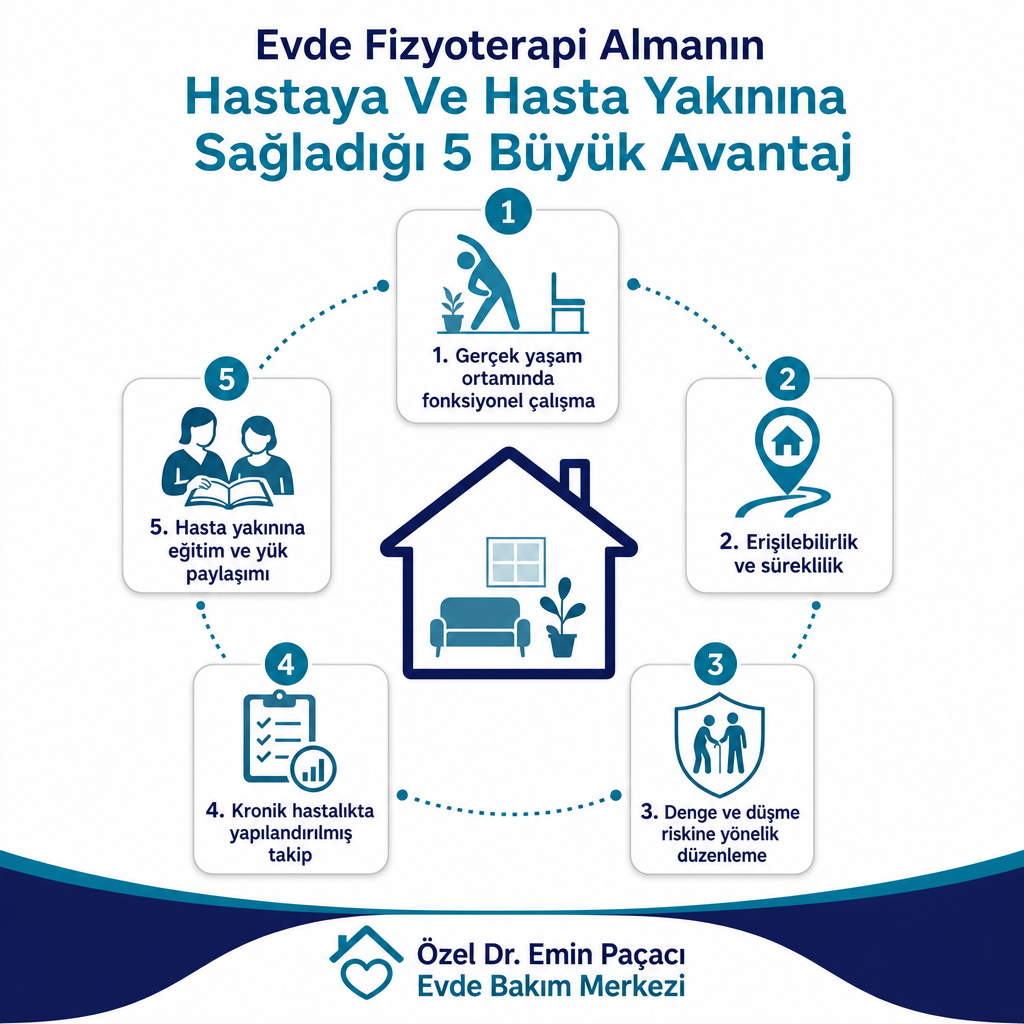 The five core advantages of home physiotherapy
The five core advantages it offers to patients
Functional rehabilitation in a real-life environment. Home physiotherapy programs allow work to be carried out in real environments where the patient conducts their daily life, such as stairs, the bathroom, the kitchen, and the bedroom. In this way, not only abstract exercise movements but real functions such as standing up, sitting in a chair, entering the bathroom, reaching the kitchen, and going up and down stairs are targeted. National and international studies report that rehabilitation programs carried out in the home environment can be associated with increases in functional independence and daily living activities. This increase can be assessed through concrete indicators such as the person independently changing between lying and sitting positions, walking short distances, or needing less assistance in basic self-care.
Access and continuity for patients with mobility limitations. For patients with severe mobility limitations, intense pain, neurological diseases, or chronic cardiac-respiratory problems, regularly traveling to and from a healthcare facility can be difficult. Conducting assessments and sessions at the patient's address can facilitate access to rehabilitation, especially for bedbound patients, those who are difficult to transfer, or those who cannot tolerate long journeys. When sessions can be planned in accordance with the patient's and caregiver's daily schedule, regular participation in the treatment plan is supported. In particular, regular and sustainable practice is important for preserving muscle strength and balance in chronic diseases; this requirement can become more accessible with home-based programs.
Balance, fall risk, and environment-specific modifications. Falls in elderly individuals and people with neurological diseases are a risk that can lead to serious consequences, both physically and psychosocially. Home physiotherapy helps identify the factors that increase risk by directly assessing elements such as the actual floor, furniture placement, corridor width, and lighting conditions during balance and walking exercises. Balance exercises adapted to the home environment, safe walking strategies, and in-home modifications (carpets, furniture placement, use of handrails) can be important in fall risk management. In this process, the physiotherapist plans together with the physician, also taking into account elements such as the patient's current balance level, accompanying illnesses, and medication use. We addressed the details of this topic in our article on loss of balance in the elderly and methods to reduce the risk of falls at home.
Structured follow-up in chronic disease management. Home physiotherapy allows rehabilitation to be continued in the home environment in many clinical conditions such as musculoskeletal system diseases, post-stroke conditions, Parkinson's disease, and other neurological presentations. In these programs, strengthening exercises, joint range of motion work, walking and balance training, respiratory exercises, and functional tasks are planned according to the individual. Scientific publications state that in some patient groups, these practices may be associated with positive outcomes in continuity of care and functional independence parameters. Regular home visits can facilitate monitoring of pain level, muscle strength, exertion capacity, and daily activity performance over time, and, when necessary, the readjustment of the treatment plan together with the physician. For assessments specific to the postoperative period, our guide to post-surgery home physiotherapy offers a detailed perspective.
Education for the patient's relatives, load sharing, and psychosocial support. Home physiotherapy does not focus solely on the patient; it enables caregiving family members to be trained in safe transfer, correct positioning, accompanying exercises, and providing support in daily activities. Learning correct techniques under professional supervision—such as transferring from bed to chair, accompanying during walking, and support in going up and down stairs—is important both for the patient's safety and for the caregiver's own musculoskeletal health. Studies show that rehabilitation processes carried out at home can support continuity of care by increasing family participation, and that in this way feelings of uncertainty and loneliness can, in some cases, decrease. Education and information also help the patient's relatives to more clearly understand when it is necessary to consult the physiotherapist again and when to consult the physician.
Factors that shape the home physiotherapy decision
The decision for home physiotherapy is made by evaluating multiple factors together, such as the patient's clinical condition, mobility, accompanying illnesses, home conditions, and caregiver support. In people whose mobility is severely limited, who are difficult to transfer, who remain in a lying position for long periods, or who require regular rehabilitation due to chronic illness, this option can be considered by the physician and physiotherapist.
The postoperative period, post-stroke rehabilitation, age-related loss of balance, chronic musculoskeletal pain, and neurological diseases are among the clinical examples where home physiotherapy assessment frequently comes to the agenda. Since symptoms and needs can differ from person to person, it is recommended that the physician and relevant specialists jointly decide which rehabilitation model (hospital, outpatient clinic, home physiotherapy) is more appropriate. Within the framework of the legislation, home physiotherapy service is also associated with physician recommendation, appropriate reporting, and team planning. The physician determines the need for home care and home physiotherapy by taking into account the patient's medical condition and goals.
Methods in practice and points to consider
The basic methods used in home physiotherapy sessions may include muscle strengthening exercises, joint range of motion work, balance-walking training, respiratory exercises, functional tasks (lying down and getting up from bed, sitting and standing up, going up and down stairs), and patient-specific education topics. The content and intensity of the applied program are determined by evaluating the patient's medical condition, fatigue level, pain status, accompanying illnesses, and safety criteria.
As with every physiotherapy application, effects such as fatigue, temporary increase in pain, muscle strain, or balance problems may occur in home-based programs; for this reason, exercises are carried out under professional supervision, within limits determined together with the physician when necessary. In terms of fall risk or sudden blood pressure and pulse changes, safety assessment before and during the session is important, especially in advanced-age individuals and those with serious chronic illness.
The suitability of the home environment for physiotherapy is also part of the process. Floor structure, lighting, in-home circulation areas, furniture placement, and the use of assistive devices (walker, cane, grab bars) are evaluated together; when deemed necessary, modification recommendations are developed. Since the assessment varies from person to person, the decision regarding the appropriate method and intensity is based on the joint clinical evaluation of the physician and physiotherapist.
The relationship of home physiotherapy with other services at our center
As Private Dr. Emin Paçacı Home Care Center, we are a Ministry of Health-licensed home health institution; we provide services such as physician examination, private nursing, physiotherapy, palliative care, wound care, serum/infusion applications, and home emergency assessment in the home environment. Our physiotherapists can, in line with physician assessment and approval, plan home physiotherapy programs for patients who have become immobile, are going through the postoperative period, have chronic illness, or experience age-related balance problems.
When home physiotherapy is considered together with our private home physician and private home nursing services, it can contribute to carrying out the patient's medical assessment, care plan, and rehabilitation goals within the same coordination. The decision to receive service should be made by evaluating together the patient's need, the physician's recommendation, and the family members' means. When we are given information about the patient's clinical condition and goals, we can provide guidance toward the appropriate assessment process.
Frequently asked questions
Who may home physiotherapy be suitable for?
It can be evaluated by the physician and physiotherapist for people with severe mobility limitations, who are bedbound, difficult to transfer, have chronic neurological or musculoskeletal system disease, experience balance disorders, or require home rehabilitation in the postoperative period. The suitability decision is made based on detailed medical assessment and individual goals.
How are the duration and frequency of sessions determined?
Session duration and frequency are planned by the physiotherapist and physician, taking into account the patient's diagnosis, general health condition, fatigue level, accompanying illnesses, and targeted functional gains. In some cases, short and frequent sessions may be preferred, while in others, sessions at longer intervals may be preferred; the plan can be updated according to the patient's response during the process.
Does home physiotherapy replace physiotherapy in the hospital?
Home physiotherapy can be complementary or an alternative to applications provided in the hospital or outpatient clinic setting; however, which model is appropriate varies from person to person. While hospitals or rehabilitation centers may be preferred in some situations requiring intensive device use, home physiotherapy may come to the agenda as an option for patients with marked mobility limitations and difficulty with transportation. This decision is based on the clinical evaluation of the physician and relevant specialists.
What is the role of the patient's relative in home physiotherapy?
The patient's relatives have an important role in safe transfer, positioning, accompanying exercises, and in-home safety arrangements. The physiotherapist can teach caregivers techniques for helping the patient in a way that protects their own health, and can inform the family about planning the home care burden.
How is the home environment evaluated for physiotherapy?
Before the application, elements such as floor characteristics, lighting, stair and corridor structure, furniture placement, and access to the bathroom and toilet are reviewed. Carpets, cables, narrow passages, or inadequate lighting that increase fall risk are identified, and recommendations can be developed for arrangements that support safe movement.