The short answer to the question of what home physiotherapy is: it is the practice of physiotherapy and rehabilitation carried out in the person's own home environment, planned through the evaluation of a physician and physiotherapist. Physiotherapy is a medical field that aims to reduce functional losses following diseases and injuries affecting the muscles, joints, nerves and movement system, to support movement capacity, and to help the person become more independent in daily living activities. When these practices are structured within the home environment for individuals who have difficulty going to the hospital or clinic, who have limited mobility, or who are going through a long-term illness process, this is called home physiotherapy. In the following sections, we address the scope of this service, in which situations it comes into consideration, how it is planned, and which topics are evaluated when making a decision, within an informative framework.
Contents
What exactly does home physiotherapy cover?
Home physiotherapy is the version of rehabilitation practices carried out in the clinic that is brought into the person's living environment. The treatment is carried out by a physiotherapist who comes to the patient's home; the plan, meanwhile, is usually prepared in line with the diagnosis and recommendations made by the relevant physician (such as physical medicine and rehabilitation, orthopedics, neurology). In this respect, home physiotherapy is not a single exercise session, but a structured process based on a medical evaluation.
Goals are defined not through abstract expressions, but through measurable functional gains. For example, concrete goals are set, such as increasing walking distance, supporting balance, increasing muscle strength, or facilitating daily living activities in home areas such as the bathroom and kitchen. The person's initial condition is recorded, and progress is monitored according to these criteria. Thus, home physiotherapy can be summarized as the form of rehabilitation service delivered in the person's own home environment.
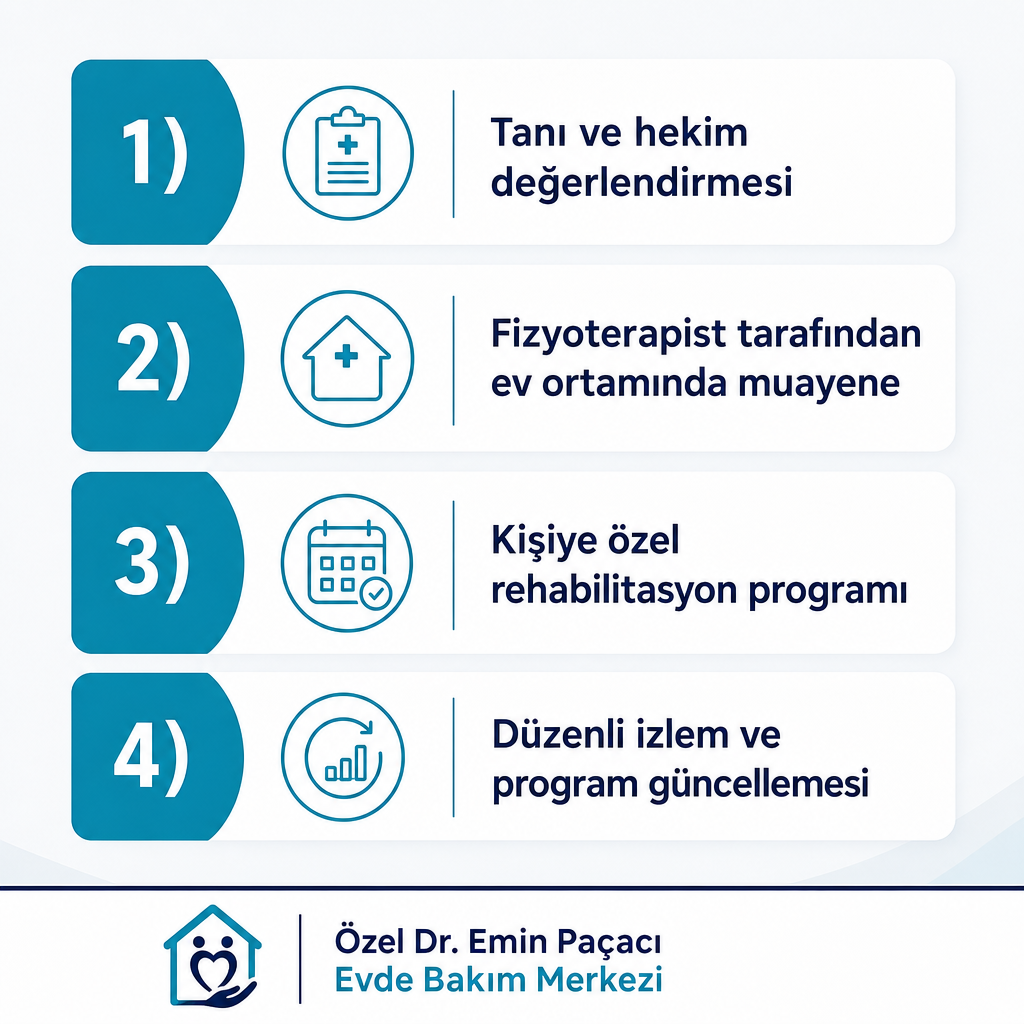 The four fundamental components of home physiotherapy
In which situations does home physiotherapy come into consideration?
Home physiotherapy is a type of service that can be considered in many different medical situations. The decision is always made taking into account the patient's clinical condition, accompanying diseases and the physician's opinion; since symptoms vary from person to person, the examples here provide a general framework.
Among the situations in which home physiotherapy is frequently sought are the following:
- Patients experiencing weakness in one half of the body or loss of balance following a stroke
- Movement and balance disorders due to neurological diseases such as Parkinson's disease and MS
- The need for early-stage mobilization and rehabilitation after operations such as hip–knee replacement, hip fracture, or anterior cruciate ligament surgery
- Elderly patients who have been bedbound for a long time and whose muscles have weakened
- Orthopedic patients experiencing pain, stiffness and reduced range of motion after trauma or surgery
- Individuals who have difficulty with daily living activities due to chronic illnesses or age-related loss of strength
The common point of these conditions is that the person's regular access to the clinic becomes difficult, or the importance of maintaining rehabilitation without interruption. Nevertheless, a physician's evaluation is recommended for the decision on which situations are more suitable for home physiotherapy and which for center-based physiotherapy. Readers curious about the daily care side of neurological diseases can also benefit from the practical information under the heading communication methods with dementia and Alzheimer's patients.
How is the treatment planned and who carries it out?
Home physiotherapy is a health service planned after a medical evaluation. The process roughly proceeds in four stages, and each stage forms the input for the next.
The first stage is diagnosis and medical evaluation: the patient's diagnosis, accompanying diseases and general condition are evaluated by the physician; suitability for physiotherapy and goals are determined. In the second stage, the physiotherapist examines the patient in the home environment; muscle strength, joint range of motion, balance, gait and daily living skills are examined. In the third stage, an individual rehabilitation program is created based on the evaluation results, including exercises, balance and walking practices, and, when necessary, the use of assistive devices. The fourth stage is regular monitoring: over time, the patient's condition is re-evaluated and the program is updated when necessary.
The regulations concerning the provision of home health services in Turkey state that medical care and rehabilitation services can be provided in the home environment in line with the physician's recommendation. For this reason, home physiotherapy is a service that must be carried out by authorized health institutions and licensed health professionals. For a broader view of how the process works, one can look at the article on how the home doctor service works.
The content of physiotherapy practices in the home environment
The content of a home physiotherapy program varies according to the person's diagnosis and functional level; the same protocol is not applied to every patient. The program is shaped according to whether the selected techniques can be applied safely in home conditions.
The main components that can be carried out in the home environment are as follows:
- Exercise and strengthening practices: Exercises applied under the guidance of a physiotherapist aimed at supporting muscle strength, joint range of motion and endurance.
- Balance and gait training: Practices aimed at reducing the risk of falling, regulating the walking pattern and supporting safe mobilization.
- Functional training: Practical applications that support adaptation to daily living activities such as turning in bed, sitting up and standing, going up and down stairs, and moving around the home.
- Manual therapy and mobilization techniques: Hand-applied techniques for joints and soft tissues when necessary.
- Respiratory and posture exercises: Programs including breathing and posture practices for patients who are on prolonged bed rest, have neurological diseases, or have limited chest cage mobility.
- Physical agents: If the physician and physiotherapist deem it appropriate, physical therapy agents such as electrical current and hot or cold applications can be used in the home environment.
Which method will be chosen is determined by the professional team, taking into account the patient's diagnosis, safety condition and available equipment. These components are structured not individually, but as a whole according to the person's goals.
What to consider when deciding on home physiotherapy?
Home physiotherapy is not a practice recommended automatically for every patient; medical, functional and environmental conditions are evaluated together. The topics that come to the fore in the decision-making process complement one another.
The medical condition comes first: factors such as the patient's diagnosis, accompanying diseases, medication use, cardiovascular and respiratory status are taken into account. Then the level of movement and function is evaluated; the person's capacity to walk, sit up and stand, make transfers and maintain daily activities is decisive. The safety of the home environment is also a critical topic: the floor structure, stairs, bathroom and toilet conditions, and whether or not there is a caregiver at home affect the applicability of the program. Finally, the sustainability of the practice is evaluated, that is, the frequency of sessions, follow-up and the long-term requirement.
Wrong exercise selection, overloading or unsuitable environmental conditions can lead to an increase in muscle and joint complaints, an increased risk of falling, or a decrease in the effectiveness of the treatment. For this reason, home physiotherapy should be planned with professional guidance. Since needs vary from person to person, a physician's and physiotherapist's evaluation is recommended for the physiotherapy plan.
Key differences between physiotherapy at a center and home physiotherapy
Both approaches involve rehabilitation practices carried out with a medical evaluation and under the guidance of a physiotherapist; the fundamental difference is where the treatment is carried out. Physiotherapy at a center means the patient going to a physical therapy unit or rehabilitation center and receiving treatment with the equipment there. Home physiotherapy, on the other hand, involves the physiotherapist carrying out the session with suitable equipment in the home environment where the patient is located.
| Topic |
Physiotherapy at a center |
Home physiotherapy |
| Place of application |
Physical therapy unit or rehabilitation center |
The home environment where the patient lives |
| Suitable profile |
Situations requiring intensive equipment or close monitoring |
People who have difficulty reaching the clinic, are bedbound, or have chronic illnesses |
| Equipment access |
Fixed hardware available at the center |
Portable suitable equipment |
| Decision-making authority |
Physician's evaluation |
Physician's evaluation |
Home physiotherapy can be considered a practical option for people who have difficulty going to the clinic, are bedbound, or cannot leave home due to chronic illnesses. On the other hand, in situations that require intensive equipment, demand close monitoring, or make it necessary for certain conditions to be met at a health institution, treatment at a center may be preferred. Since this distinction must be made on a person-by-person basis, the decision should be made by the physician.
Home physiotherapy in Turkey and the regulatory framework
The provision of home health services in Turkey is regulated by legislation published by the Ministry of Health and its affiliated institutions. The relevant regulation defines that home examination, tests, analyses, treatment, medical care and rehabilitation services can be provided in the environment where the patient is located, in line with the physician's recommendation. The regulations concerning home care services, on the other hand, envisage that services such as home nursing, physiotherapy and psychosocial support be carried out with a multidisciplinary team approach.
Within this framework, the home physiotherapy service is expected to be provided by authorized health institutions (public or private), units holding a Ministry of Health license, and licensed physicians and physiotherapists, in accordance with the relevant legislation. The services provided by public home health units and those provided by private institutions may differ in terms of scope, accessibility, reimbursement conditions and operation. For the decision on which option is suitable, including public resources in particular, a physician's evaluation and communication with the relevant institutions are important. Those who want to understand the application process can benefit from the guide on how to apply for home care services step by step.
The place of home physiotherapy in holistic care at our center
As the Private Dr. Emin Paçacı Home Care Center, we are a Ministry of Health–licensed home health institution operating in Üsküdar, Istanbul. With our team consisting of physicians, nurses and physiotherapists, we organize services such as home physician visits, private nursing, home physiotherapy, palliative care, wound care and IV access/serum applications with a holistic approach.
We treat home physiotherapy not as a single service, but as a rehabilitation field that can be planned together with home private medicine and home private nursing practices. Since each person's current diagnosis and daily living needs are different, we determine the program content through the evaluation of a physician and physiotherapist and update it over time when necessary. When you need it, all you have to do is provide us with information so that we can share how an evaluation can be made according to your diagnosis, goals and home conditions.
Frequently asked questions
How many sessions does home physiotherapy take?
The session duration and the total number of sessions vary according to the patient's diagnosis, functional level and treatment goals. There is no standard duration; the plan is made individually and can be updated according to the monitoring results.
Does home physiotherapy completely replace treatment at a center?
Home physiotherapy can, in many cases, be an alternative or complementary to practices at a center; however, for some diagnoses, the need for treatment carried out at a health institution may continue. The physician should decide which approach is suitable.
Who should carry out home physiotherapy?
Home physiotherapy should be carried out by licensed physiotherapists, with a physician's evaluation and in accordance with the legislation. The treatment plan is based on a medical evaluation.
Is pain normal during home physiotherapy?
Muscle fatigue or a slight feeling of discomfort may occur during some exercises. When significant pain, an increase in complaints, or new complaints develop, the physiotherapist and physician should be informed; the limits and intensity of the exercises are determined by the professional team.
Is access to home physiotherapy possible through public institutions?
In Turkey, public home health units can provide home examination, care and rehabilitation services to patients who meet certain criteria. The application routes and scope of these services can be learned through the information channels of the relevant public institutions.