The answer to how to request a nurse at home is a process with specific steps that is shaped according to the patient's clinical condition and the chosen channel. In Turkey, this request can be carried out through two different routes: the Ministry of Health's public home health services and licensed private home care institutions. The basic logic is the same in both routes; the medical need is assessed by a physician, nursing care is planned according to this assessment, and it is regularly maintained in the home environment. In this guide, we concretely address the application steps of both channels, the information that needs to be prepared, where the process breaks down, and which procedures must be carried out by the family and which by licensed healthcare workers.
Table of Contents
Home nursing service covers professional healthcare practices carried out by licensed nurses in the patient's own living space. These practices may include medication and IV monitoring, wound and pressure ulcer care, monitoring of vital signs (blood pressure, pulse, fever, etc.), catheter and probe care, nutritional monitoring, and informing the patient's relatives. According to Ministry of Health regulations, home health and care services are a multidisciplinary service planned under physician supervision; nursing practices are also part of this plan. This distinction is important, because the scope of nursing care is not an independent request but becomes clear depending on the medical goals set by the physician. Our article what is home nursing service, which details the fundamental differences between service types, offers a separate starting point for those who want to grasp the basics of the subject.
The Two Main Channels for Requesting a Home Nurse
In Turkey, requesting a home nurse is generally considered under two main headings. The first is the public home health and nursing services carried out by the Ministry of Health and affiliated institutions. The second is the home nursing service provided through licensed private home care or home health institutions. Both channels are subject to the same regulatory framework, and in both, the scope of the service is determined according to the patient's clinical condition and the physician's assessment.
Which channel is appropriate varies according to the patient's medical condition, how quickly the process needs to be organized, and the type of care requested. For a patient's relative, the right starting point is first to distinguish whether the patient's need is medical or focused on social support. When this distinction is clarified, it becomes easier to head to the right application point.
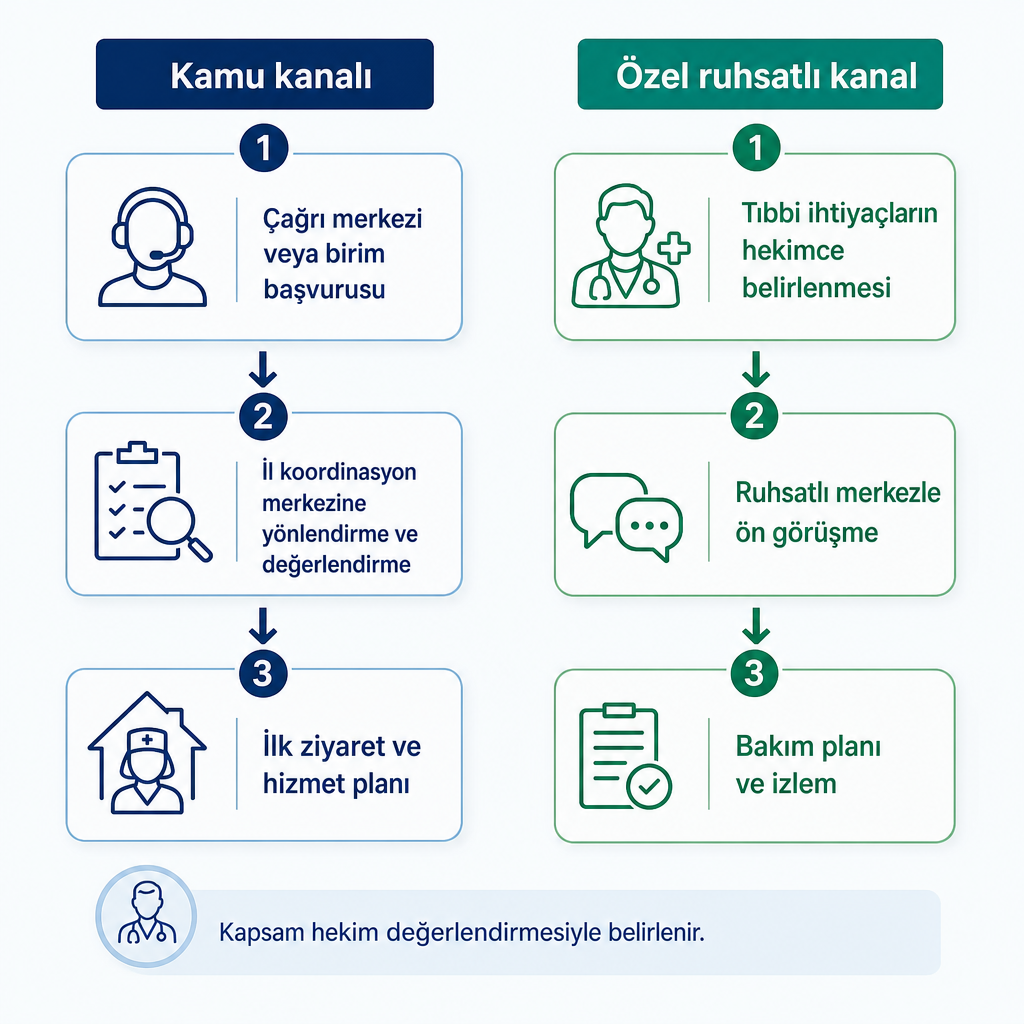 The Two Channels for Requesting a Home Nurse
Requesting a Home Nurse Through the Public System
Home health services provided by the Ministry of Health and its affiliated institutions are organized for bedridden patients, those with advanced chronic diseases, those in need of palliative care, and individuals who have difficulty accessing the hospital. According to the relevant regulations, this service may include physician examination, nursing care, continuation of medical treatment at home, palliative care, and guidance services. The scope is determined according to the assessment of the coordination unit in the province and the physician.
Application Channels and Step-by-Step Process
Application for public home health service is made through the designated contact number and relevant units defined across Turkey. The process generally proceeds with the following steps:
- Initial application via the call center. Applications are received through the Home Health Services Coordination line at 444 38 33, established for home health services across Turkey. The patient, patient's relative, or guardian calls this line and shares identity, address, and illness information.
- Referral to the provincial coordination center. The national call center forwards the application to the home health coordination center of the relevant province according to the reported residence information. In some cases, community health centers (TSM), family physicians, or hospitals' home health units may also serve as application points.
- Application form and assessment. The Home Health Service Application Form (Annex-3) included in the regulation is filled out to provide detailed information about the patient's clinical condition and home conditions. The provincial coordination center assesses the patient's eligibility together with the physician and healthcare team.
- Initial visit and service plan. For applications deemed eligible, a team composed of physicians and nurses assesses the patient at home; it creates a service plan based on medical history, current diagnoses, treatments used, and care needs. In line with this plan, the frequency and scope of home nursing service are determined.
The decisive point in the functioning of the public channel is that the application alone is not sufficient; clinical eligibility is confirmed by the team's assessment.
The Point That Should Not Be Confused with Home Care Assistance
One of the most common conceptual confusions in applications is that medical nursing service and home care assistance in the nature of social aid are assumed to be the same. The Home Care Assistance program carried out by the Ministry of Family and Social Services is a social support provided to families for disabled individuals in need of care, and it is separate from the application for medical nursing service.
In home care assistance applications, the Turkish ID number, health board report, household income declaration, and some additional documents are requested. The application can be made through the provincial directorate or social service centers and via the "Preliminary Application for Home Care Requests of Disabled Individuals in Need of Care" service on e-Government. This process is a social-aid-focused application that differs from the organization of medical nursing service. Confusing the two applications may lead to heading to the wrong institution and loss of time.
Preparation and Steps in Requesting Private Home Nursing
Licensed private home care centers can provide home nursing service with teams composed of physicians, nurses, and other healthcare professionals. These institutions are subject to Ministry of Health regulations and are obliged to operate in accordance with license and regulatory requirements. In the private home nursing service we carry out, the care plan is also created according to the patient's clinical requirements in collaboration with the physician and nurse.
Prerequisites: Preparation Checklist
Having the following information ready before the request contributes to the process proceeding smoothly:
- The patient's identity and contact information
- Discharge summary, diagnosis, and treatment summaries obtained from the hospital or physician
- List of current medications, medical devices, and applied treatments
- Basic information about the home environment (room layout, elevator situation, hygiene conditions, etc.)
- If the patient has a legal representative or guardian, the relevant decision and contact information
This information helps to properly plan the scope of nursing care and safety measures. For details of the documents that may be requested during the application, our article list of documents required for home care is a practical preparation resource.
Typical Steps in a Private Request
- Determining medical needs. The patient's clinical condition, physician examination, and discharge reports, if any, are examined to assess whether home nursing care is needed. The medical decision and care goals are determined by the physician.
- Preliminary meeting with a licensed center. In the first meeting, the patient's medical history, expected nursing duties, and home conditions are shared. This meeting contributes to the formation of the initial draft of the service plan.
- Creating the care plan. The physician and nurse prepare a plan that includes medication and IV monitoring, wound and catheter care, vital sign monitoring, nutritional monitoring, and educational activities. The plan is shaped according to the patient's clinical requirements in terms of visit frequency and duration.
- Information and consent. The patient and their relatives are informed about the content of the planned service, the sharing of responsibilities, communication channels, and possible risks; when necessary, the informed consent form and related documents are signed.
- Starting the service and follow-up. The nurse assesses the clinical condition at each visit, performs the planned procedures, and contacts the physician when necessary. The physician may update the nursing plan according to the course of treatment.
Since the physician determines the medical framework of the care plan, one stage of the process is also intertwined with private home physician services assessment.
Common Mistakes That Disrupt the Process
Some mistakes during a home nurse request may cause delays in the process. Knowing these in advance makes it easier to apply through the right channel in one go.
- Confusing home health service with home care assistance. For medical nursing, one must apply to the Ministry of Health home health system or healthcare institutions; for social aid, one must apply to the Family and Social Services units.
- Sharing incomplete or incorrect medical information. When diagnoses, medications used, and previous treatments are not fully conveyed, both public and private teams may have difficulty creating the correct care plan.
- Requesting nursing without a physician's assessment. The scope of the service and the boundaries of medical authority are matters that must be determined by a physician; requests made without an assessment make it difficult to clarify the service boundaries.
- Ignoring the safety and hygiene conditions of the home environment. According to regulations, the environment where the service will be provided must comply with basic hygiene and safety conditions; unsuitable environments may pose risks for both the patient and the healthcare worker.
In such situations, re-sharing the information with the relevant institutions and renewing the physician's assessment generally help to remedy the process.
The Boundary Between Family Care and Professional Nursing
During the home care process, some daily living activities (such as nutritional support, basic personal care, and environmental arrangement) can be carried out by family members. However, procedures requiring medical knowledge, asepsis, and professional competence—such as vascular access management, IV administration, injections, and wound and catheter care—fall within the professional boundaries of nursing and medicine.
The legislation stipulates that healthcare services be carried out by licensed healthcare professionals, under physician supervision, and in accordance with established procedures. Therefore, for practices involving medical intervention, obtaining a physician's assessment and professional nursing support is considered appropriate. When the division of labor between the family and the professional team is clearly established, both daily care and medical practices proceed on their own proper foundation.
The first step in determining the right channel is to distinguish whether the patient's need is medical or focused on social support; then to turn to a physician for clinical assessment. Since a person's clinical condition and care requirements may differ, it is considered appropriate for the scope and final decision to be made by a physician. You can review the general framework of which services can be provided at home on our services page.
Frequently Asked Questions (FAQ)
Are home nursing service and home care assistance the same thing?
No. While home nursing service refers to medical nursing care provided under physician supervision, home care assistance is a social support provided by the Ministry of Family and Social Services for disabled individuals in need of care.
How does one apply for public home health services?
The patient, the patient's relative, or the family physician can apply by calling the call center at 444 38 33 designated across Turkey; or through the relevant home health units, community health centers, and family physicians.
Is a health board report definitely required to request a home nurse?
In public home health services, assessment of the clinical condition by a physician is essential, and medical documents are requested in many cases. In home care assistance applications in the nature of social support, however, a disability health board report is among the mandatory documents.
Who determines the scope of the home nursing service?
The scope of the service is determined by the physician who assesses the patient's clinical condition; the nursing team performs its practices in accordance with this plan. In private home care institutions as well, the care plan is created through physician-nurse collaboration.
In which situations should one go to the hospital instead of a home nurse?
The scope of home health services is determined by regulation; situations requiring emergency intervention and advanced intensive care are assessed under hospital conditions. In the presence of signs such as sudden loss of consciousness, severe respiratory distress, or uncontrolled bleeding, applying to emergency health services is directed by physician assessment.