The short answer to the question of what the scope of home nursing care is as follows: home nursing covers the monitoring, care, medical procedures, education, and coordination services carried out in the patient's living environment, in line with the physician's evaluation and the care or treatment plan they establish. Its content varies according to the person's diagnosis, general health status, mobility level, the medical devices they use, and their care needs. For this reason, instead of a single standard list, we speak of a service framework shaped according to the individual.
Home nursing differs from caregiver support that assists with daily life; it includes medical procedures requiring nursing knowledge and competence. The scope is not limited to nursing alone either. When deemed necessary, a physician, physiotherapist, dietitian, or other health professionals may be included in the process. In this guide, we address the practice areas that make up the scope, the limits of the service, and the planning criteria in an informative manner.
Contents
What home nursing care is and how it is defined
Home nursing is the nursing service provided to people who have difficulty reaching a healthcare facility or for whom it is deemed appropriate that part of their medical care be continued in the home environment. In the Ministry of Health's regulation regarding home health services, medical services that can be performed in the living areas of individuals who are bedridden, device-dependent, or homebound are considered within this scope. In addition to a physician and nurse, the team may also include a physiotherapist, psychologist, social worker, dietitian, and other health professionals depending on the patient's needs.
The key point here is the order that determines the scope. The question that comes before "Which procedure can be performed?" is this: does the person genuinely need nursing care in the home environment, and can this care be planned safely? The fact that a procedure is technically feasible at home does not mean it is appropriate for every patient. You may also benefit from the content titled the scope and legal framework of home nursing service, which addresses this distinction in more detail.
The main nursing practices that make up the scope
The content of home nursing care covers various distinct practice areas. Each heading comes into play depending on the patient's clinical condition and the physician's plan; not all of them need to be present in the same patient at once.
Monitoring of health status and vital signs. During nursing visits, the person's general condition is observed; vital signs such as blood pressure, pulse, temperature, respiratory rate, oxygen saturation, and changes in consciousness and general appearance can be tracked. The frequency of measurements is determined according to the clinical condition. A single measurement often does not provide sufficient information on its own; the course of changes over time is considered together with the patient's complaints and the physician's evaluation.
Medication administration in line with the physician's orders. Medications planned by the physician can be administered according to the appropriate route and timing. The nurse's responsibility is to carry out the administration to the right person, with the right medication, the right dose, and via the right route, to evaluate the patient beforehand, to observe afterward, to report any unexpected symptoms to the responsible physician, and to record the administrations. Medication selection, dose changes, or rearranging the plan are matters for the authorized physician, not for the nursing service.
Injection administration. In cases where a physician's order and a suitability assessment exist, medications administered intramuscularly, subcutaneously, or intravenously, as well as monitoring and education regarding insulin administration, may come into play. The route of administration is determined according to the medication's properties, the patient's condition, and the physician's plan; beforehand, elements such as allergy history, medications in use, bleeding risk, and the administration site are evaluated.
Serum and intravenous line procedures. At the physician's decision, it may be necessary to establish an intravenous line, monitor the line, or carry out planned intravenous administrations. Redness, swelling, or tenderness at the administration site, as well as the patient's general condition, are monitored. The fact that intravenous administration can be performed in the home environment does not automatically mean it is appropriate for every patient and every medication; the physician makes the decision by evaluating the clinical condition and the necessary monitoring possibilities.
Wound care and dressing. Assessing the appearance of the wound, renewing the dressing with the planned method, observing the condition of the skin around the wound, and reporting to the physician any findings suggestive of infection or changes in the healing process fall within this area. The type, depth, and location of the wound and the presence of additional conditions such as diabetes affect the care plan. For basic hygiene and monitoring information, you can look at the content titled home wound care and reducing the risk of infection.
Catheter, tube, and medical device care. In patients who live with devices such as a urinary catheter, PEG, or tracheostomy, monitoring the general condition of the device, observing situations such as blockage, leakage, or dislodgement, and informing the family about the care process may be involved. The method to be used and the care interval are determined according to the type of device; changing the procedures related to the device on one's own is not appropriate.
Monitoring of pressure ulcer risk and skin integrity. In people with limited mobility, redness or color change, moisture and irritation of the skin, areas under pressure, and the need for repositioning are evaluated. Risk assessment is not limited to skin observation alone; the patient's mobility capacity, state of consciousness, nutrition, and daily care conditions are also taken into account.
Blood draw and laboratory coordination. Blood draws can be planned at home for tests requested by the physician. The nurse informs the patient, ensures appropriate sample collection conditions, labels and protects the sample correctly, and contributes to the coordination of the laboratory process. Which tests will be requested and the interpretation of results fall within the scope of the physician's evaluation.
Diabetes and blood sugar monitoring. Monitoring blood sugar measurements, evaluating insulin administration according to the physician's plan, and care education fall within this area. Findings that may suggest low blood sugar, such as sweating, trembling, and altered consciousness; and findings that may suggest high blood sugar, such as excessive thirst, frequent urination, or marked fatigue, are evaluated. Insulin dose or treatment plan is not changed by the person's own decision; these adjustments are made by the physician.
Post-discharge nursing follow-up. In people who have been discharged, wound and dressing follow-up, intravenous line, tube, or catheter care, monitoring of planned medication administrations, and informing the patient's relatives come into play. The scope is determined according to the patient's diagnosis and the recommendations of the healthcare facility. For information on preparing the home environment, you can benefit from the guide titled arranging the home health environment after discharge.
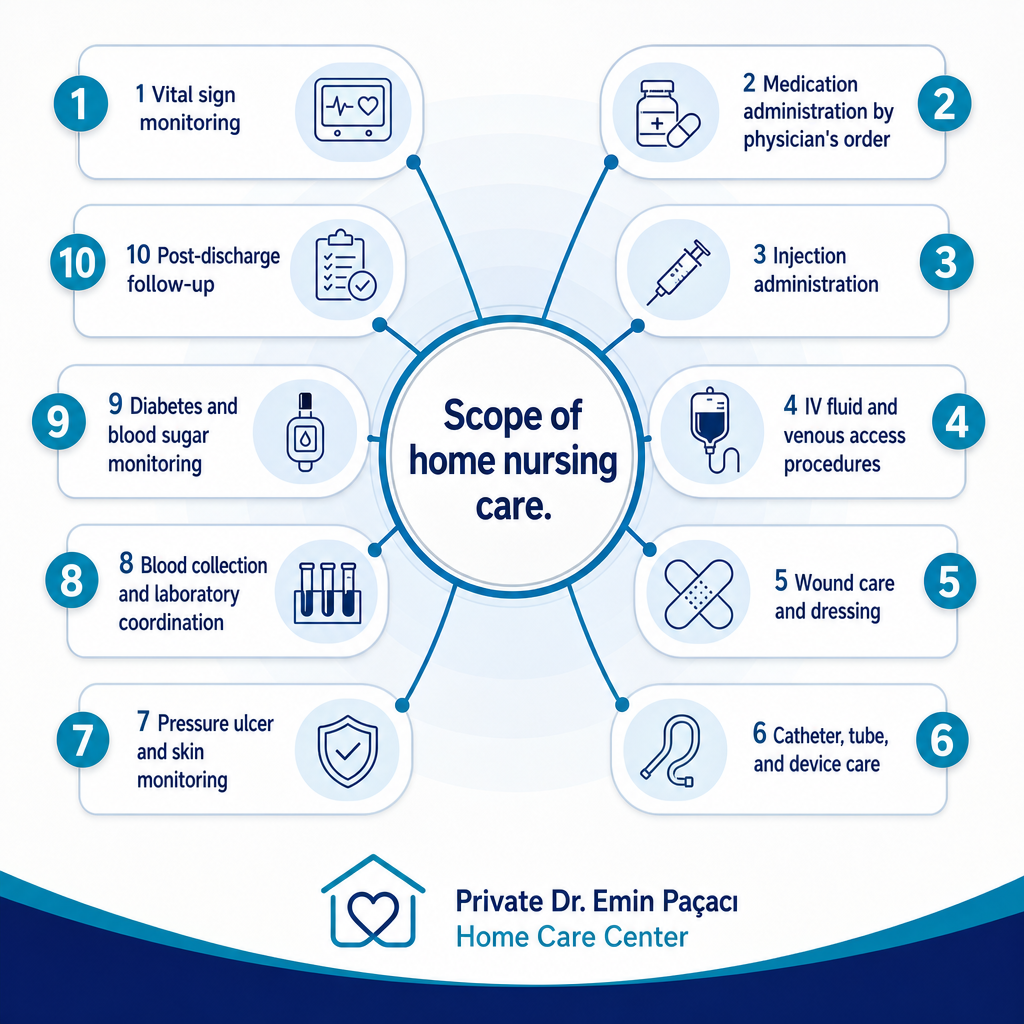 Main areas of practice within home nursing care
Visit frequency and planning formats
Home nursing does not consist solely of short visits made for a single procedure. Different planning formats may come into play depending on the patient's needs. The table below presents the general scope of these formats together.
| Service format |
General scope |
| Short-term visit |
Injection, dressing, vital sign monitoring, or a specific nursing procedure |
| Regular visit |
Chronic illness, wound, catheter, or post-discharge monitoring |
| Daytime or nighttime support |
Need for care and observation during certain hours |
| Long-term companionship |
Situations requiring nursing supervision for a significant portion of daily care |
| 24-hour planning |
Situations where the need for continuous observation and nursing support is deemed appropriate by the physician's evaluation |
The duration and frequency of visits are determined by taking into account the patient's medical needs, the care plan, the home environment, and family support. "24-hour service" does not mean uninterrupted medical intervention in every case; it refers to nursing care and observation throughout the planned period. As the patient's condition changes, the plan may also be reconsidered.
Who home nursing care may be considered for
Home nursing care can be considered for various groups of people:
- Those who need nursing follow-up after surgery or a medical procedure
- People who are bedridden or homebound
- Those who need regular follow-up due to chronic illness
- Those who need daily care support along with advanced age
- Those who have wound, pressure ulcer, or dressing needs
- Those living with a catheter, PEG, or tracheostomy
- Those who need an injection or physician-planned intravenous administration
- People whose transportation to the hospital is difficult due to limited mobility
- Patients who need nursing follow-up during the palliative care process
Being in one of these groups does not necessarily mean the service is appropriate. The decision is made based on the person's clinical condition, whether the care can be carried out safely at home, and the physician's evaluation. Symptoms vary from person to person; it is recommended to consult a physician for evaluation. The content titled the home follow-up process in chronic illness, which addresses how follow-up is structured in chronic illnesses, can help you understand this decision.
The limits of the service and the division of labor with the physician
Home nursing does not replace physician services. Knowing its limits as well as its scope is important for the correct planning of the service. The nurse does not make a diagnosis, does not create a treatment plan in place of the physician, does not start or stop medication on their own decision, does not change the medication dose, and does not perform interventions that are not appropriate to carry out at home. According to the home health service regulation, the nurse and other team personnel carry out their duties within the framework of their own professional legislation, their training, and the work plan determined by the responsible physician.
Emergencies are outside this framework. In cases of symptoms requiring urgent evaluation, such as severe shortness of breath, loss of consciousness, newly developing signs of stroke, chest pressure, or serious bleeding, a home nursing visit should not be awaited; the 112 Emergency Call Center should be called. Home nursing is a planned care and medical monitoring service; it does not replace emergency health services.
Which criteria are evaluated during planning
When determining the scope of the service, many interrelated headings are considered together:
- The patient's diagnosis and current health status
- The treatment and care plan determined by the physician
- The level of dependency in mobility and daily living activities
- The need for a wound, catheter, intravenous line, or medical device
- Medications used and their routes of administration
- How often vital signs will be monitored
- The physical conditions of the home environment
- The role of the patient's relative in the care process
- The contribution of other health professionals when necessary
- Access to a healthcare facility and transfer possibilities in an emergency
In interventional medical services that can be provided at home within the scope of the legislation, the patient or their legal representative must be informed, consent must be obtained in appropriate cases, and records must be kept. These criteria aim to make the care both safe and sustainable.
The distinction between home nursing, home care, and home health
These three concepts can be confused with one another in everyday use; however, they define different areas. Home nursing is the medical care, monitoring, administration, and education service carried out by a nurse. Home health is a broader framework that can include physician evaluation, nursing, rehabilitation, wound care, and similar medical services. Home care, on the other hand, can refer to the support a person needs in their daily living activities, personal care, and life routine.
Knowing this distinction helps you correctly name the service that suits your needs and clarify your expectations. For the detailed differences between the concepts, you can look at the content titled the difference between home health service and home care and the content titled the scope of home health service, which describes the broader framework. Which type of service the need corresponds to often becomes clear not through a single heading, but through the evaluation of these three areas together.
Frequently Asked Questions
Is home nursing care only injections and dressings?
No. In addition to injections and dressings, vital sign monitoring, wound assessment, catheter care, blood draws, post-discharge follow-up, care education, and other nursing practices tied to the physician's plan may also be within the scope.
Is a physician's evaluation necessary in home nursing care?
A physician's evaluation is an important element in determining medical procedures and the care plan. The nurse works within the responsible physician's plan and the limits of their own professional authority.
Can the nurse change the medication dose at home?
No. Changes in medication dose or the treatment plan are evaluated by the physician. The nurse carries out the planned administration and reports changes in the patient's condition to the healthcare team.
Can home nursing care be used in emergencies?
Home nursing is a planned care and medical monitoring service. In the case of symptoms suggesting a life-threatening situation, the 112 Emergency Call Center should be called and emergency health services should be used.
Is care education provided to family members?
In appropriate cases, the patient and their relatives can be given information about the care process, the use of medical devices, changes requiring observation, and situations that require communication with the healthcare team. In the relevant regulation, providing education and counseling to the patient and family is also among the components of the service.