The question of what home IV antibiotic treatment is refers to continuing antibiotic treatment that must be administered intravenously at a person's home instead of hospitalization, in cases deemed appropriate by the physician. The expression "IV" here means the medication is given into the vein. This option coming into consideration is not solely dependent on the need for antibiotics; the patient's clinical condition, the characteristics of the infection, the need for vascular access, the suitability of the home environment, and the monitoring possibilities are all evaluated together. The key point that distinguishes this practice from other forms of treatment is this: the choice of antibiotic, the route of administration, the duration, and the follow-up plan are determined by the physician; the application and vascular access care, meanwhile, are carried out by competent health personnel according to the plan. In this respect, home IV antibiotic treatment should not be thought of as self-administration of medication at home.
Contents
What home IV antibiotic treatment means
IV antibiotic treatment is the administration of an antibiotic intravenously rather than taken orally. When carried out at home, this practice is continued in the home environment for individuals who are assessed as not requiring hospitalization. In the medical literature, this approach is called outpatient parenteral antimicrobial therapy, abbreviated as OPAT.
Carrying out treatment at home does not mean that the patient will not be evaluated at any healthcare institution. Physician check-ups, laboratory examinations, vascular access checks, and changes to the treatment plan when necessary are integral parts of the process. In other words, the home is the place where treatment is administered; medical responsibility and monitoring do not disappear.
In Türkiye, home healthcare services cover evaluation, treatment, medical care, rehabilitation, and monitoring services provided in their own environment to people who are bedridden, device-dependent, or housebound due to diagnosed illnesses, or who have difficulty accessing healthcare services due to old age. The relevant regulation stipulates that the service be carried out through physician assessment, informing, consent, record-keeping, and coordination processes.
Why antibiotics are given intravenously
Administering an antibiotic intravenously rather than orally is not an arbitrary preference but a decision based on the type of infection and the patient's clinical condition. When making this decision, the physician evaluates together many elements that may appear independent of one another:
- The region where the infection is located and the probable microorganism,
- The severity of the infection and the response to current treatment,
- The patient's ability to take oral medication,
- The presence of absorption problems with orally administered medication,
- Whether administering the antibiotic intravenously is medically necessary,
- Kidney and liver functions,
- Accompanying illnesses and other medications used,
- Allergy history,
- Whether the patient can be safely monitored at home.
In some cases, treatment started intravenously may be reassessed by the physician once clinical improvement is achieved and a suitable oral treatment option becomes available. This transition is not a decision the patient can make alone; just as with the choice of medication, changing the route of administration requires a medical assessment.
Who can be considered for home IV antibiotic treatment
The home treatment option depends not on a single condition but on several conditions being present at the same time. It is generally considered when the following elements are provided together:
- The patient's general condition being stable enough for home monitoring,
- The absence of an additional medical need requiring hospitalization,
- Intravenous antibiotic treatment being deemed necessary for the infection,
- The presence of suitable conditions in the home environment for administration and follow-up,
- Vascular access care being able to be safely maintained,
- The patient or caregiver being able to communicate with the healthcare team,
- The necessary check-ups and laboratory monitoring being able to be planned,
- The physician managing the treatment deeming home administration appropriate.
In the IDSA recommendations regarding outpatient parenteral antimicrobial therapy, it is stated that for home administration, the patient or caregiver should be able to communicate with the treatment team, be competent in administration, and have suitable storage conditions available. The same source also emphasizes that for some patients, treatment at a healthcare institution rather than at home may be safer.
Old age alone is not an obstacle to home IV antibiotic treatment. However, cognitive status, mobility limitation, manual dexterity, vision problems, and whether caregiver support is available are also evaluated. For this reason, instead of generalizations such as "elderly" or "young and healthy," an individualized assessment is taken as the basis.
How treatment is planned and who takes part
The planning of treatment begins with the physician's medical assessment. The patient's diagnosis, current examinations, previous treatments, known drug allergies, and medications used are reviewed; opinions are sought from relevant physicians when necessary. During planning, the necessity of antibiotic treatment, the route of administration and type of vascular access, the estimated duration of treatment, the frequency of administration, the necessary laboratory checks, vascular access monitoring, the communication channel to be used in case of possible side effects, and the course of action to be followed if a response to treatment is not obtained are determined.
In home healthcare services, the patient's medical assessment, care plan, visit plan, and the informing and consent processes are recorded. The regulation stipulates that an assessment form be prepared and a service plan be created for individuals included in the scope of home healthcare services. This record-keeping arrangement ensures that the process is traceable and auditable.
Home IV antibiotic treatment is not limited to a single application; different healthcare workers have separate responsibilities.
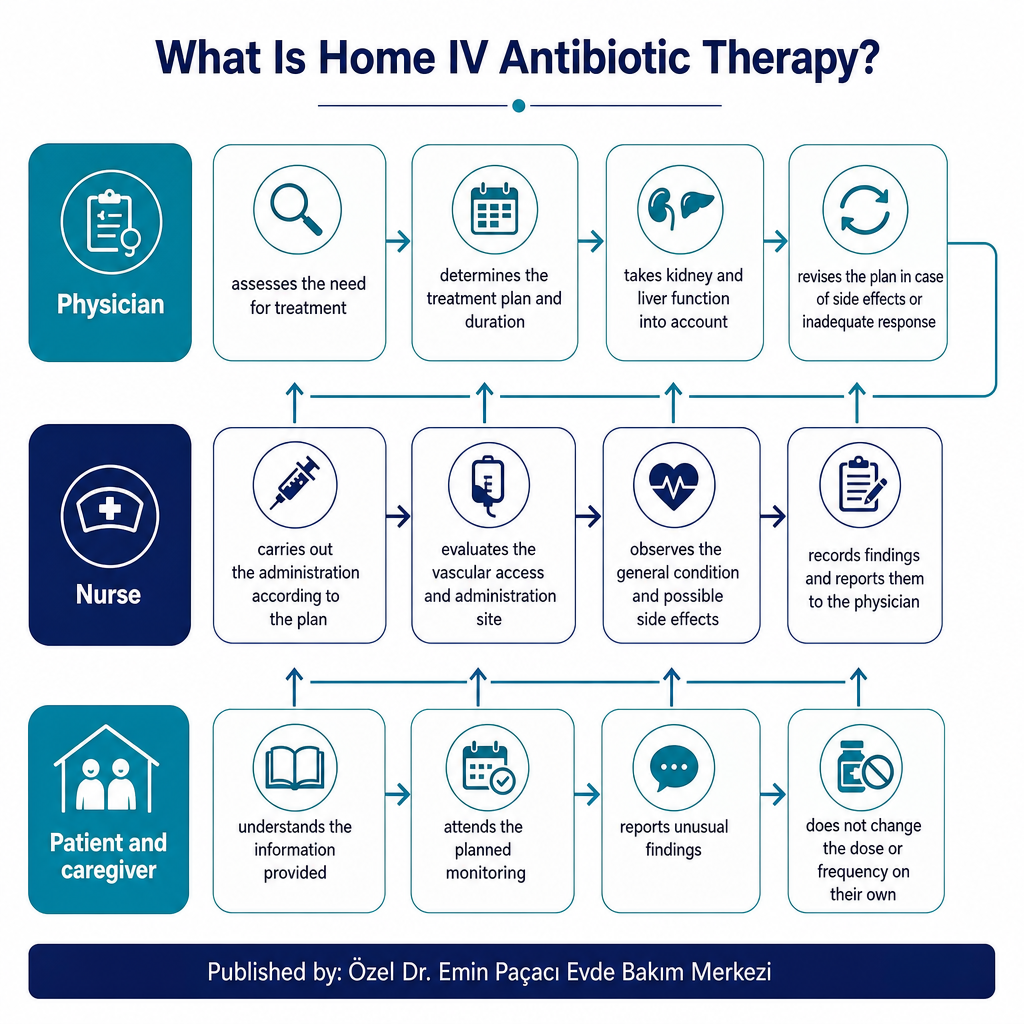 Roles and responsibilities in home IV antibiotic therapy
The physician assesses the necessity of antibiotic treatment, creates the appropriate plan, determines the duration of treatment and the monitoring need, takes into account patient characteristics such as kidney and liver functions, rearranges the plan in case of side effects or insufficient response, and if necessary ensures that the patient is evaluated at a healthcare institution. In the IDSA source, it is stated that the physician managing the treatment is responsible for the treatment indication, antibiotic selection, treatment duration, and subsequent medical assessments.
The nurse carries out the administration according to the physician's plan, assesses the vascular access and the application area, observes the patient's general condition and possible side effects, records the findings, and informs the physician when necessary. For information about the scope of nursing services carried out at home, the content titled What Is Private Home Nursing Service? can be reviewed.
The role of the patient or caregiver is to understand the information provided by the healthcare team, participate in the planned monitoring, and report unusual findings. Changes regarding the drug name, dose, or frequency of administration should not be made by the patient or caregiver.
Why vascular access is so important in the process
In IV antibiotic treatment, vascular access is the fundamental element that enables the administration of treatment. The type of vascular access and its duration in place are determined by the healthcare team according to the estimated duration of treatment, the characteristics of the medication, the vascular structure, and the patient's clinical condition. This choice affects both the safety and the continuity of the treatment.
The following problems may arise in relation to vascular access: redness, pain, swelling, or increased warmth at the application site; blockage of the vascular access; the dressing coming loose or getting wet; leakage of the medication outside the vein; infection around the vascular access; clotting problems related to the vascular access.
If these findings are observed, intervening on the vascular access, changing the application, or attempting to establish a new vascular access is not the correct approach; instead, the healthcare team should be contacted. IDSA states that regular monitoring of vascular access complications and antimicrobial side effects is one of the fundamental elements of home OPAT safety.
Possible risks and findings to report to the healthcare team
As with every medical treatment, there may be risks in intravenous antibiotic administration as well. These risks vary according to the antibiotic used, the duration of treatment, the patient's general condition, and the type of vascular access. Being aware of the risks makes it easier to recognize them as soon as they arise and report them to the healthcare team.
In terms of allergic reactions, a rash on the skin, itching, swelling of the face or lips, difficulty breathing, tightening of the throat, dizziness, or a sudden deterioration of general condition may be a sign of a serious reaction. In such findings, emergency healthcare services should be used. The IDSA source states that administering the first dose of a newly started antibiotic at home can only be considered in suitable patients and under the supervision of healthcare personnel trained in responding to anaphylaxis.
Among digestive system complaints, nausea, vomiting, and diarrhea may be associated with some antibiotics. Severe, prolonged, or bloody diarrhea should be evaluated by a physician if accompanied by fever or a marked deterioration of general condition.
Some antibiotics can cause undesirable effects on the kidneys, liver, or blood cells. For this reason, blood and urine tests may be planned according to the duration of treatment and the medication used. IDSA recommends serial laboratory monitoring during OPAT and states that the tests to be performed and their frequency vary according to the antimicrobial used.
Seeing together which findings should be reported to the healthcare team without delay during treatment makes decision-making easier:
| Situation |
Possible findings |
Approach |
| Possible allergic reaction |
Widespread rash, itching; swelling of the face, lips, tongue, or throat |
If there is shortness of breath or rapidly developing swelling, it is an emergency; if not, report to the team immediately |
| Sign of infection |
New or increasing fever, chills, marked weakness |
Contact the healthcare team |
| Vascular access problem |
Pain, swelling, redness, discharge at the application site, swelling along the arm |
Do not intervene; report to the team |
| Integrity of the vascular access |
The access dislodging, the dressing coming loose, suspicion of the medication leaking out |
Do not change the application; inform the team |
| Serious general condition |
Shortness of breath, altered consciousness, feeling faint |
Use emergency healthcare services |
Findings such as difficulty breathing, tightening of the throat, altered consciousness, or rapidly developing widespread swelling are considered emergencies and emergency healthcare services should be sought without wasting time.
Is it the same as IV fluid therapy
No. "Having an IV drip" is a general expression and can refer to administering fluids, medication, or another treatment intravenously. In IV antibiotic treatment, however, the aim is specific: the intravenous administration of the antibiotic determined by the physician. In other words, not every intravenous administration is an antibiotic treatment.
This distinction is important, because the need for antibiotics depends on the evaluation of the infection and the physician's decision. The use of antibiotics is not appropriate for viral infections that do not require antibiotics; unnecessary use neither benefits the patient nor is it a correct approach in general. For general information about treatments administered intravenously, the content titled Home IV Drip Service: Safe IV Treatment can be reviewed.
In which cases home administration may not be suitable
Whether home treatment is suitable is determined not merely by the patient's desire to be at home, but according to medical safety criteria. If one of the following situations exists, evaluation or admission at a hospital may be required instead of home administration:
- The patient's general condition not being stable,
- The need for respiratory or circulatory support,
- The need for close and continuous medical observation,
- Signs of severe or rapidly progressing infection,
- A serious allergy history,
- The absence of safe administration and monitoring conditions in the home environment,
- The patient or caregiver being unable to communicate adequately with the healthcare team,
- The necessary laboratory and physician monitoring not being able to be provided,
- Vascular access complications being at a level that cannot be managed at home.
For this reason, treatment at a healthcare institution may be more suitable for some patients. The contribution of the patient and their relatives to the decision-making process comes through open communication with the healthcare team: known drug and antibiotic allergies, previously experienced antibiotic side effects, all medications and herbal products used, kidney or liver diseases, use of blood thinners, previous problems related to vascular access, whether a caregiver is available to continue treatment at home, and access to check-up and laboratory monitoring should be shared. During administration, the name, dose, duration, or frequency of the antibiotic should not be changed without the knowledge of the healthcare team; unused medications, waste materials, and vascular access equipment should also be managed according to the methods determined by the healthcare institution.
Our related home healthcare areas
As Private Dr. Emin Paçacı Home Care Center, the service titles we publish include private home physician services, private home nursing, and home healthcare services related to home IV drips and IV administrations. We determine the scope of the relevant service in line with the patient's clinical condition and the physician's assessment. When it comes to intravenous administrations, we emphasize that the treatment decision and the monitoring plan belong to the physician, while the administration is carried out by competent healthcare personnel according to the plan.
For the scope of the physician's assessment, you can review our private home physician services page. If you would like to see in general which service comes into consideration in which situation, the Our Services page is a resource that can be consulted. Symptoms and treatment needs vary from person to person; consulting a physician is recommended to determine the appropriate treatment path.
Frequently asked questions
What is home IV antibiotic treatment?
It is the continuation of intravenous antibiotic administration deemed necessary by the physician in the home environment, in suitable patients instead of hospitalization, with the planning and monitoring of the healthcare team.
Can home IV antibiotic treatment be applied to everyone?
No. The patient's general condition, the characteristics of the infection, the need for vascular access, home conditions, caregiver support, and monitoring possibilities are evaluated together; for some patients, treatment at a healthcare institution may be more suitable.
Can antibiotics be self-administered at home?
Except for certain models specifically assessed by the healthcare team, where the necessary training and monitoring system exists, it is not appropriate for the patient to establish vascular access or administer antibiotics on their own. The administration plan is determined by the physician and the healthcare team.
Is a blood test required during treatment?
Laboratory monitoring may be required with some antibiotics and especially in prolonged treatments. Which tests will be performed and how often is determined according to the antibiotic used and the patient's condition.
What should be done if there is swelling around the vascular access?
The vascular access should not be intervened with, the administration should not be changed, and the healthcare team should be informed. If there is shortness of breath or rapidly developing deterioration of general condition, emergency healthcare services should be used.