The short answer to the question of what home blood collection service is: it is the collection of the blood sample required for laboratory tests requested by a physician, taken at the person's address by authorized healthcare personnel and delivered to the relevant laboratory under appropriate conditions. It may come into consideration in cases of old age, limited mobility, bed dependency, post-operative follow-up, or situations that make it difficult to reach a healthcare facility. The issue to be decided here is not planning the blood collection need on its own; it is handling the test request, sample conditions, and the person's condition together with the physician's evaluation.
In this article, we address the definition of home blood collection, the situations in which it is considered, the sample collection and transport mechanism, safety points, and how it differs from other services such as home doctor examination and home nursing within an informative framework.
Contents
In which situations is home blood collection considered
Home blood collection is not automatically a suitable option for every laboratory test or every person. The need is determined not solely by the person's request; it is determined by considering together the current complaints, diagnoses, treatments used, previous results, and the physician's clinical evaluation.
The practice may come into consideration with physician evaluation, particularly in the following situations:
- In elderly individuals who have difficulty going to a healthcare facility,
- In people who are bed-dependent or have limited mobility,
- In situations requiring post-operative follow-up,
- In the monitoring of chronic diseases,
- In patients who find it difficult to go outside due to physical, neurological, or cognitive reasons,
- In situations where the physician requests a specific laboratory examination as part of home medical or nursing follow-up.
Among the services published by our center are home blood tests upon a doctor's request. The test requirement, suitability for blood collection, and the necessary medical evaluation are determined by the physician. This approach positions home blood collection not as a standalone procedure, but as part of a monitoring plan.
How does the home blood collection process work
The operation of the process may vary depending on the requested tests and the person's health condition. Nevertheless, several complementary basic stages can be mentioned: clarification of the test request, evaluation of the person and the environment, collection of the sample, and delivery of the sample to the laboratory under appropriate conditions.
During the preliminary evaluation stage, which laboratory tests are necessary is determined; the test request is made by a physician. Tests requiring fasting, medication use, problems experienced during previous blood collection, and special sample conditions may be included in the evaluation at this stage. In some tests, blood may need to be collected into specific tubes, delivered to the laboratory within a certain time, or transported under appropriate temperature conditions. Therefore, not only the collection of blood but also the correct preparation and transport of the sample is an inseparable part of the process.
Before the procedure, the healthcare personnel checks the person's identity information and the test request. The person's general condition, whether dizziness or fainting occurred during previous blood collection, bleeding tendency, and the appropriate position for the procedure are evaluated. Being in a safe position is important; the healthcare personnel decides whether blood collection while seated or lying down should be preferred in people with a history of dizziness or fainting.
The blood collection procedure is performed by trained and authorized healthcare personnel using appropriate antisepsis and single-use materials. The amount of blood to be collected and the tubes to be used vary according to the requested tests; different tubes may be needed for multiple tests. Collecting the samples in the correct tube, in sufficient quantity, and preparing them in accordance with laboratory rules is decisive for the evaluability of the results.
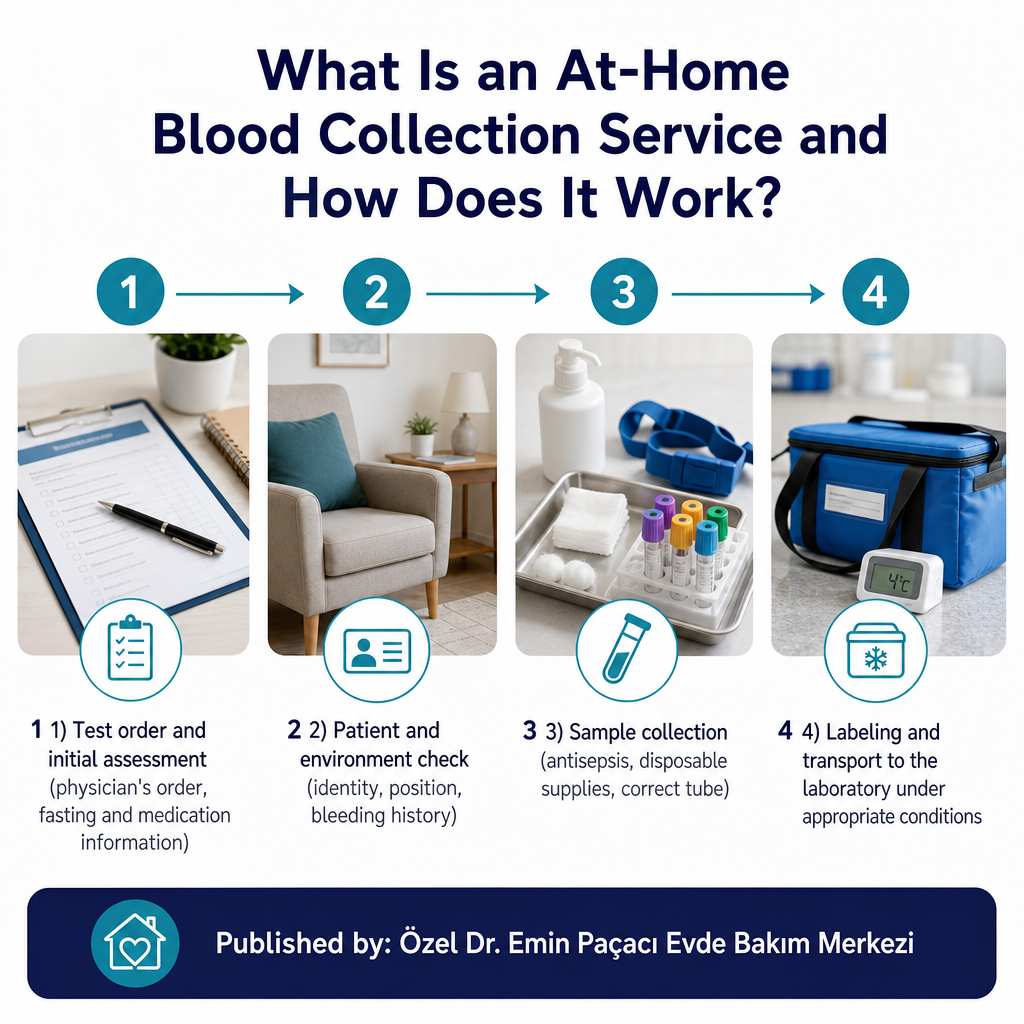 Key Steps in the At-Home Blood Collection Process
Why is labeling the sample and delivering it to the laboratory critical
Blood samples are labeled in accordance with the person's information and the requested tests. A labeling error is a seemingly simple but decisive step of the process, as it can cause even a correctly collected sample to be unevaluable.
Transport conditions also directly affect the reliability of the result. Closed and appropriate transport conditions that reduce the risk of the sample breaking, spilling, or being exposed to external factors during transport should be used. The World Health Organization recommends that laboratory samples be transported in leak-proof packaging, in containers that prevent breakage and spillage, and together with the necessary documents. After the sample reaches the laboratory, the analysis process is carried out according to the laboratory's practices.
Our article on the clinical importance of sterilization in injection and serum applications in the home environment, which addresses the relationship between sterilization and sample integrity in more detail, provides complementary information on how the hygiene chain is maintained under home conditions. For planning practices such as sample collection and follow-up in the post-discharge arrangement, our guide on arranging the home health environment after discharge may be useful.
Which points stand out in terms of safety
Although blood collection is a short medical procedure, like any procedure it may carry certain risks. The World Health Organization states that bruising may occur in the patient during blood collection; and for healthcare workers, there may be a risk of needlestick injury and exposure to bloodborne infections. For this reason, safety is addressed as a chain of practices that protects both the person and the performing personnel.
In a safe practice, the following points stand out:
- Ensuring hand hygiene before and after the procedure,
- Using appropriate gloves for each person or procedure,
- Performing skin antisepsis,
- Using sterile and single-use needles and blood collection tools,
- Disposing of used sharp-cutting materials in a puncture-resistant waste container,
- Correctly labeling the sample tubes,
- Transporting the samples under the conditions specified by the laboratory,
- Briefly observing the person after the procedure.
The World Health Organization counts hand hygiene, glove use, skin antisepsis, sterile and single-use blood collection tools, and the proper disposal of sharp-cutting waste among the basic safety practices. Applying these steps together forms the basis for the procedure to be carried out safely in the home environment.
What may occur during or after blood collection
Although it varies from person to person, after blood collection, tenderness at the needle entry site, limited bruising, or short-term dizziness may occur. In some people, seeing blood, prolonged fasting, anxiety, or similar previous experiences may trigger dizziness. Such temporary reactions are one of the reasons why personnel observe the person briefly after the procedure.
In the following situations, it is important to inform the healthcare personnel before or during the procedure:
- Having fainted during previous blood collection,
- Having a known disease related to bleeding or clotting,
- Use of blood-thinning medication,
- Significant and continuing bleeding at the needle entry site,
- Increasing swelling or widespread bruising,
- Prolonged drowsiness or feeling unwell after the procedure.
Medical evaluation is required for severe or persistent symptoms. Bleeding disorders, medications used, and the person's general health condition are topics that should be taken into account from the outset in blood collection planning.
How does home blood collection differ from home doctor examination and home nursing
Home blood collection is a practice limited to the collection of a blood sample for specified laboratory tests and sending it to the laboratory. It does not diagnose on its own and does not include the medical interpretation of laboratory results. This boundary is important so that the service is not confused with other home health practices.
Home doctor examination, on the other hand, may include the physician evaluating the person in their environment, requesting laboratory or imaging examinations in line with examination findings when deemed necessary, and creating a follow-up plan. For scope, you can review our home private medical care page. Home nursing may include different nursing practices and follow-up services in line with the physician's plan; for details, you can look at our home private nursing page.
In short, home blood collection may be part of a physician's evaluation or nursing follow-up, but these services should not be considered interchangeable. Which practice is appropriate depends on the person's condition and the physician's decision.
What is evaluated before the service
Gathering accurate information before planning supports both safety and the evaluability of the result. The following topics stand out:
- The name of the requested laboratory tests,
- Whether the test requires fasting or any other preparation,
- The person's current illnesses,
- Medications used and conditions that may create a bleeding risk,
- Dizziness or fainting experienced during previous blood collection,
- Whether the sample requires special transport conditions,
- Whether the person can be in an appropriate and safe position within the home,
- By which physician the results will be evaluated.
It is not appropriate for a person to stop medication on their own, change the fasting period, or choose a laboratory test without a test request. Preparation conditions are explained by the physician or laboratory according to the type of test. When this information is clarified in advance, the practice to be carried out at home becomes more organized and predictable.
How are the results interpreted
A laboratory result alone does not mean a disease diagnosis. The same value may be interpreted differently in different people according to age, gender, current illnesses, medications used, nutritional status, and the conditions under which the test was performed. For this reason, the results should be evaluated without being detached from their context.
The results are evaluated by the physician together with the person's complaints, examination findings, previous laboratory results, known illnesses, and medications used. If deemed necessary, additional testing, a follow-up examination, or evaluation at another healthcare facility may be planned. The evaluation and treatment decision belong to the physician; since symptoms and findings vary from person to person, the appropriate approach is also determined individually.
Frequently Asked Questions
What is home blood collection service?
It is the collection of a blood sample for laboratory tests requested by a physician, taken at the person's address by authorized healthcare personnel and sent to the laboratory under appropriate conditions.
Can home blood collection be done for every test?
No. The type of test, the required sample conditions, the laboratory's acceptance criteria, and the person's health condition are evaluated. Suitability is determined according to the conditions of the physician and the relevant laboratory.
Is a physician's request required for home blood collection?
The necessary examinations for home blood tests must be determined by a physician. The scope of the requested tests and the preparation conditions may vary from person to person.
What is done if dizziness occurs during blood collection?
If dizziness is felt, the situation is reported to the healthcare personnel. The person may need to be placed in a safe position and observed briefly; if symptoms continue, a medical evaluation should be performed.
When do blood collection results come out?
The time to obtain results varies according to the type of test, the laboratory's working arrangement, and the transport conditions of the sample. Information on the time frame is determined by the relevant laboratory.