The short answer to the question of what home palliative care is: it is a holistic care approach offered to individuals with a life-threatening, often progressive illness within their own home environment, addressing the control of pain and other symptoms together with psychological, social, and spiritual support. Its aim is less to eliminate the disease than to protect the quality of life of the patient and their family and to keep daily life as sustainable as possible. This article was prepared to explain the definition and components of home palliative care, for whom it may become relevant, and how it is planned, within the framework of current legislation and definitions. It is worth stating from the outset that medical decisions regarding the process belong to the physician and healthcare team following the patient.
Contents
The scope and aim of home palliative care
According to the widely used definition by the World Health Organization, palliative care is an approach that aims to improve the quality of life of patients facing life-threatening illnesses and their loved ones by identifying physical, psychosocial, and spiritual problems early and addressing them holistically. In the "Regulation on the Provision and Coordination of Home Health and Palliative Care Services" published in Turkey, palliative care is defined as holistic care encompassing the control of pain and other symptoms along with psychosocial and spiritual support in situations where curative treatment is not possible or its benefit is limited, in order to protect the quality of life of the patient and their family.
Home palliative care, on the other hand, is the continuation of this approach in the patient's own home. It is a type of service that brings medical monitoring and supportive care practices into the home environment, particularly for individuals who are bedridden, have difficulty reaching the hospital, or have a chronic illness requiring frequent hospitalization. In this care, professionals such as physicians, nurses, physiotherapists, and, when needed, psychologists and social workers work in a coordinated manner; the goal is to keep symptoms under control, to preserve the patient's functional capacity as much as possible, and to support family members throughout the care process.
An important detail is this: home palliative care can accompany active treatment of the disease while it is ongoing; in advanced stages, it may come to the forefront when the goals of treatment change. The assessment of suitability is carried out by the physician following the patient and the relevant healthcare team.
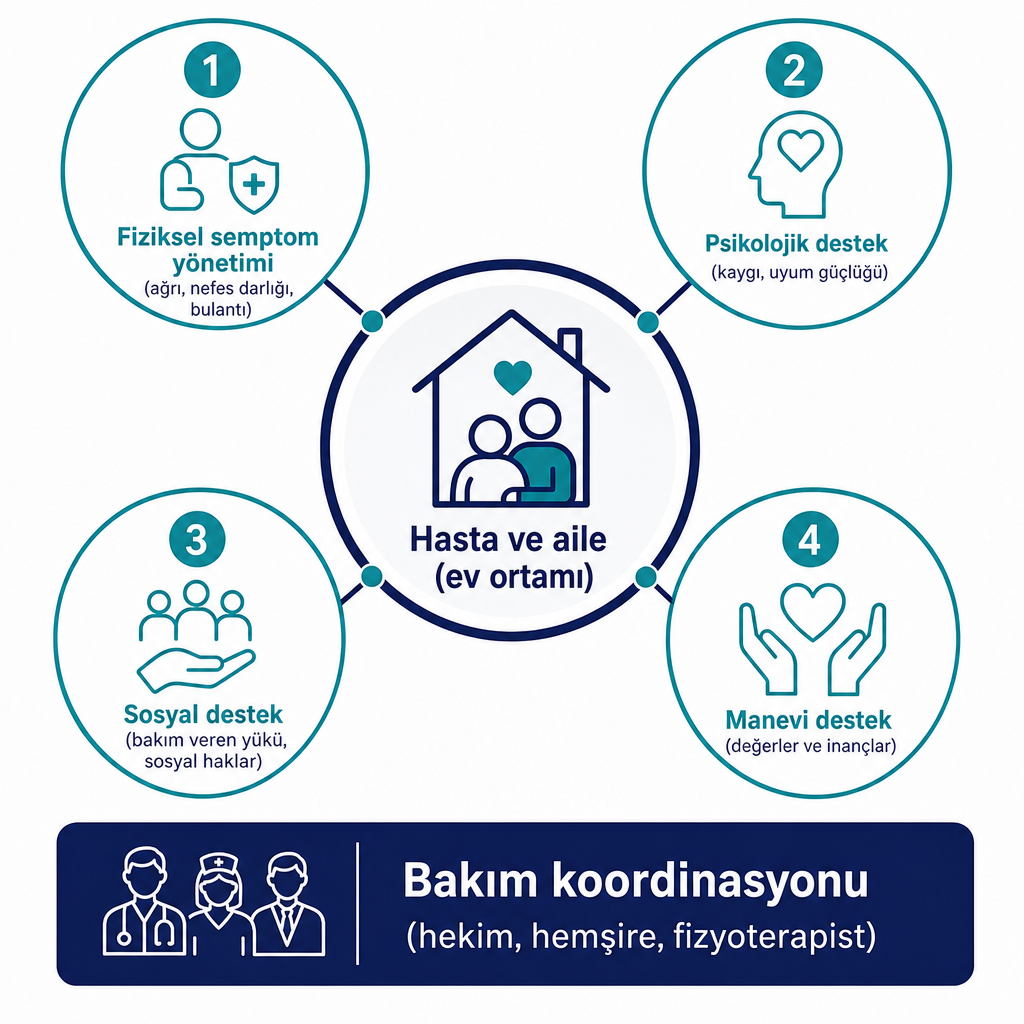 The four dimensions of home palliative care
Core components of palliative care
Palliative care is a multidisciplinary approach and usually proceeds through several complementary components. When provided in the home environment, these components do not change; only because the place of application is the patient's home, the physical conditions of the home and the capacity of family members are additionally taken into account in planning.
- Management of physical symptoms: Evaluating distressing symptoms such as pain, shortness of breath, nausea, fatigue, and sleep disturbances, and bringing them under control with appropriate medical methods.
- Psychological support: Professional support for anxiety, depressive mood, and difficulty in adjustment that may be seen in the patient and family members; psychiatric or psychological counseling when needed.
- Social support: Assessing the burden on family members providing care, informing about social rights and support mechanisms, and, when needed, support from a social worker.
- Spiritual support: Attending to the needs of the patient and family regarding their values, beliefs, and sense of meaning in life.
- Care coordination: Organizing the flow of information among the hospital, family physician, home health unit, and other specialty areas; ensuring the harmonious management of medication, the follow-up plan, and check-up appointments.
Addressing these components together distinguishes palliative care from a single intervention: what matters here is a continuous system of monitoring and support that considers the patient as a whole along with the family's situation.
For whom may home palliative care become relevant?
Palliative care is not limited only to the end-of-life period; it may become relevant in many patient groups at different stages of illness. In the informational texts of public and university hospitals in Turkey, the following are counted among the groups who may need palliative care:
- Advanced-stage cancer patients
- Patients with advanced organ failure (heart, lung, liver, kidney, etc.)
- Individuals with neurological and neurodegenerative diseases such as Alzheimer's, Parkinson's, and ALS
- Elderly patients with multiple chronic illnesses and markedly reduced functional capacity
- Patients who need long-term support after intensive care
Within these groups, home palliative care may stand out particularly for patients with limited mobility, for whom frequent hospital visits are difficult, or for whom long-term care at home is planned. The adaptation process of patients discharged from intensive care to home carries its own specific needs; for practical information for patients' relatives on this transition, you can take a look at our guide on adapting to the home care process after intensive care.
When deciding, the stage of the disease, symptom burden, the physical conditions of the home, the presence of people in the family who can provide care, and the accessibility of home health and palliative services in the region are evaluated together. This assessment is carried out by the physician following the patient and the palliative care team; the views of family members and the patient's preferences are also included in the process.
The team and practices in the process
Home palliative care is a team effort. In this team, roles are usually distributed as follows:
- Physician: Responsible for the medical management of the disease, planning symptom control, medication adjustments, and coordination with the hospital when needed.
- Nurse: Carries out clinical practices such as monitoring vital signs, administering medications, tracking serum and infusions, wound and pressure sore care, and checking catheters and tubes; also trains the family in basic care.
- Physiotherapist: Plans exercise programs to preserve mobility; can provide support in areas such as positioning in bed, transfers, and breathing exercises.
- When necessary, professional groups such as psychologists, psychiatrists, dietitians, and social workers also join the process.
The practices that can be carried out within the scope of home palliative care vary according to the patient's clinical condition; however, they may include elements such as regular medical evaluation, monitoring of pain and other symptoms, tracking of medication and nutrition regimens, mobility and rehabilitation support, personal care and hygiene support, and care training for the family.
As a home care center, we too can bring together home private medical care, home private nursing, and home physiotherapy services within a single plan in a way that aligns with palliative care goals. The content and scope of these services are shaped by the institution's Ministry of Health license and relevant legislation; practices are planned for patients the physician deems suitable.
The relationship between home-based and hospital-based palliative care
Palliative care services can be provided in palliative care units within hospitals, in day care centers, at home through home health units, or in some long-term care institutions. Home palliative care constitutes the home-centered part of this spectrum and is often carried out in coordination with hospital-based services.
As long as the patient's condition is stable and can be managed at home, care can be planned at home. In cases of acute exacerbations, complex interventions, or situations requiring advanced intensive care, hospitalization may be necessary. For this reason, when creating a home palliative care plan, the institutions to be consulted and the communication channels in emergencies are also clarified from the outset. Regular information sharing between hospital and home care teams contributes to the safe and holistic progress of the process.
Palliative care and legislation in Turkey
In Turkey, palliative care services are defined by the relevant directives and regulations of the Ministry of Health. The "Regulation on the Provision and Coordination of Home Health and Palliative Care Services" and the "Directive on the Application Procedures and Principles of Palliative Care Services" set out the framework for the provision of palliative care services in facilities belonging to public, university, and private health institutions.
In the informational texts of the Ministry of Health, it is emphasized that providing medical, psychological, social, and spiritual support to palliative patients and their families is one of the main goals. A portion of palliative care services is provided under the Social Security Institution (SGK) in public hospitals and city hospitals; details regarding SGK coverage and application conditions are explained on the Ministry of Health's palliative care services page and in the current regulations published by SGK.
The financing of palliative care services in private health institutions, on the other hand, may vary depending on the relevant institution's contract status with SGK and the type of service provided; for definitive information on this matter, it is necessary to consult directly with the relevant institution and SGK. The establishment, operation, and coordination of home health and palliative care units are also subject to Ministry legislation; licensed institutions are obliged to provide services in accordance with this framework.
What criteria are evaluated in the home palliative care decision?
The home palliative care decision is made separately for each patient. The criteria frequently taken into account in the assessment are as follows:
| Criterion |
What it evaluates |
| Stage and course of the disease |
Situations where curative treatment is limited or the focus has shifted to symptom control |
| Symptom burden |
Whether symptoms such as pain, shortness of breath, and fatigue can be controlled with home monitoring and intervention |
| Mobility and access |
Bedridden status, difficulty with transfers, or the impracticality of frequent hospital visits |
| Home environment and caregiver |
The presence of a safe home environment and people who can provide support |
| Service network in the region |
The accessibility of home health and palliative care teams in the relevant region |
These elements are evaluated together by the patient's physician in light of clinical data and discussions held with the family. The physician and team decide whether palliative care will be continued at home, in the hospital, or with a mixed model. For a general framework of how the process works at home, you can review our article explaining how home doctor service works.
Possible benefits and limitations
Among the possible benefits of home palliative care are the following: the familiar home environment may reduce stress and restlessness in some patients; the possibility of regular monitoring at home instead of frequent hospital visits for patients with limited mobility; the ability of family members to participate more actively in the care process and receive training from the team; and the coordination of hospital and home care services may help reduce unnecessary hospitalizations in some patients.
The limitations, however, should not be overlooked. Not every medical intervention can be performed at home; in sudden clinical deteriorations, rapid access to the hospital may be needed, and the physical conditions of the home may not always be ideal. For this reason, the home palliative care plan is designed within a flexible framework that does not exclude options such as hospital admission and hospitalization when needed; the process can be reviewed again according to the patient's condition.
Since symptoms and needs vary from person to person, it is recommended to consult the patient's own physician and the palliative care team regarding the suitability and content of home palliative care. When the family's situation, the patient's preferences, and the available service options are discussed together, the most suitable care model emerges more clearly.
Frequently Asked Questions
Is home palliative care only end-of-life care?
No. Palliative care can be applied for symptom control and supportive care from the early stages of illness; the end-of-life period is only one part of this spectrum. In some patients, palliative care may continue for a long time concurrently with the treatment of the disease.
Does home palliative care replace the treatment of the disease?
The main goal of palliative care is less to treat the disease than to reduce symptoms and improve quality of life. In suitable cases, it can be carried out together with treatments aimed at the disease; the physician decides whether treatment will be continued or not.
Is home palliative care covered by SGK?
A significant portion of palliative care services is provided under SGK in public and city hospitals. Coverage and application conditions are clarified according to the current regulations of the relevant institution and SGK. Whether services in private institutions are covered may vary depending on the terms of the contract with SGK.
What is the role of family members in the process?
Family members are usually an important part of daily care; they contribute to personal care, nutrition, mobility support, and medication tracking. The palliative care team can offer the family training on the care process, monitoring symptoms, and emergency warning signs, along with psychosocial support.
How are emergencies managed in home palliative care?
When creating a home palliative care plan, the institutions to be consulted and the contact information are determined in advance for the unexpected worsening of symptoms or newly developing emergencies. In situations such as sudden shortness of breath, changes in consciousness, or uncontrollable pain, rapid communication with the physician or the relevant health unit and, when necessary, admission to the hospital may be required.