Home palliative support is a multi-step process for families who want to bring the management of pain and other symptoms in a life-threatening illness into the home environment. Preparation can be completed within days; the care itself usually spans weeks, months, and longer periods. The cost varies depending on the frequency of visits, the composition of the team, and the procedures required. For a conceptual answer to what palliative care is, you can refer to our definition article, while in this guide you can focus on how the process is planned and sustained at home. For the definition and scope of palliative care, you can take a look at the page describing all of our home care services.
Contents
Preparing for home palliative support
The first step of the process is the assessment of the need for palliative care by a physician. According to the Ministry of Health's palliative care guideline, this care is indicated for patients who require early diagnosis and management of pain and other symptoms in life-threatening illnesses; the decision is made by the physician's clinical assessment. In other words, you do not initiate home palliative support on your own; first you clarify the needs with a physician who knows the clinical picture.
Two things proceed in parallel during the preparation phase. On the one hand, the patient's medical condition, current treatment, and any pain management plan initiated in the hospital are documented. On the other hand, the suitability of the home for care is assessed. The legislation, under which home health and palliative care are jointly organized, defines the evaluation of the suitability of the patient's home care conditions, family support, and medical requirements as part of the process.
Which components will be needed in care brought into the home environment also becomes clear at this stage. In a palliative patient, home clinical monitoring and treatment planning, regular nursing practices, and physiotherapy aimed at slowing the loss of mobility may all come into play at the same time. The multidisciplinary team approach is a fundamental principle of palliative care: the physician, nurse, physiotherapist, and, when necessary, psychosocial support are planned together.
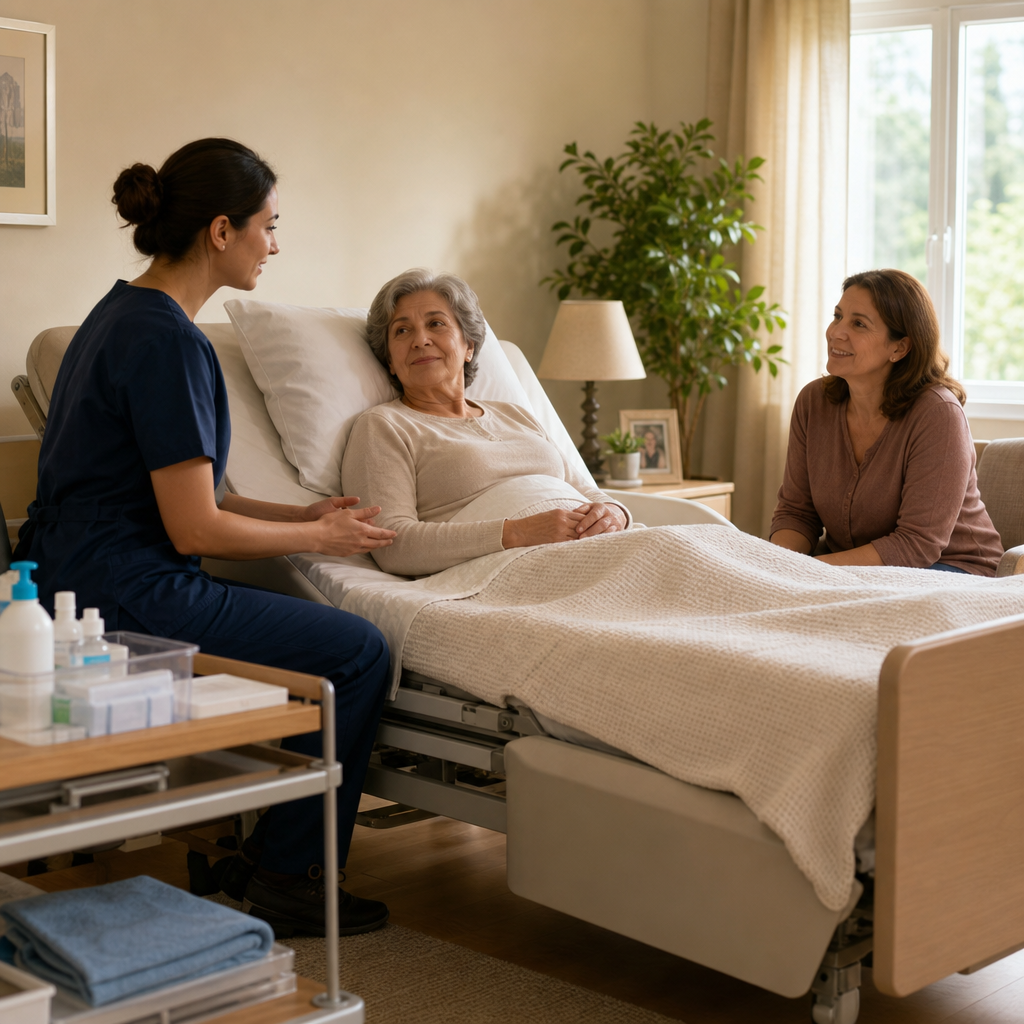
Home checklist before starting
Before the professional team arrives at the home, there is a concrete groundwork the family can prepare. The following headings turn the environment, equipment, record-keeping, and support network requirements defined in official home care documents into practical preparation.
- Environment: A well-lit, ventilable area with easy access to the patient's bed and surroundings; an arrangement that prevents slipping and falling.
- Equipment placement: A location set aside in advance for an adjustable bed, mobilization aids, and hygiene supplies, where the team can work comfortably.
- Documents: Keeping the discharge summary, the current pain management plan, medication reports, and previous test results together and easy to find.
- Communication: An accessible communication channel with the responsible physician and team; clarifying within the family who to contact in an emergency.
- Care log: A simple record noting day by day the symptoms, sleep, appetite, pain level, and changes in general condition.
- Support network: Sharing the care burden within the family and reviewing social service supports.
This list covers not disease management but environmental preparation. Interventional care decisions belong to the team; the family's role is to prepare the conditions in which this care will be carried out safely and regularly.
Step-by-step operation of home palliative support
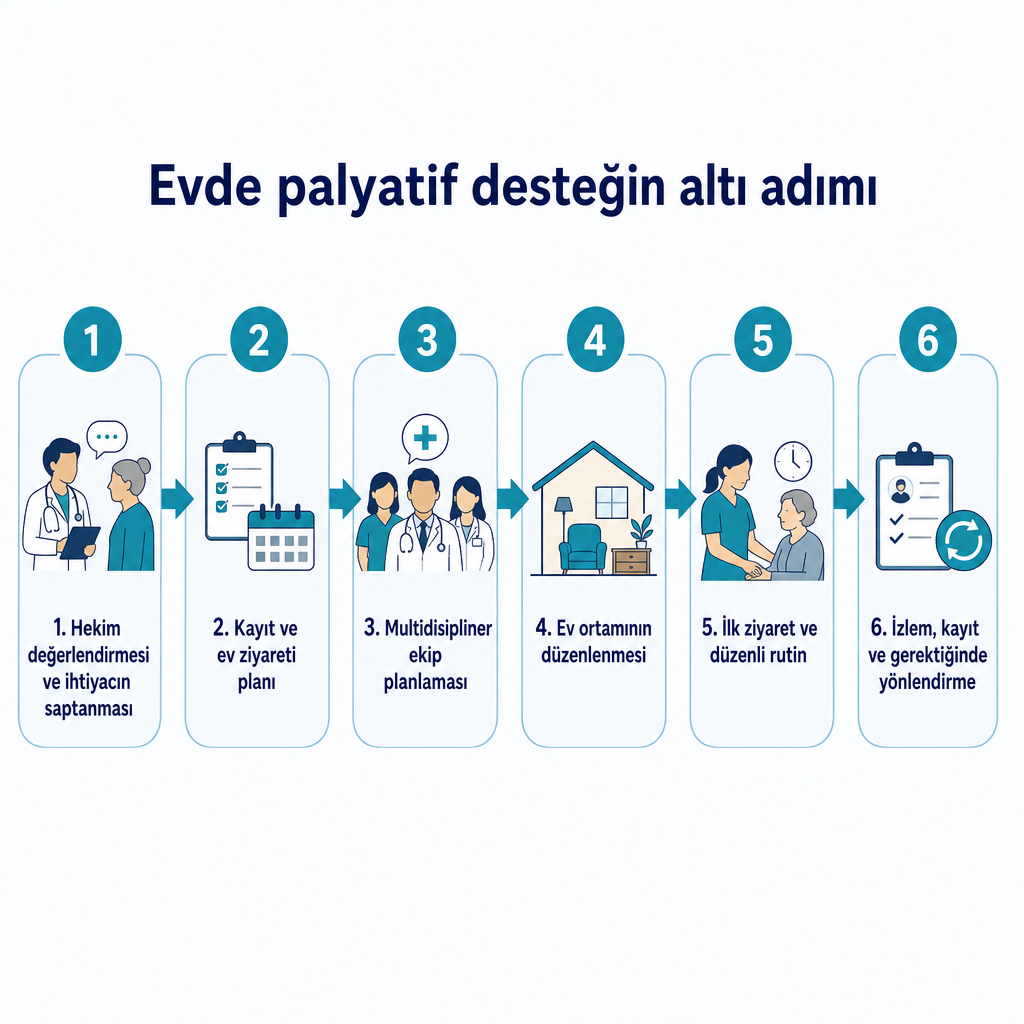
Home palliative care proceeds in a specific sequence described in the legislation. The following steps are the general framework of the process; the frequency and content of visits are determined by the physician's decision according to the patient's condition.
- Physician assessment and identification of the need. The patient is assessed by a physician; the need for palliative care and its sustainability at home are determined.
- Creating the registration and home visit plan. Once the need is confirmed, the home care process is recorded and a plan is drawn up for regular visits.
- Multidisciplinary team planning. The roles of the physician, nurse, and physiotherapist; and psychosocial support when needed, are structured according to the patient's requirements.
- Arranging the home environment. The placement of the bed, mobilization aids, and necessary medical equipment in accordance with safety and hygiene conditions is completed.
- First visit and start of the routine. During the first visit, the clinical condition is observed on site; then, with regular visits, symptom monitoring, continuation of the treatment planned by the physician, and rehabilitation practices are carried out.
- Monitoring, record-keeping, and referral when necessary. Each visit is recorded; when the condition changes, the plan is reassessed and, when necessary, a referral is made to a higher-level health facility.
Within this operation, nursing and physiotherapy are two separate but connected branches. Our guide on the scope and operation of home nursing care, in which we describe how the nursing process is planned in the postoperative period, similarly shows the logic of bringing the nursing routine into the home environment in palliative care. On the mobilization and functional rehabilitation side, our guide describing the structuring of home physiotherapy in stroke patients provides an example of how practices aimed at range of motion and daily living activities are set up at home.
Common mistakes and solutions
In home palliative care, disruptions usually arise not from the treatment itself but from breaks in the continuity of the process. Official guidelines clearly describe these points of disruption.
Break in continuity of pain management. The pain management guideline in palliative care emphasizes that pain treatment initiated in the hospital or palliative center must absolutely be continued at home; for this, a detailed discharge summary, pain management plan, and medication reporting are mandatory. The most common mistake is the incomplete transfer of these documents and insufficient assessment of newly emerging pain. The solution is to take over the pain plan together with its documentation and to report every change to the team.
Neglect of mobilization and rehabilitation. The palliative rehabilitation document lists insufficient attention to mobilization and daily living activities and failure to ensure the continuity of physiotherapy support among the factors that reduce effectiveness. Regular, patient-tailored home physiotherapy practices close this gap; adapting range of motion, mobilization, and breathing exercises to the home environment are the leading approaches that slow the loss of function.
Lack of record-keeping and communication. Home health guidelines identify incomplete record-keeping, failure to follow the home visit plan, and breaks in coordination between teams as the leading problems that cause the system to falter. A simple but consistent care log and a single communication channel markedly reduce information loss.
The effectiveness of palliative care often depends as much on the uninterrupted flow of information between steps as on the correctness of the treatment.
What the family can do and the boundaries requiring a professional team
The family's role is real and valuable, but its boundaries are drawn by legislation. The areas the family can safely undertake are: preparing and securing the environment, the patient's comfort, nutrition and hygiene support, daily observation and recording of symptoms and general condition, maintaining communication with the team, and psychosocial support. This contribution eases the team's work and directly affects the quality of care.
Interventional procedures beyond this are the responsibility of authorized health personnel. Home health legislation states that examinations, tests, treatment, and medical care practices are to be carried out by health personnel. It is clear that interventional procedures such as IV/serum administration, injection, catheter monitoring, wound care, and the like can only be performed at home by authorized health personnel, and that family members are not expected to undertake these procedures. We illustrated the planning principle for safely bringing common fluid and drug treatments into the home environment in our article on home serum administration and safe IV treatment.
On the medication side the boundary is even clearer. The pain guideline emphasizes that, especially, the dose adjustment, drug combination, and monitoring of strong analgesics must be carried out under the supervision of a specialist physician; and that drug treatment should not be left to the patient or family. For this reason, this guide does not include any drug names, doses, or usage schedules; these belong to the area that the physician plans and the team administers.
We take over this side of the work. With the physicians, nurses, and physiotherapists on our team, we undertake the continuation at home of the treatment planned by the physician, regular monitoring, and referral when necessary. Conveying to our team in detail your patient's diagnosis, current treatment, level of daily need, and where you live is the practical starting point for assessing the need for palliative support and jointly creating home care options and a suitable visit plan. This way, we can prepare a recommendation tailored to you.
Frequently Asked Questions
Who is home palliative support suitable for?
It is considered for patients who need management of pain and other symptoms in a life-threatening illness. The decision on suitability is made by the physician, who assesses the patient's medical condition and home care conditions.
How long does the home palliative process last?
Palliative care is a chronic and ongoing care model; it often spans weeks, months, and longer periods. The frequency of visits is not fixed; it is determined according to the patient's condition and clinical judgment.
What can the family do at home?
Preparing and securing the environment, patient comfort, nutrition and hygiene support, observing and recording symptoms, and communicating with the team are the areas the family can safely undertake.
Can the family perform procedures such as IV/serum and wound care?
No. Interventional procedures such as IV/serum, injection, catheter, and wound care can only be performed at home by authorized health personnel; a licensed team is required for these procedures.
What should we do as a first step?
Conveying the patient's condition to a physician in detail and requesting an assessment of the need for palliative support is an appropriate starting point. After the assessment, home care options can be planned together.