The short answer to the question of who makes up a home healthcare team is this: the team may consist of the health professionals needed based on the patient's medical requirements, primarily a physician, nurse, and physiotherapist. There is no fixed staff; the patient's diagnosis, mobility capacity, chronic illnesses, and follow-up plan are the determining factors. In this article, we explain in an informative manner the scope of each professional group's duties, why the team composition varies from patient to patient, and which specialists can be added to the team for different needs. It should also be stated from the outset that the decision regarding assessment and treatment always belongs to the physician.
Table of contents
The core members of the home healthcare team
At the center of health services provided at home, there are usually three professional groups: physician, nurse, and physiotherapist. The scope of duties of these three differs from one another, and overlapping them is not possible in terms of professional authority.
The physician leads the team's medical assessment and decision-making process. They evaluate the patient's medical history and complaints, perform physical examinations, plan the follow-up of chronic illnesses, determine the need for necessary tests and consultations, and create the care plan. The physician also decides whether nursing or physiotherapy is needed; reassesses when there is a change in the patient's condition; and determines the necessity of further examination or referral to a healthcare institution when required. Decisions about medication changes, treatment plans, or any medical application should not be made without a physician's assessment. Under our private home medicine heading, topics such as home examination, chronic illness follow-up, and family briefing are covered.
The nurse carries out the patient's daily or periodic medical care in line with the care plan created by the physician. While the scope of duties varies according to the patient's condition, it may include monitoring vital signs such as blood pressure, pulse, temperature, and respiration; administering medications and treatments planned by the physician; wound and dressing care; monitoring medical devices such as catheters; and evaluating the suitability of blood draws and intravenous applications. The nurse also informs the physician about the patient's care needs and explains the process to the patient's relatives. They cannot make a diagnosis outside their own professional authority or make treatment decisions in place of the physician. You can find details about the scope on our private home nursing page.
The physiotherapist becomes part of the team for patients who require movement and function assessment. Their assessment becomes relevant for people with mobility restrictions, balance problems, muscle weakness, or rehabilitation needs following surgery or neurological illness. The physiotherapist evaluates movement, balance, and muscle strength; identifies limitations in daily living activities; prepares a rehabilitation plan consistent with the physician's assessment; and informs the patient and their relatives about safe movement and transfer. If a new or significant complaint arises during movement, the assessment is repeated by the physician and physiotherapist. We cover this area in detail under our home physiotherapy heading.
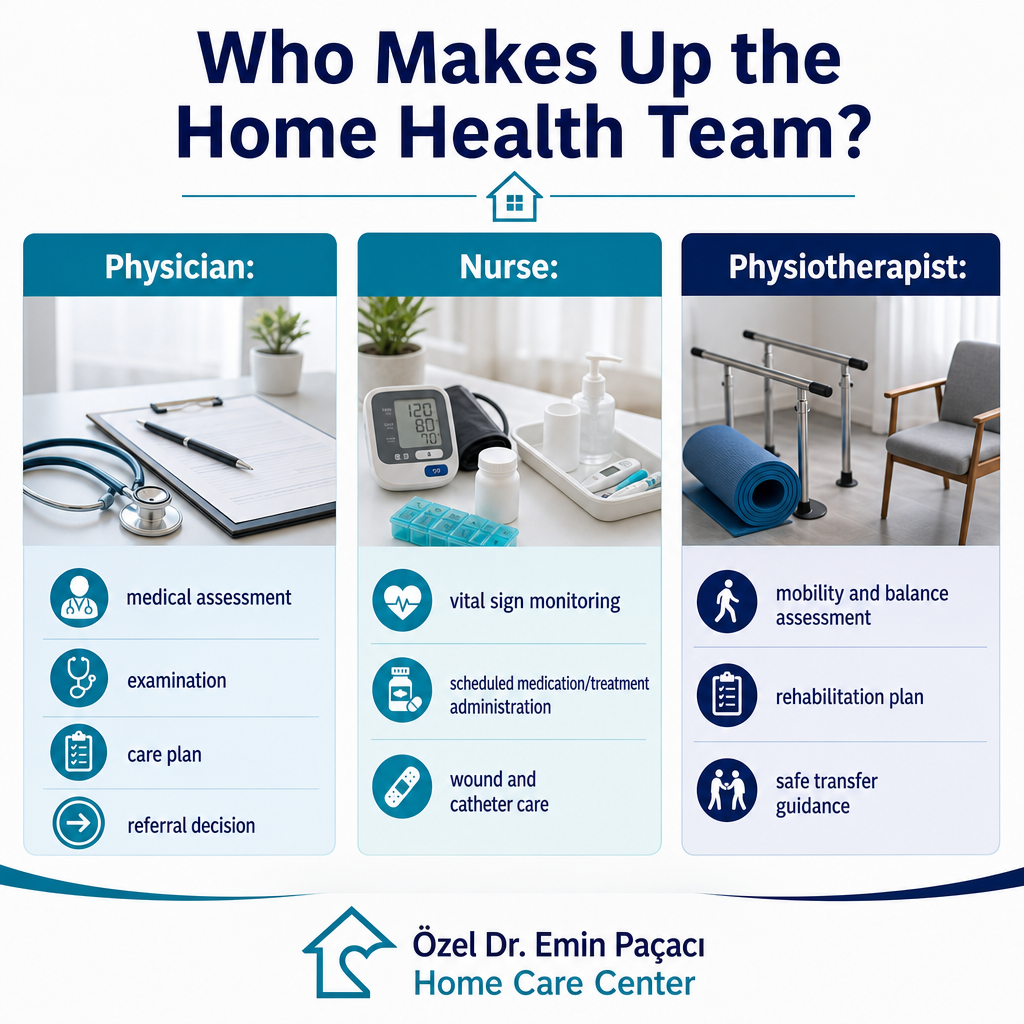 Core team responsibilities
Other professionals who may join the team based on need
Beyond the core team, other professional groups may also be included in the assessment depending on the patient's condition. In home healthcare services provided publicly in Turkey, a physician, nurse, health officer, and driver may be assigned in the minimum team; professional groups such as physiotherapist, dietitian, psychologist, and social worker may also be added based on need.
The health officer or auxiliary health personnel supports the delivery of the service in line with their job description and the responsible physician's plan. Since the scope of duties varies according to the institution and service model, the responsibilities of the health officer, health technician, and auxiliary health personnel should not be considered the same.
The dietitian may be part of the team for patients who require nutritional assessment. Their opinion may be sought for people with chronic illnesses, swallowing difficulties, enteral nutrition, weight loss, or special nutritional needs. The dietitian evaluates nutritional status, determines needs according to the patient's medical condition, and works in coordination with the team. Since the nutrition plan changes according to the person's illnesses, the treatments they use, and laboratory results, general recommendations and a personalized plan should be distinguished from one another.
The psychologist contributes to the assessment of adaptation difficulties in situations where long-term illness, dependency, mobility restriction, or the burden of care affects the patient and family. Adaptation to the illness process, anxiety and stress, caregiver burden, communication problems, and psychosocial support during the end-of-life and palliative care process are among these areas. A psychological assessment does not replace a medical diagnosis and treatment decision.
The social worker evaluates the social circumstances of the patient and family. Their role becomes important in situations such as the patient living alone, the absence of someone to provide care, difficulty in sharing the responsibility of in-family care, or the need for social support.
The driver and logistics support personnel, especially in public teams, contribute to safely transporting health personnel and equipment to the visit location. The driver does not perform medical assessment or health applications. Since transportation and logistics duties may be organized differently in private institutions, the same number of personnel should not be expected at every visit.
Does the same team go to every patient?
No. The composition of the team varies according to the patient's needs, and it is not mandatory for a professional who is not needed as a result of the assessment to join the visit. The table summarizing needs and possible team composition makes this concrete.
| Prominent need |
Professional who may stand out in the team |
| General medical assessment |
Physician |
| Regular vital sign and care monitoring |
Nurse |
| Mobility restriction, balance problem, rehabilitation |
Physiotherapist |
| Nutrition problem, swallowing difficulty, enteral nutrition |
Dietitian |
| Psychological strain, adaptation difficulty |
Psychologist |
| Insufficient caregiver support, social circumstances |
Social worker |
For this reason, the term "home healthcare team" does not describe a single professional group. The team refers to a multidisciplinary working structure created according to the patient's needs; even for two patients with the same diagnosis, the team may be formed differently.
How does the team work together?
At the foundation of teamwork lie joint assessment and information sharing. The physician determines the medical framework; the nurse carries out the daily or periodic care monitoring; the physiotherapist evaluates the needs in the area of movement and function. Other health professionals contribute to the plan in line with their own professional areas.
The following points are decisive in the process:
- Sharing the patient's current condition within the team
- Preserving the scope of duties of each professional group
- Keeping records of the applications performed
- Reporting new symptoms to the responsible health personnel
- Updating the care plan according to the patient's condition
- Informing the patient and their relatives about the process
- Obtaining opinions from different areas of expertise when necessary
In public home healthcare services, team planning is done by the responsible physician according to the patient's condition; the visit time, assessments to be made, and the personnel to be on the team are also determined within this planning. One of the documents confirming that the process is based on the physician's assessment is the consent process we cover under the heading home healthcare service consent form.
The difference between a home healthcare team and a caregiver
These two concepts are often confused, yet their scopes of duty are separate from one another. The home healthcare team consists of healthcare professionals and carries out medical assessment, nursing care, rehabilitation, or other health services within the framework of their professional authority.
The caregiver, on the other hand, primarily provides daily living support: assisting during meals, support with dressing and personal care, accompaniment in bed or in-home movements, helping maintain the daily routine, and supporting the patient's relatives in daily care. The caregiver cannot make a medical diagnosis, prescribe medication, administer injections, or create a treatment plan. Although the two types of service can be planned together, their duties are not the same; clarifying this distinction is important for requesting the correct service.
What information can be asked when planning the team?
Before the service is planned, the patient or the patient's relatives may request information on the following topics:
- Which health professional will join the visit
- Whether the service is based on a physician's assessment
- The scope of the nursing or physiotherapy application
- Whether different professional groups can be included in the team when necessary
- How service records are kept
- Which healthcare institution to turn to in a medical emergency
- In what respects public home healthcare services differ from private home care services
The duties of the people on the team are explained within the framework of the relevant professional legislation and the institution's service plan. You can access all service headings on our services page. In our approach, which professional will join the visit is determined as a result of the patient's assessment.
When might a home team not be sufficient?
Home healthcare is not a suitable option in every medical situation. In cases such as rapid deterioration in the patient's general condition, change in consciousness, severe respiratory distress, chest pain, uncontrolled bleeding, or severe trauma, emergency health services should be sought instead of planning a home team.
Such symptoms may vary according to the person, existing illnesses, and clinical assessment. In emergencies, 112 Emergency Health Services should be called. As for the question of which professionals will be involved in planning the service, the correct starting point is a physician's assessment; the team composition takes shape after this assessment, according to the patient's needs.
Frequently Asked Questions
Is a doctor always present on the home healthcare team?
A physician's assessment may be necessary depending on the scope of the service. However, not every visit needs to take place with the same team structure; a nursing or physiotherapy visit can be carried out separately in line with a previously created medical plan.
Is a physiotherapist included in the home healthcare team?
If the patient has movement, balance, or rehabilitation needs, a physiotherapist may be included in the team. The physiotherapy plan is created according to the patient's medical condition and assessment results.
Are a nurse and a caregiver the same person?
No. A nurse is a healthcare professional and provides medical care services within the scope of their professional authority. A caregiver, on the other hand, provides support in daily living activities.
Is a dietitian or psychologist present on the home healthcare team?
When needed, a dietitian, psychologist, or social worker may be included in the teamwork. The contribution of these individuals depends on the needs of the patient and family determined as a result of the assessment.
Is a family relative considered a member of the team in home healthcare service?
A family relative is not a member of the healthcare team. However, they can provide important support in terms of information sharing, daily observation, and understanding the care plan.