The short answer to the question of what conditions are required for home health care is this: the patient's medical condition must be suitable for monitoring in a home environment, must meet one or more of the clinical criteria defined in the regulations, basic safety and hygiene conditions must be present at home, and all these elements must be evaluated holistically by a physician. In this article, we explain these conditions without reducing them to a list consisting of age or a single diagnosis; under the headings of medical suitability, application and consent process, home environment, and regulatory framework. Our aim is to clearly convey what is evaluated when you are considering this option for a loved one.
Table of Contents
Definition of home health care and regulatory framework
In the regulations, home health care is defined as providing medical services that can be carried out on-site to individuals who are determined to need health care in the place where they live. The main purpose of this service is to deliver medical care, follow-up, and some treatment applications in the home environment to people who have become dependent on bed, home, or a medical device due to diagnosed illnesses and who have difficulty going to a health institution.
In Turkey, this field is framed by two separate regulations. Public home health services are regulated by the Regulation on the Provision of Home Health Services by the Ministry of Health and Its Affiliated Institutions; private home care centers, on the other hand, are regulated by the Regulation on the Provision of Home Care Services. These regulations define which patients can benefit from the service, application channels, team structure, consent processes, and record-keeping obligations.
Here, it is necessary to distinguish between two frequently confused concepts. Home health care includes clinical applications such as medical evaluation, examination, treatment, and follow-up. Home care, on the other hand, covers topics such as daily life support and personal care and is addressed by a separate regulation. The conditions of the two are therefore different from each other; to see the distinction and the workings in Istanbul more closely, you can review our article explaining how home care service works in Istanbul.
Clinical suitability: which patients are evaluated
Home health units affiliated with the Ministry of Health evaluate every applicant patient according to standard criteria and determine suitability for the service through this evaluation. The groups that are prioritized for evaluation in provincial health directorate and hospital resources are defined in detail:
- Patients who, due to a diagnosed illness, are dependent on bed, home, or a medical device such as an oxygen machine or ventilator.
- Elderly individuals aged 80 and over who have difficulty accessing health care and request home health care.
- Patients aged 65 and over who have a chronic illness documented by a medical board report and are fully or severely dependent in terms of daily life activities.
- Patients who are in the palliative care process and whose medical care is deemed appropriate to continue at home.
- Patients who have been discharged after treatment or surgical procedure in the hospital and whose maintenance treatment the physician deems appropriate to continue at home.
- Individuals with diabetes, heart failure, stroke, COPD, Alzheimer's/dementia, neurodegenerative diseases, terminal-stage cancer, multiple chronic illnesses, and patients requiring medical care after a major joint fracture or surgery.
These lists should not be read as an automatic acceptance table. Each criterion is reinterpreted by the physician according to the patient's medical, functional, and social condition. For example, a chronic illness diagnosis alone is not a sufficient entry ticket; what is decisive is whether monitoring the patient at home is appropriate in terms of safety and follow-up compared to hospital monitoring. This decision belongs to the physician and is made separately for each case.
Application, evaluation, and consent requirements
Individuals or their relatives requesting public home health care can apply by calling the national call center number 444 38 33, or through their affiliated family medicine unit and provincial coordination centers. During the application, the patient's identity information, current diagnoses, reports, and contact information are recorded; the process is carried out by the coordination unit at the provincial center. To see in more detail which documents are requested according to the type of application, you can review the list of documents required for home care.
The person deemed suitable is visited at home by a team consisting of a physician and auxiliary health personnel. This first visit is actually the most critical condition of the process; because suitability for home health care is clarified not by a phone application, but by an on-site evaluation. During the visit, the patient's medical condition, level of dependency, and accompanying illnesses are evaluated in detail; the scope of the service that can be provided is determined, and the suitability of the home environment is reviewed.
Another indispensable condition of the process is written consent. People deemed suitable for home health care are informed, and the Home Health Care Information and Consent Form included in the regulation is filled out and recorded. This form documents that the patient or their legal representative understands and accepts the scope and possible limitations of the service. The service cannot begin without consent being obtained.
Safety and suitability conditions regarding the home environment
Meeting medical criteria alone is not sufficient; the home itself must also meet certain conditions in terms of basic safety and hygiene. During a home visit, the team generally observes the following: enough movement space to allow physician examination, nursing applications, and physiotherapy; a clean and as hygienic as possible work surface for injections, dressings, or IV applications; safe placement of medical devices such as oxygen machines, aspirators, hospital beds, or walkers; a wiring and outlet arrangement suitable for the safe use of electrical medical devices; and the physical and psychosocial capacity of family members who will take part in care to bear this burden.
These conditions are observed anew at each visit; when necessary, arrangement suggestions are offered to the family. For a practical framework on how the home environment can be prepared after discharge, our article addressing arranging the home health environment after discharge can be a guide. If, as a result of the evaluation, the home environment is thought to be medically inadequate, the physician may reshape the follow-up plan and recommend hospital-based monitoring.
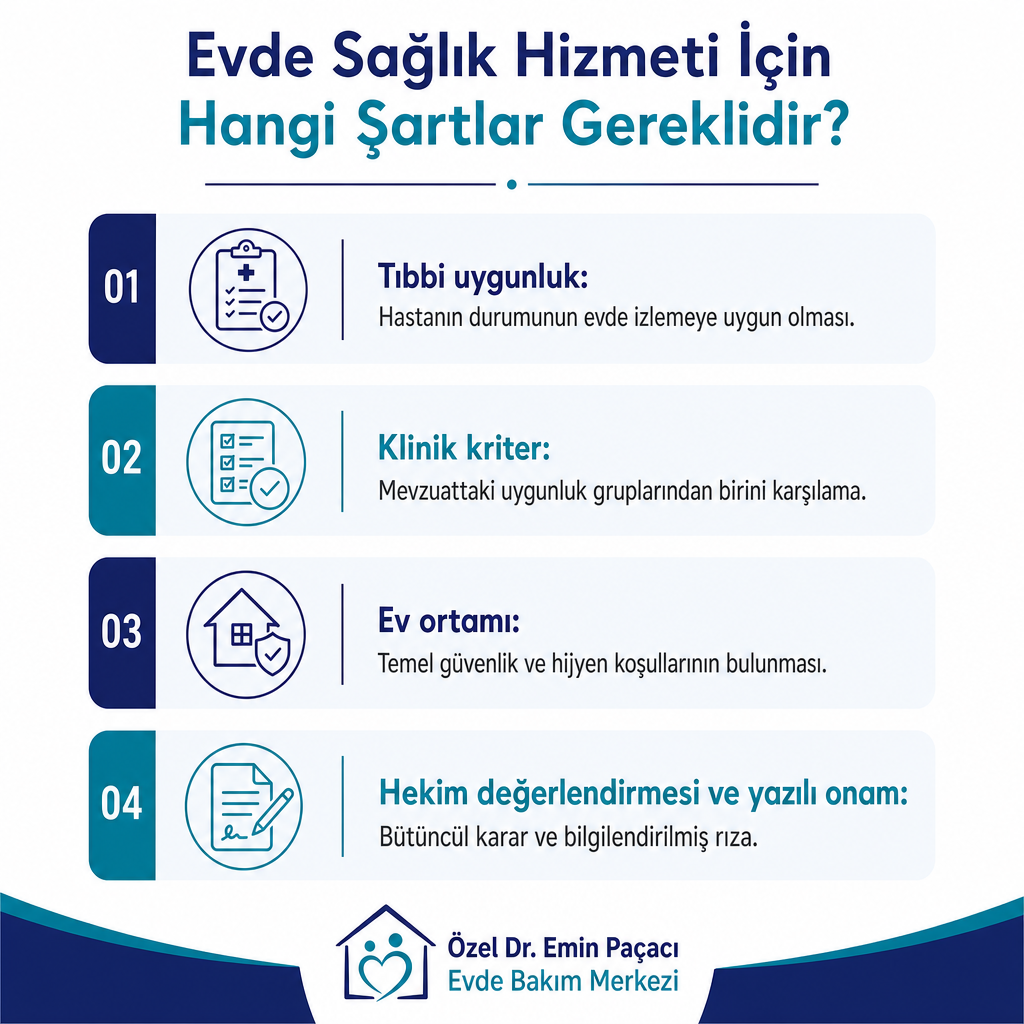 The four basic conditions required for home health care
Service conditions at private home care centers
In Turkey, private home care centers are licensed by the Ministry of Health and operate according to the provisions of the Regulation on the Provision of Home Care Services. This framework defines that centers work with a team consisting of physicians, nurses, and other health professionals, their medical record-keeping obligations, and standards for patient safety.
When planning service at a private center, the following elements are generally considered together: the patient's diagnosis and medical needs along with complication risks according to the stage of the illness; mobility level along with neurological and cognitive status; available social support and care capacity at home; the scope of procedures that can be applied at home; and the informed consent, expectations, and limits of the patient and their family.
As the Private Dr. Emin Paçacı Home Care Center, we provide medical services such as home physician examination, home private nursing, home physiotherapy, palliative care support, wound care, and home IV/serum applications with teams consisting of licensed physicians, nurses, and physiotherapists. We plan every type of service we offer according to the patient's diagnosis, general condition, and physician evaluation; the decision of which patient will be followed at home and which at a health institution is based on medical criteria.
If you want to see in more detail how different disciplines work in the home environment and their scope, you can review our pages on home private medicine, home private nursing, and home physiotherapy. Since each patient's circumstances are different, sharing the patient's diagnosis, current reports, level of dependency, and the district they are in will make the evaluation easier so that we can prepare a suitable plan.
Criteria carrying weight in the decision process
The answer to the question of what conditions are required for home health care is not limited to a list of age or diagnosis; the decision is based on a multidimensional clinical evaluation. The table below summarizes the main criteria that the physician and team weigh together and why each is decisive.
| Criterion |
Why it matters |
Indicator against home monitoring |
| Medical stability and risk |
Vital signs, respiration, circulation, and level of consciousness must be safely monitorable |
Rapidly changing conditions requiring advanced intervention |
| Functional dependency |
The level of dependency determines the frequency and scope of visits |
Need for monitoring at intensive care level |
| Care support |
The family's or caregiver's capacity to sustain daily care affects effectiveness |
Absence of any support to bear the care burden |
| Home environment and hygiene |
Suitable space and hygiene are essential for wound care, injection, and IV |
An environment unsuitable for procedures that cannot be cleaned |
| Information and consent |
Written consent is the legal and ethical foundation of the process |
Inability of the patient or representative to give consent |
In terms of medical stability, if advanced interventions that need to be provided in a hospital environment are in question, home health care may not come into consideration. Functional dependency is one of the fundamental elements determining prioritized groups in public services and directly shapes the visit plan. In cases where care support is concentrated in a single person, the physician may reorganize the service plan accordingly. If the home environment is inadequate, some procedures may need to be continued at a health institution. Informed consent, on the other hand, is a clear requirement in the regulations and constitutes the ethical ground of the process.
These criteria are supported by detailed protocols for public home health units, and by their own clinical operating procedures for private centers. In both channels, the final decision belongs to the physician and the team; each patient's circumstances are evaluated separately. If you are wondering about suitability for a loved one, the practical step to take is to present the diagnosis, reports, and general condition for a physician's evaluation.
Frequently asked questions
What is the difference between home health service and home care service?
Home health service covers clinical applications such as physician examination, medical evaluation, treatment, and follow-up. Home care service, on the other hand, is more focused on supporting daily life activities (personal care, nutrition, mobility assistance) and is regulated by a separate regulation.
Is a medical board report mandatory to benefit from home health care?
In public home health services, a medical board report documenting a chronic illness is an important criterion, especially for patients aged 65 and over who are fully or severely dependent in terms of daily life activities. However, the existence of the report alone is not sufficient and is considered together with the physician evaluation.
Is age alone a sufficient condition for home health care?
Elderly individuals aged 80 and over who have difficulty accessing health care are counted among the prioritized groups in public home health services. Nevertheless, the scope and frequency of the service are determined according to the patient's medical condition and level of dependency in addition to age.
What does the home health team do when it comes to the home?
The team visits the patient at home, evaluates their medical condition, determines the appropriate service items (such as examination, dressing, injection, education), and creates the care plan. The patient and their family are informed about the scope of the service; in public services, an information and consent form is filled out.
In which situations may a home health care request not be accepted?
If the patient's medical condition is not suitable for home monitoring, if there is a need for monitoring at an intensive care level, or if the criteria defined in the regulations are not met, the service may not be deemed appropriate. This decision is made by the physician and the team as a result of clinical evaluation; when necessary, hospital-based follow-up is recommended.