The difference between home health care and home care, in the simplest terms, lies in the purpose of the service and its scope of duties. Home health care covers medical examinations, follow-up, treatment, and rehabilitation applications carried out by health professionals such as physicians, nurses, and physiotherapists. Home care, on the other hand, refers to the personal, social, and supportive services that help a person maintain their daily life. The two services can be planned together for the same person; however, home care does not replace medical evaluation or treatment on its own. Clarifying this distinction makes it easier to correctly determine whom to consult for which need.
Contents
What is home health care?
According to the definition in the Ministry of Health legislation, home health care is the medical service that can be provided in the living environment to individuals who are bedridden, device-dependent, or homebound due to diagnosed illnesses. In other words, at its core there is a medical decision, examination, or monitoring.
Within this framework, home health applications may include physician examination and clinical evaluation, follow-up of a diagnosed illness, monitoring of the treatment plan, nursing services, wound care in line with clinical evaluation, vital sign monitoring, physiotherapy and rehabilitation, palliative care support, and, when necessary, advanced evaluation or planning referral to a health institution. The scope varies according to the person's diagnosis, general health condition, level of dependency, and physician evaluation.
In the legislative regulation, individuals aged 80 and over, patients dependent on devices or homebound, highly dependent people with certain chronic illnesses, and those requiring medical care after discharge are listed among the groups that can be evaluated within the scope of home health. According to the regulation, the service can be planned on a continuous or temporary basis; for example, the medical care needed for a certain period after discharge can be addressed as temporary home health care. For the basis of these definitions, the Official Gazette regulation on home health services can be reviewed.
The medical side of the service is not limited to a single profession. Topics such as home physician care, private home nursing, and home physiotherapy can be planned separately or together according to the person's medical needs.
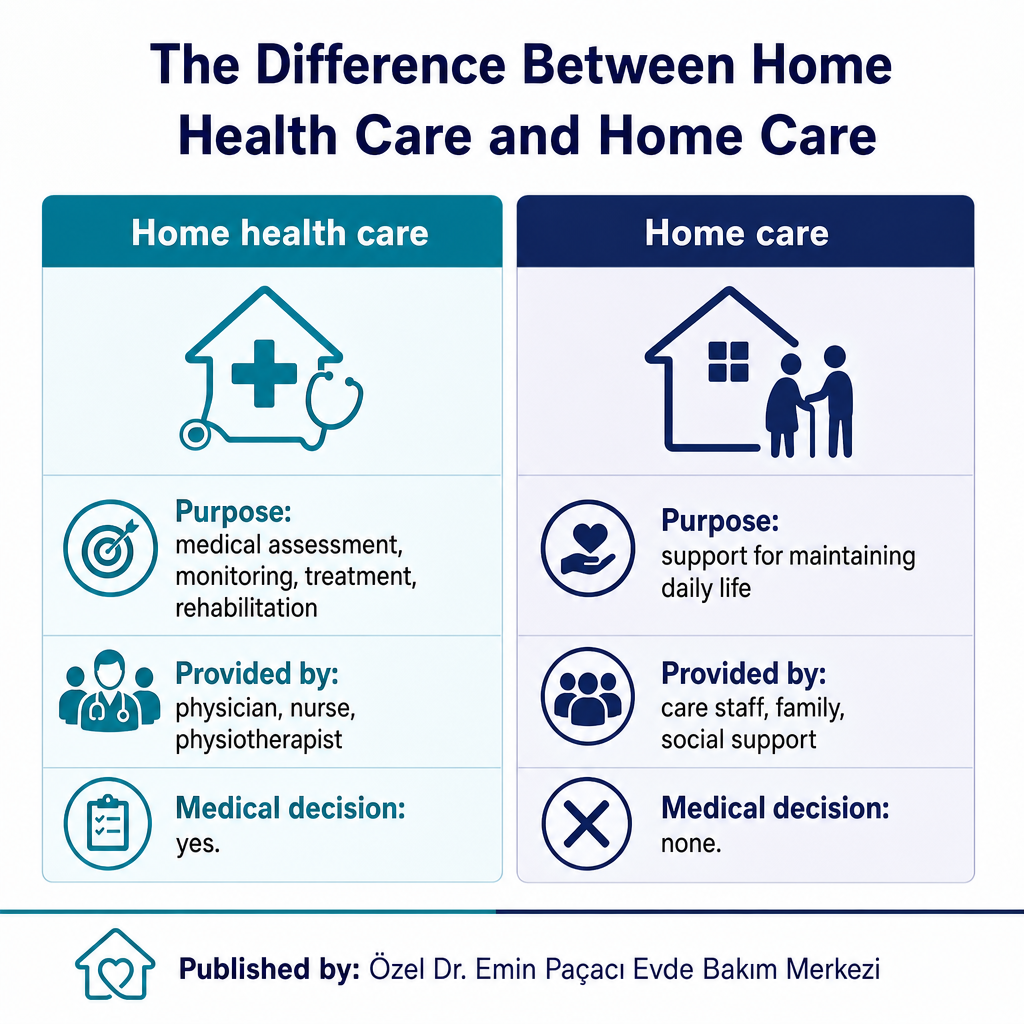 Home health care versus home care: distinction of purpose and role
What is home care and how it differs from home care allowance
Home care describes the supports provided so that a person can maintain their daily life in a home environment. In the regulation of the Ministry of Family and Social Services, home care is defined as the service provided to improve the living environment, assist with daily life activities, and offer social, physical, and psychological support.
The supports within this scope may include assistance with personal care, help with dressing and daily preparations, assisting during the nutrition process, supporting safe movement within the home, contributing to the maintenance of daily life order, social communication and companionship, and helping caregivers with daily organization. The common point is that these tasks are supports that facilitate life without requiring medical diagnosis or treatment.
A commonly confused distinction is this: home care service and home care allowance are not the same concept. Home care allowance may be in the nature of social assistance directed at people who undertake the care of disabled individuals meeting certain conditions. Home care service, on the other hand, defines the care and support activity actually provided in the home environment. The former is a payment/support mechanism, the latter is a directly carried-out service.
Key topics that distinguish the two services
The most practical way to see the difference is to read the services side by side under the same headings.
| Comparison heading |
Home health care |
Home care |
| Core purpose |
Medical evaluation, follow-up, treatment, and rehabilitation |
Support for maintaining daily life |
| Service providers |
Physicians, nurses, physiotherapists, and authorized health workers |
Care personnel, family members, or social support staff |
| Medical decision |
Made by physicians and relevant health professionals |
Does not carry the duty of medical decision-making |
| Sample tasks |
Examination, nursing, wound care, physiotherapy, medical follow-up |
Personal care, nutrition support, companionship, daily assistance |
| Diagnosis and treatment |
May be within the scope of medical evaluation |
Not within its scope |
The essence of the table can be summed up in a single question: does the need require a medical evaluation, or support in daily life? This question largely determines which service will come to the fore.
Do nurses and care personnel do the same job?
No. As a health professional, a nurse carries out medical evaluation and nursing applications in line with the physician's plan. Matters such as medication administration, wound care, intravenous procedures, or medical follow-up depend on the person's condition and the evaluation of the authorized health worker.
The duty of care personnel, on the other hand, is concentrated in the areas of daily life support, personal care, and companionship. Care personnel cannot make a diagnosis in place of a physician or nurse, cannot plan treatment, and cannot take on the scope of duties of a health professional. This boundary is decisive in preventing confusion when planning the service. Similarly, procedures such as blood sample collection in the home environment also fall within the scope of health personnel; for more information about the process, the article explaining how home blood collection service works can be reviewed.
Which need brings which service to the agenda?
The simplest way to decide is to look at the nature of the need.
If the need requires a health-related evaluation such as examination, illness follow-up, medical application, wound assessment, rehabilitation, nursing monitoring, or implementation of a treatment plan, then home health care comes to the agenda. Within this scope, examples include being bedridden or homebound due to illness, significant difficulty in reaching a health institution, planned medical follow-up after discharge, the need for medical monitoring with advanced age, regular evaluation of chronic illnesses, and the palliative care process.
In contrast, if the need is to be supported in activities such as dressing, nutrition, personal hygiene, safe movement within the home, companionship, or maintaining a daily routine, the situation can be evaluated within the scope of home care. The scope of these supports varies according to the person's level of dependency, living space, care plan, and family support.
The two needs are often present together in the same person. For example, someone whose movement is restricted after surgery may need physiotherapist evaluation and nursing monitoring while at the same time requiring support in daily activities such as dressing or nutrition. At this point, what is important is to plan by separating the scopes of duties of health care and care support. Since whether the service is suitable for the person depends on existing diagnoses and clinical evaluation, it is recommended to consult a physician for eligibility. For details about the application criteria, the article on the conditions required for home health care can be reviewed.
How are the two services planned together?
In situations requiring both medical and daily life support, the boundaries of duties must be clearly defined. The intertwining of roles can blur both responsibility and monitoring.
A typical division of labor can be established as follows:
- Physician: Carries out the general evaluation and determines the need for medical follow-up.
- Nurse: Carries out nursing services in line with the physician's plan.
- Physiotherapist: Evaluates in terms of movement, balance, and functional capacity.
- Care personnel: Provides support in daily life activities.
- Family or caregiver: Shares the person's daily routine and observations with the team.
In private health institutions, home physician care, nursing, and physiotherapy can be planned under separate headings. Our center's home physician care service includes topics such as examination, chronic illness follow-up, informing the family, and, when necessary, referral to an advanced health institution; for details, you can review the private home physician care page. Home health care is not intended to meet daily care needs; home care, likewise, does not take the place of medical examination or treatment follow-up. Just as a nurse performing wound care does not mean the person's dressing or daily household needs will be met, providing companionship does not mean medical follow-up is being carried out.
The difference between public home health care and private institutions
Public home health services are carried out by health facilities affiliated with the Ministry of Health and relevant public units within the framework of legislation. Application and eligibility assessment are conducted according to the procedures of the public service itself.
Private home care institutions, on the other hand, operate as licensed health institutions within the scope of the relevant health legislation. The scope of the service is determined in line with the assigned health personnel, the visit plan, and the person's medical needs. In both models, the suitability of the health service to the person's condition depends on clinical evaluation. The two structures differ in terms of application channel and delivery model and should not be regarded as a single system that substitutes for one another. Which channel is appropriate is shaped according to the nature of the need and the person's medical condition.
Frequently Asked Questions
What is the difference between home health care and home care?
Home health care covers medical applications such as examination, follow-up, treatment, nursing, and rehabilitation. Home care, on the other hand, provides support in personal care, nutrition, companionship, and daily life activities. The fundamental distinction lies between medical evaluation and daily life support.
Is home care service provided by a nurse?
It varies by type. Medical nursing services are carried out by a nurse. Personal care and daily life support, on the other hand, can be provided by care personnel or family members.
Can a person receiving home health care also need care support?
Yes. The need for medical follow-up and the need for daily life support can be present in the same person. In this case, the duties of health care and care support are planned separately.
Does home care service treat the illness?
Home care service is intended to support daily life; it does not carry the duty of making a diagnosis or planning treatment. When a new symptom or health problem arises, a physician evaluation is required.
Is home physiotherapy within the scope of home care?
Home physiotherapy is a health service that requires training and competence. It is evaluated by a physiotherapist according to the person's movement and functional condition; it differs from daily care support.