There is no single answer to the question of who home health care is suitable for; suitability is determined by considering the person's medical condition, mobility capacity, care needs, home environment, and physician evaluation together. This service aims to enable people who have difficulty going to a health institution, have mobility limitations, are bedridden or dependent on devices, or require regular medical monitoring after discharge to benefit from health services in their own living environment. However, not every health need falls within this scope; some situations require outpatient examination, while others require emergency admission. Below, we provide an informative overview of which groups and criteria shape suitability.
Table of Contents
What is home health care and what does it not cover?
Home health care refers to the planning of physician examination, nursing practices, medical follow-up, rehabilitation, wound care, palliative support, and, when necessary, diagnostic testing processes at the person's home. In Ministry of Health sources, this service is defined as the provision of health services needed during the care period following diagnosis and treatment or during chronic disease monitoring, particularly for bedridden individuals, by trained personnel in the home environment.
To correctly answer the suitability question, one distinction must be clarified from the outset: home health and daily living support are not the same concept. Supports such as bathing, dressing, meal preparation, or household chores fall mainly within the domain of social care. Examination, vital sign monitoring, wound assessment, nursing practices, and physiotherapy, on the other hand, are evaluated within the scope of medical health services. This distinction is the first branching point that determines which service a person is suitable for; because the suitability picture of a person who needs only daily support differs from that of a person who requires regular medical monitoring. For detailed differences between the two services, the content titled The Difference Between Home Health Care and Home Care can be reviewed.
Who may be eligible for home health care?
Suitability relates not to a single characteristic but to the combination of several medical and functional conditions. The following groups represent typical situations that may be considered for home health care assessment; however, in each case the final decision depends on the physician's evaluation.
People who are bedridden or have severe mobility limitations. People who have difficulty walking, cannot get out of bed, or need another person's help to meet their personal needs may be considered within this scope. People who develop dependency due to stroke, advanced neurological disease, muscle disease, severe orthopedic problems, or long-term immobility can be given as examples of this group.
Elderly individuals who have difficulty reaching a health institution. With advanced age, mobility limitations, balance problems, multiple chronic diseases, or cognitive difficulties may be observed. The Istanbul Provincial Health Directorate specifies elderly individuals aged 80 and over who request services among the groups that can benefit from public home health services. In addition, people aged 65 and over who are fully or severely dependent in their daily living activities due to a chronic disease may also be included within the scope of assessment. However, age alone does not indicate the necessity of home health care; what is decisive is the person's functionality, existing diseases, and whether they can safely access a health institution.
People who require regular monitoring due to chronic disease. Advanced-stage respiratory system diseases, advanced neurological or muscle diseases, chronic conditions that cause mobility limitations, people with multiple diseases, or patients requiring continuous medical care or device support may need regular health monitoring. For details on the continuity of monitoring in chronic disease, the content titled What Is the Importance of Home Care in Chronic Disease? may be a guide.
Patients requiring follow-up after discharge. Some patients returning home after surgery, severe illness, prolonged hospitalization, or intensive medical care may require regular monitoring for a period. During this period, monitoring of the wound or suture area, assessment of movement and mobilization, monitoring of nutritional status, reassessment of medication treatment by the physician, catheter or medical device monitoring, and the determination of care needs in the home environment may come to the fore. The fact that home health was recommended in the discharge plan does not mean that the content of the service is automatically determined; the current condition and discharge documents are evaluated by the physician.
People in need of palliative care. In advanced and life-threatening diseases, palliative care focuses not only on the medical dimension but also on the person's symptoms, functionality, and family support. The Istanbul Provincial Health Directorate counts people who have previously received palliative care services and for whom continuing medical care at home is deemed appropriate within the scope of public home health services. For details on the subject, the guide titled What Is Home Palliative Care? can be reviewed.
People with wounds, pressure sores, or skin problems requiring care. Mobility limitations, long-term bed confinement, circulatory problems, or certain chronic diseases can lead to skin integrity problems. In such cases, assessment of the wound, creation of a care plan, and monitoring of infection signs may be necessary. The scope varies according to the type, depth, and location of the wound and the person's general health condition.
People in need of home physiotherapy assessment. The need for physiotherapy may arise after post-surgical mobility limitations, stroke, neurological diseases, musculoskeletal system problems, or prolonged hospitalization. In the assessment, the person's mobility capacity, balance and muscle strength, daily living activities, fall risk, the physical conditions within the home, and the limitations set by the physician are taken into account. For the general scope of the service, the Home Physiotherapy page can be consulted.
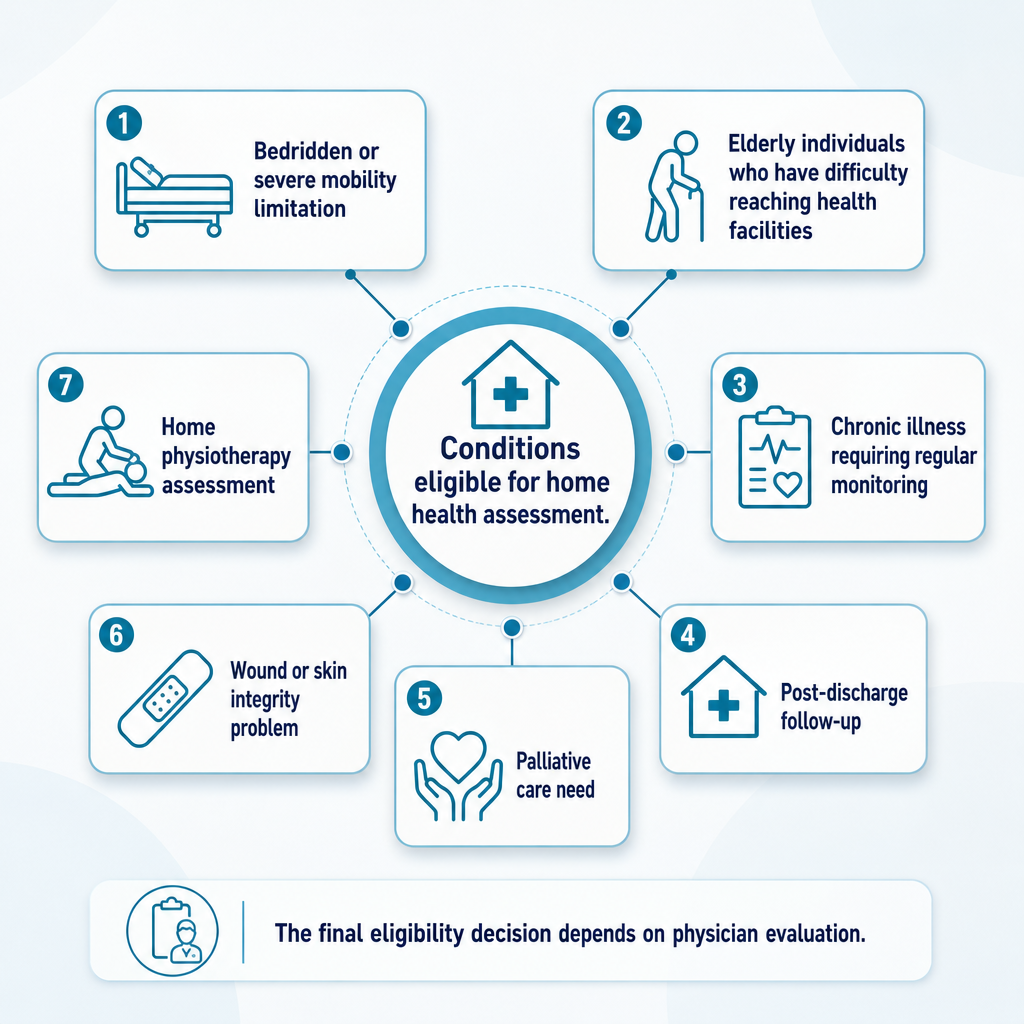 Groups of people eligible for home health care assessment
What criteria are taken into account when assessing suitability?
Belonging to the above groups does not alone determine suitability. Which person can benefit from planned home health care becomes clear through the joint evaluation of several complementary criteria.
| Criterion |
What is examined |
How it affects suitability |
| Medical need |
Existing disease, follow-up frequency, devices used, ongoing treatment |
If there are rapidly worsening signs, emergency evaluation may be needed instead of planned service |
| Mobility and dependency |
Bed dependency, sitting and standing, walking, self-care |
For a person who can safely reach the institution, outpatient evaluation may be appropriate |
| Continuity of care |
Whether a one-time visit or regular monitoring is required |
Follow-up frequency and duration are determined according to medical need |
| Suitability of the home environment |
Lighting, hygiene, safety, equipment placement, fall risk |
If the environment is inadequate, the plan may change or another channel may be needed |
| Informing |
Scope, process, possible risks, warning signs for admission |
Must be shared with the patient or their legal representative |
When medical need is assessed, the presence of newly emerging or rapidly worsening signs requires a different course than a planned home visit. The level of mobility and dependency indicates whether the person can safely reach a health institution; for people who can access it safely, outpatient evaluation is often more appropriate. Under the heading of continuity of care, while a single physician evaluation is sufficient for some patients, others require regular nursing, physiotherapy, or physician monitoring. The suitability of the home environment, on the other hand, covers whether the area where the service will be provided is favorable in terms of safety and hygiene. Finally, the scope of the service, the expected process, and which signs warrant admission to a health institution are shared with the patient or their legal representative; when necessary, the participation of a family member providing care can be planned in the process.
What topics may be included in private home health services?
The service scope of private health institutions varies according to the license and area of authority. Among the service topics we publish as the Private Dr. Emin Paçacı Home Care Center are home physician services, private nursing, physiotherapy, palliative care, wound care, blood tests by physician order, acute and chronic patient follow-up, post-surgical follow-up, and transfer support. For a breakdown of all topics, the Our Services page can be consulted.
Under the heading of home physician services, we carry out tasks such as physical examination, general assessment, chronic disease follow-up, family information, and, when necessary, referral for further evaluation. We address the content of nursing practices in detail in the content titled What Is the Scope of Home Nursing Services? Which service a person is suitable for is decided by the physician by evaluating together their clinical condition, the nature of the required medical procedure, and home conditions. If the nature of the need is not yet clear, sharing information about the existing diagnosis, follow-up frequency, and home conditions makes it easier to determine the appropriate service topic.
In which situations may home health care not be suitable?
In some situations, a different admission channel is needed instead of planned home health care. These include: the person being in a condition to reach a health institution and there being no need for medical evaluation at home, the requirement for advanced tests or procedures that cannot be performed at home, the emergence of a new sign suggesting a life-threatening condition, the home environment not being safe or adequate for the required service, and the service falling outside the institution's area of authority.
An important boundary is this: home health care does not replace emergency service or ambulance service. In cases of loss of consciousness, serious difficulty breathing, chest pain, severe bleeding, seizure, serious trauma, or similar life-threatening symptoms, 112 Emergency Health Services should be called. Ministry of Health sources also state that new emergency situations arising in people receiving home health care that differ from their existing follow-up condition do not fall within the duty area of the home health unit, and that in such cases 112 or the emergency service should be contacted.
What is the main difference between public and private home health care?
Public home health services are carried out in accordance with the admission and suitability criteria determined by the Ministry of Health. In public services in Istanbul, criteria such as age, level of dependency, chronic disease, bed or device dependency, and the need for medical follow-up after discharge are taken into account. These criteria form the official framework that determines to whom the public service is open.
In private home health services, the scope may vary according to the institution's license, medical staff, area of operation, and the services offered. In both cases, a medical suitability assessment is required, and the scope of the public service and the services offered by a private institution cannot be automatically considered interchangeable. For admission channels and contact details, the content titled How to Access Home Health Care in Üsküdar? may be a guide. Which channel is appropriate varies according to the person's condition and the nature of the need.
Frequently Asked Questions
Can only elderly people receive home health care?
No. Age alone is not decisive. People of different age groups who have bed or device dependency, severe mobility limitations, chronic disease, post-discharge follow-up, or a need for palliative care can also be evaluated.
Can a person who is not bedridden receive home health care?
In some cases, yes. Even if the person is not bedridden, if there is mobility limitation that makes it difficult to reach a health institution, a post-discharge follow-up requirement, or a need for regular medical care, a physician evaluation can be carried out. In public services, their own suitability criteria are additionally applied.
Can home health care be used in emergencies?
Home health care should not be awaited for a new life-threatening condition. In cases of symptoms such as loss of consciousness, chest pain, serious shortness of breath, or severe bleeding, 112 Emergency Health Services should be called.
Are home health care and home caregiving the same?
No. Home health care covers medical evaluation, follow-up, and health practices. Home caregiving, on the other hand, may focus on care tasks such as support in daily living activities and companionship. The appropriate type of service is determined by evaluating the nature of the need.
Who makes the decision on suitability for home health care?
Suitability is determined by the physician by evaluating the person's diseases, level of dependency, current treatment, home conditions, and the nature of the requested service. When necessary, the opinions of nurses, physiotherapists, and other health professionals are also included in the process.