There is no single fixed answer to the question of what home health care covers; the scope is determined according to the patient's diagnosis, medical needs, mobility limitations, the conditions of the home environment, and the physician's assessment. In general terms, this service may include a physician examination at home, medical follow-up, certain tests and sample collection procedures, physician-ordered applications, nursing care, physiotherapy, wound care, palliative support, and, when necessary, referral to a health facility or transfer coordination. Our aim here is to explain concretely which topics can be addressed in the home environment, which ones must be performed at a health facility, and how the scope is determined.
According to the official definition in Turkey, home health care refers to the medical services that can be provided in the environment where individuals live to those who, due to diagnosed illnesses, have become bedbound, device-dependent, or homebound, or who have difficulty accessing health services due to old age. This framework also explains why the scope varies from person to person: the determining factors are the patient's clinical condition and the follow-up or treatment plan that is created.
Contents
What does home health care mean?
Home health care is the provision of certain medical services in the environment where the patient lives, in situations where it is difficult for the patient to reach a health facility. The scope is determined in line with the patient's current health status and the follow-up or treatment plan created by the physician. For this reason, the content of the service provided to two different patients under the same heading can differ significantly.
This service does not mean only daily personal care support. It includes procedures that require the assessment of health professionals, such as examination, medical follow-up, nursing applications, and rehabilitation. On the other hand, daily living needs such as cleaning, meal preparation, dressing assistance, or companionship are considered a separate category from medical home health care. This distinction is important for families to clarify which support they are seeking for which need.
Which medical topics can be addressed in the home environment?
The topics that may come up in the home environment are not individually alternatives to one another; they are components that can be planned together according to the patient's condition. The prominent areas are as follows:
- Physician examination and medical assessment at home: The general condition, current complaints, known illnesses, and treatments in use are reviewed; a physical examination may be performed, vital signs may be evaluated, and whether further tests or an assessment by a different specialty are needed may be examined. After the examination, the patient and their relatives may be informed about the current situation. For details on this topic, you can benefit from our private physician service at home page.
- Home follow-up of chronic illnesses: In people with diabetes, heart failure, COPD, post-stroke conditions, dementia, and more than one chronic illness, findings such as blood pressure, pulse, fever, or respiration may be evaluated; nutrition, mobility, and fluid intake may be reviewed. The frequency of follow-up is not fixed; daily, weekly, or monthly planning varies according to the physician's assessment.
- Home nursing services: Dressing and wound care, catheter or sonde care, physician-ordered injections, follow-up of serum and intravenous applications, monitoring of vital signs, and post-discharge care support may fall within this scope. For information on the scope of applications, you can refer to our private nursing service at home page.
- Testing and sample collection: If deemed necessary by the physician, certain blood or biological samples may be collected in the home environment; the sample must be stored under appropriate conditions and delivered to an authorized laboratory. The process is explained in our article on how the home blood collection service works.
- Physiotherapy and rehabilitation: Mobility capacity, muscle strength, joint range of motion, balance and coordination, and in-home movement safety may be evaluated. The content of the application is determined according to the patient's diagnosis and current capacity; details are provided on our home physiotherapy service page.
- Wound care and follow-up: In pressure ulcers, post-surgical wounds, and chronic wounds, the location of the wound, skin integrity, discharge, odor, findings suggesting infection, and the nutrition-mobility status are addressed together. Wound care is not limited to changing the dressing; it also requires the assessment of underlying risks.
- Palliative care support: In serious or progressive illnesses, this may include symptom assessment, the physician's management of pain and other complaints, review of nutrition and fluid intake, planning of daily care needs, and informing the patient's relatives. Palliative care is not specific only to the end of life; it may come up at different stages of long-term illnesses.
- Post-discharge home follow-up: In line with the discharge summary, current diagnoses, follow-up plan, up-to-date medication list, and findings to watch for, physician assessment, nursing care, and wound follow-up may be planned.
- Certain applications under physician supervision: In the official regulation, procedures such as injections and sondes are indicated as examples of applications that can be performed in the home environment. Before these applications, the patient or their legal representative must be informed and the necessary consent must be obtained. The decision for serum, intravenous access, or injection is made not only based on request; it is made by jointly evaluating medical necessity, the patient's general condition, and the suitability of the home environment.
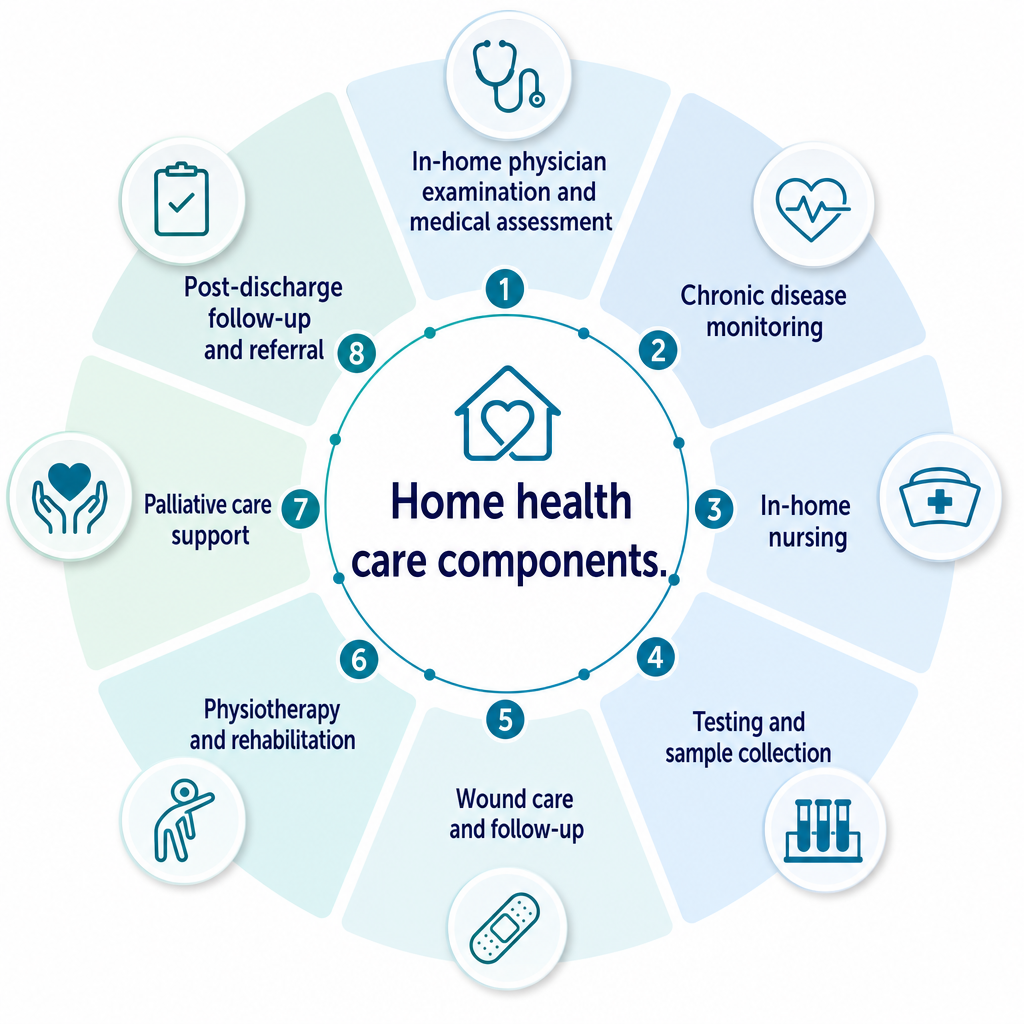 Main components of home health care
What are the limits of home health care?
To correctly understand the scope, it is also necessary to know what cannot be done in the home environment. An assessment performed at home may not replace every kind of examination or test that must be performed at a health facility. In situations requiring advanced imaging, intensive monitoring, surgery, or hospitalization, admission to a health facility is required. Similarly, collecting a sample at home does not mean that all tests can be performed in the home environment; depending on the type of test, the patient may need to go to a laboratory.
The most critical limit concerns emergency situations. Home health care is a planned medical assessment and follow-up service; it is not an alternative to the emergency department or hospitalization. According to the official regulation, if the home health team determines that the patient needs emergency health care, it ensures that the patient makes use of the 112 emergency health services. In the case of symptoms such as sudden changes in consciousness, severe shortness of breath, chest pain, newly developing signs of paralysis, uncontrolled bleeding, or severe deterioration of the general condition, a planned home visit should not be awaited; emergency health services should be contacted directly.
If the discharge plan includes checks or procedures that must be performed at a health facility, these are not automatically replaced by home health care. For this reason, the distinction between the follow-up that can be continued in the home environment and the procedures that must be performed at a facility should be clarified at the beginning of the care plan.
For whom might home health care be considered?
Home health care comes up more frequently in certain situations. The prominent groups can be summarized as follows:
- People who are bedbound or device-dependent,
- Elderly individuals who have difficulty leaving home or reaching a health facility,
- Patients who need a high level of support in daily living activities,
- People who require medical follow-up for a certain period after discharge,
- Those who require regular health monitoring due to chronic illnesses,
- Those with mobility limitations following a stroke or neurological illness,
- Patients who need palliative care,
- Those who need wound care or long-term nursing support.
In the public home health care legislation, people aged 80 and over, severely dependent chronic patients, device-dependent or homebound individuals, those deemed suitable for home medical care after palliative care, and people who need temporary or continuous medical care after discharge are included within the scope. These criteria do not mean that service will automatically be provided to every person; eligibility is determined through the assessment of health professionals.
What is the difference between home health care and home care?
Although the two concepts are often used interchangeably, their scopes are different. Home health care refers to medical services provided by physicians, nurses, physiotherapists, or other health professionals. Home care, on the other hand, may cover, in addition to medical care, supports that help the person maintain their daily life: services such as personal hygiene, dressing, nutrition, in-home support, and companionship are evaluated separately according to the nature of the provider and the service contract.
A patient may need both medical and daily living support during the same period. In such cases, the scope of health care and care support should be determined separately; which need will be met by which professional group should be defined from the outset. Clarifying this distinction reduces confusion in terms of both budget and responsibility planning.
How is the scope of the service determined?
When determining the scope, the following criteria are generally evaluated together:
| Criterion |
What it determines |
| Diagnosis and current health status |
Which medical topics are needed |
| Difficulty in reaching a health facility |
Whether the service will be considered in the home environment |
| Bed, device, or home dependency |
The frequency of follow-up and the intensity of care |
| Whether the procedure can be safely performed in the home environment |
Which application will be performed at home and which at a facility |
| Equipment and human resources |
The feasibility of the planned service |
| Consent and information conditions |
The legal steps required before the application |
In private institutions, the scope of service varies according to the institution's permits, staff structure, technical capabilities, and the patient's individual medical needs. Among the service headings published by our center are home physician, private nursing, palliative care, wound care, physiotherapy, physician-ordered blood tests, chronic patient follow-up, post-surgical follow-up, applications under physician supervision, and transfer support. Which headings are appropriate for a patient becomes clear through the assessment of the patient's condition; since the condition and symptoms vary from person to person, the assessment and treatment decision belong to the physician.
How do the application channels work?
For public home health care, applications can be made to the Ministry of Health Home Health Care Communication Center via the hotline 444 38 33. Applications are subjected to a preliminary assessment; for those deemed suitable, the first visit is carried out accompanied by a physician, and it is evaluated whether the person falls within the scope of home health care. The scope and planning of the public service are carried out according to the relevant legislation and regional service organization.
In private health institutions, the application, assessment, and service planning are carried out within the framework of the institution's own working order and the conditions for compliance with legislation. In the first stage, the patient's diagnosis, current treatment plan, mobility limitations, and the conditions of the home environment are reviewed; afterwards, which headings are appropriate is determined. If you are not sure which service heading your need corresponds to, by sharing the patient's condition, findings, and care goals, we can clarify the appropriate assessment framework together.
Frequently asked questions
Is home health care provided only to bedbound patients?
No. Bed or device dependency are important criteria; however, difficulty in reaching a health facility due to old age, post-discharge medical follow-up, chronic illnesses, wound care, and the need for palliative care may also be taken into consideration.
Is home health care used in emergency situations?
Home health care is a planned medical assessment and follow-up service. When an emergency is detected, the 112 emergency health services come into play. In the case of severe or sudden-onset symptoms, a planned home visit should not be awaited.
Does home serum or injection service fall within this scope?
If deemed appropriate by the physician, if there is medical necessity, and if the application can be performed in the home environment, certain injection or intravenous applications may be considered. The necessity and content of the application are determined by health professionals.
Does home health care cover all procedures performed in hospital?
No. At home, only services that can be performed in line with the patient's current condition and treatment plan can be provided. In situations requiring advanced imaging, intensive monitoring, surgery, or hospitalization, admission to a health facility is required.
Which health professionals can take part in home health care?
Depending on the patient's needs, physicians, nurses, physiotherapists, dietitians, psychologists, social workers, or other relevant health professionals may take part. The team structure is determined according to the patient's medical needs.