The short answer to the question "what is a home healthcare consent form" is this: it is a written record documenting the acceptance given by the patient or their legal representative of their own free will, after the necessary explanations have been provided about the healthcare service or medical intervention planned to be delivered in the home environment. This document is not merely a signature page; it is the written portion of the information process that explains to the patient the scope of the planned service, how it will be applied, its possible risks, alternatives, and the consequences that may arise if the service is declined. In the Regulation on Patient Rights, consent is defined as a person accepting a medical intervention of their own free will and in an informed manner.
What makes this form important within the framework of home care is that the decision is made in the patient's own living space and often in an environment where relatives are present. The following headings concretely explain which process consent documents, how it differs from informed consent, what information the form contains, who signs it, and the patient's right to change their decision.
Table of Contents
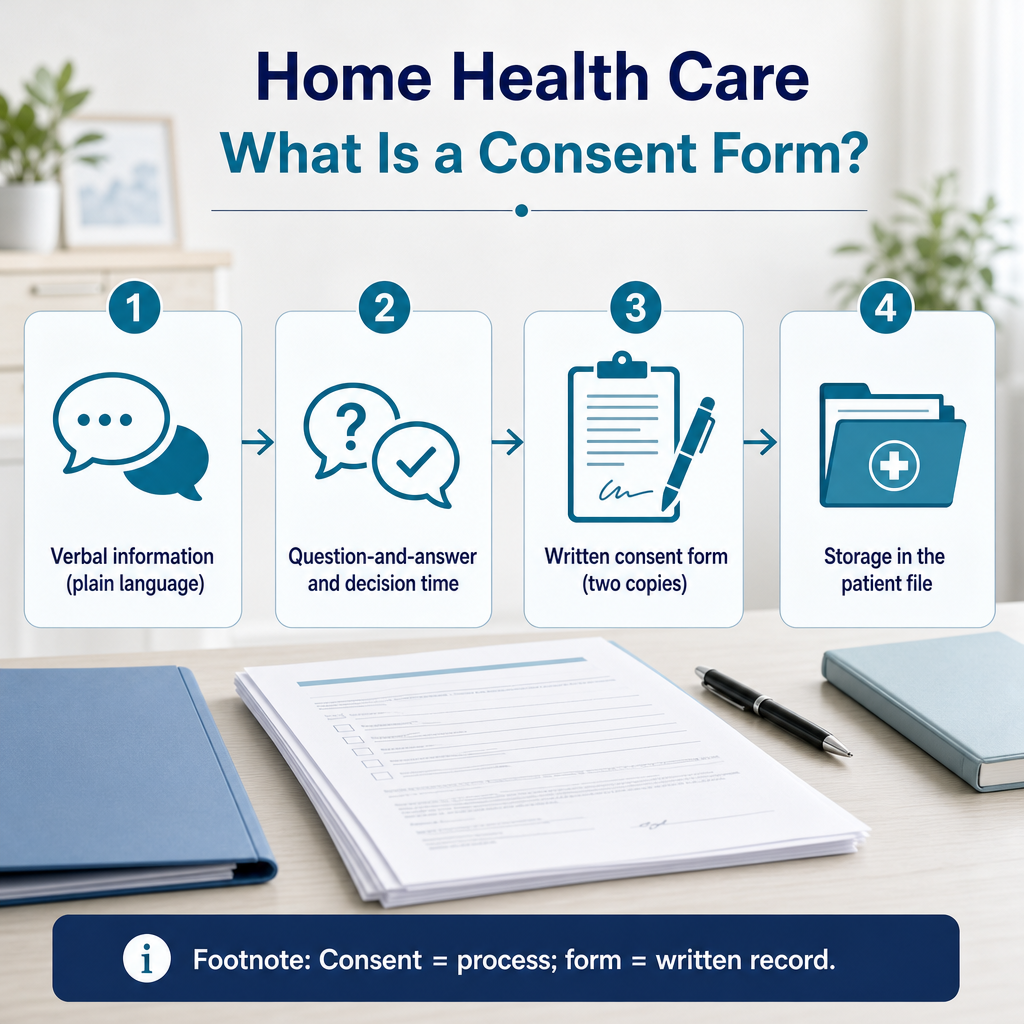
The two concepts are often confused, yet their differences are decisive in terms of the validity of the decision. Informed consent is the entire process of providing the patient with information, the patient understanding this information, and deciding of their own free will. The consent form is the written record of this process. Therefore, merely having the patient sign a form does not, in itself, constitute adequate information.
According to the Regulation on Patient Rights, the information in the form must also be conveyed to the patient verbally; the information must be provided in plain language that the patient can understand and with consideration for their social and cultural characteristics. The essential principle is that the patient themselves is informed. At their request, the patient may ask for another person to be informed as well; however, this request must be recorded in writing.
The practical consequence of this distinction is clear: a well-prepared form does not replace the conversation, it documents the conversation. If a process in which the patient can ask questions, receive answers, and decide without pressure has not been carried out, a signed paper alone cannot be considered to have completed the information process.
The content of the form varies according to the service to be provided and the medical procedure to be applied. Nevertheless, certain headings are generally included within the scope of information. The table below shows the information expected to be in the form, together with which question this information answers from the patient's perspective.
| Information in the form |
The question it answers for the patient |
| Identity information (patient and, if necessary, legal representative) |
Who is giving consent |
| The subject of the service or medical intervention |
What will be applied |
| Where, by whom, and how it will be provided |
Which healthcare professional will perform the procedure |
| Expected medical purpose and alternatives |
Why this option, is there another way |
| Possible risks and complications |
What undesirable situations may arise |
| Consequences that may arise in case of refusal |
What happens if I do not accept |
The form also includes the important characteristics of the medications, materials, or devices to be used, how to access medical assistance when necessary, the answers given to the patient's questions, the declaration of acceptance or refusal, and the name, signature, and date of the healthcare professional providing the information. In the article of the Regulation on Patient Rights concerning the scope of information, it is stipulated that information such as the probable course of the illness, the manner in which the intervention will be applied, alternatives, benefits and risks, complications, and the possible consequences of refusing the intervention must be explained.
 Components of the home health care consent process
No. The content of the consent form differs according to the nature of the service, and this distinction is important in practice. Three different situations need to be distinguished from one another.
General home healthcare consent may document that the patient has accepted receiving home healthcare and has been informed about the general framework of the service. For example, general consent may be obtained for home physician evaluation, nursing follow-up, or care planning.
Special consent for medical intervention is a separate requirement. When an injection, intravenous procedure, wound care, or another intervention is involved, a procedure-specific explanation and consent may be required in addition to the general consent. Therefore, the "home healthcare consent form" and the "consent form for a specific medical intervention" should not be regarded as the same document.
Information sharing and recording consent is the third heading. Sharing the patient's health information with a patient's relative or another person is a matter that must be addressed separately; the patient's privacy must be protected and the scope of sharing must be determined. Which form is necessary is decided by the healthcare professional, taking into account the service to be provided and the patient's medical condition.
The consent form generally takes shape with the participation of three parties: it is signed by the patient, by the legal representative if the patient lacks decision-making capacity, and by the healthcare professional who provides the information and will carry out the medical intervention.
If the patient is a minor or incapacitated, the permission of the parent or guardian is required in the relevant situations. On the other hand, it is essential that a minor or incapacitated patient who is able to understand what is explained also participates, to the extent possible, in the information and decision-making process. Even in a process carried out through a legal representative, the patient's existing level of comprehension and ability to communicate must be taken into account.
On the matter of copies, the legislation is clear: according to the Regulation on Patient Rights, the consent form is signed in two copies. One of the copies is placed in the patient's file, and the other is given to the patient or their legal representative. The healthcare professional who prepares the form is responsible for the accuracy of the information provided. In home care services, the patient's file may also contain medical evaluations, physician orders, the care plan, follow-up notes, and test results; the legislation also provides that the patient may request the information in their file.
When is consent obtained, can it be withdrawn
Consent is obtained after sufficient information has been provided about the planned healthcare service or medical intervention and before the application begins. The patient must be allowed a reasonable amount of time to make a decision, their questions must be answered, and the decision must not be made under pressure. In home care arrangements as well, it is stipulated that the informed consent of the patient or their legal representative must be obtained before admission to the service; furthermore, the patient must be informed about the content of the service, their rights, obligations, and possible risks.
The process is not static. If a change is subsequently made to the service plan or a new medical application comes up, re-information and consent may be required depending on the nature of the change. This is a point frequently encountered in chronic conditions where home follow-up lasts a long time; for the general operation of the process, you may review our article explaining how the home follow-up process works in chronic illness.
Except in legally mandatory situations, the patient has the right to refuse the treatment planned to be applied or the ongoing treatment, or to request that it be stopped. In this case, the possible consequences of refusal are explained to the patient or their legal representative and a written declaration is obtained. The withdrawal of consent does not mean that every previously accepted procedure can automatically be continued; which application will be stopped or whether a new plan is required is explained by the healthcare team after evaluating the medical condition.
In emergency situations where consciousness is lost, there is a threat to life, and the patient's consent cannot be obtained, certain exceptions exist to allow the necessary medical intervention to be performed. In this case, the procedure performed and the reason consent could not be obtained are recorded; if possible, the patient's relative or legal representative is informed. When the patient regains consciousness or decision-making capacity is established, the patient's consent is sought for subsequent interventions.
These two documents serve different functions and one does not replace the other. The consent form is a record documenting the medical acceptance given by the patient after being informed about the healthcare service or medical intervention. The service contract, on the other hand, is a document of an administrative nature that regulates the parties to the service, its scope, the planning conditions, and the responsibilities of the parties.
The fact that a service contract has been signed does not replace the informed consent required for a medical intervention. Likewise, the consent form is not regarded as the document that regulates all the administrative or contractual details of the service. When signing a document placed before them, the patient and their relative should distinguish which document covers which subject; this distinction ensures that both the medical acceptance and the conditions related to the service are correctly understood.
Topics that should be clarified before signing
The consent form is one of the documents that supports the patient's right to decide and right to be informed. At the same time, it creates a record of what information the healthcare team provided and which service the patient accepted. However, the form does not eliminate the healthcare worker's medical responsibility; for consent to be valid, the information must be understandable, the decision must be made of free will, and the procedure to be applied must remain within the limits of the consent.
Before signing, the patient or their legal representative may ensure that the following points have been explained:
- Which service or procedure is planned and which healthcare professional will perform it
- How the service will be carried out in the home environment and what the possible risks are
- Whether other evaluation or application options exist
- What consequences may arise if the service is not accepted
- What follow-up and communication arrangement will be applied after the procedure
- With whom and to what extent the health information may be shared
If there are sections that are not understood, it is appropriate to request clarification from the healthcare professional before signing. It is one of the fundamental principles of the legislation that information must be provided in a language the patient can understand.
When planning home healthcare in Üsküdar and Istanbul
When evaluating home healthcare in Istanbul, the patient's medical need, mobility status, the suitability of the home environment, the necessary equipment, and the scope of the healthcare team's duties are considered together. The home care services legislation also stipulates that the home environment be suitable for the provision of safe and effective care; and that the patient's care and treatment plan be established through a physician evaluation. The consent process is also an inseparable part of this planning: as it becomes clear which service will be provided within what scope, the content of the information to be given to the patient also becomes concrete.
The scopes of home physician, nursing, and physiotherapy services differ from one another; for this reason, the information provided for each service may also include different headings. To learn about the general framework of these services, you may review our pages on private home physician services, private home nursing, and home physiotherapy. Which document will come up at which stage is evaluated according to the patient's medical condition and the planned service; this evaluation and treatment decision belongs to the physician.
Frequently Asked Questions
In medical interventions, the patient's consent is essential. A consent form is prepared for interventions stipulated in the legislation or where the possibility of dispute exists; the information is conveyed verbally and the form is signed.
Yes. The consent form is signed in two copies, and one of the copies is given to the patient or their legal representative.
Can a patient's relative give consent on behalf of the patient?
This situation varies according to the patient's age, decision-making capacity, and the legal representation relationship. If the patient is in a condition to make a decision, the essential principle is that the patient themselves is informed and gives consent. In cases requiring legal representation, the approval of the relevant representative may be obtained.
No. The consent form only indicates that the patient has been informed and has accepted a specific service or medical intervention. Medical outcomes may vary according to the patient's general health status, diagnosis, the procedure applied, and other clinical factors.
The content of the form is explained to the patient or their legal representative by the healthcare professional involved with the planned service and medical intervention. The information must be provided in a language the patient can understand.