The short answer to the question of what home IV fluid service is: it is the administration of fluids or planned medical products intravenously in the patient's environment by competent healthcare personnel, provided a physician deems it appropriate following a medical evaluation. In everyday language, "getting an IV" is perceived as a simple procedure; however, from a clinical standpoint, the content, amount, infusion rate, and duration of the fluid given are determined according to the person's condition, and the procedure requires evaluation beforehand, monitoring during, and observation afterward. This article explains, within an informative framework, what an IV fluid is, how it acts in the body, in which situations it comes into consideration, and why the decision belongs to the physician.
Table of Contents
The Ministry of Health's legislation on home care services regulates the framework for the service provision of home care centers and the healthcare personnel working in these centers. IV fluid administration, within this framework, is one of the applications carried out under physician supervision as part of home health services. As Private Dr. Emin Paçacı Home Care Center, we handle intravenous applications not merely as a fluid-administration procedure, but as a process that begins with medical evaluation and continues with monitoring and documentation.
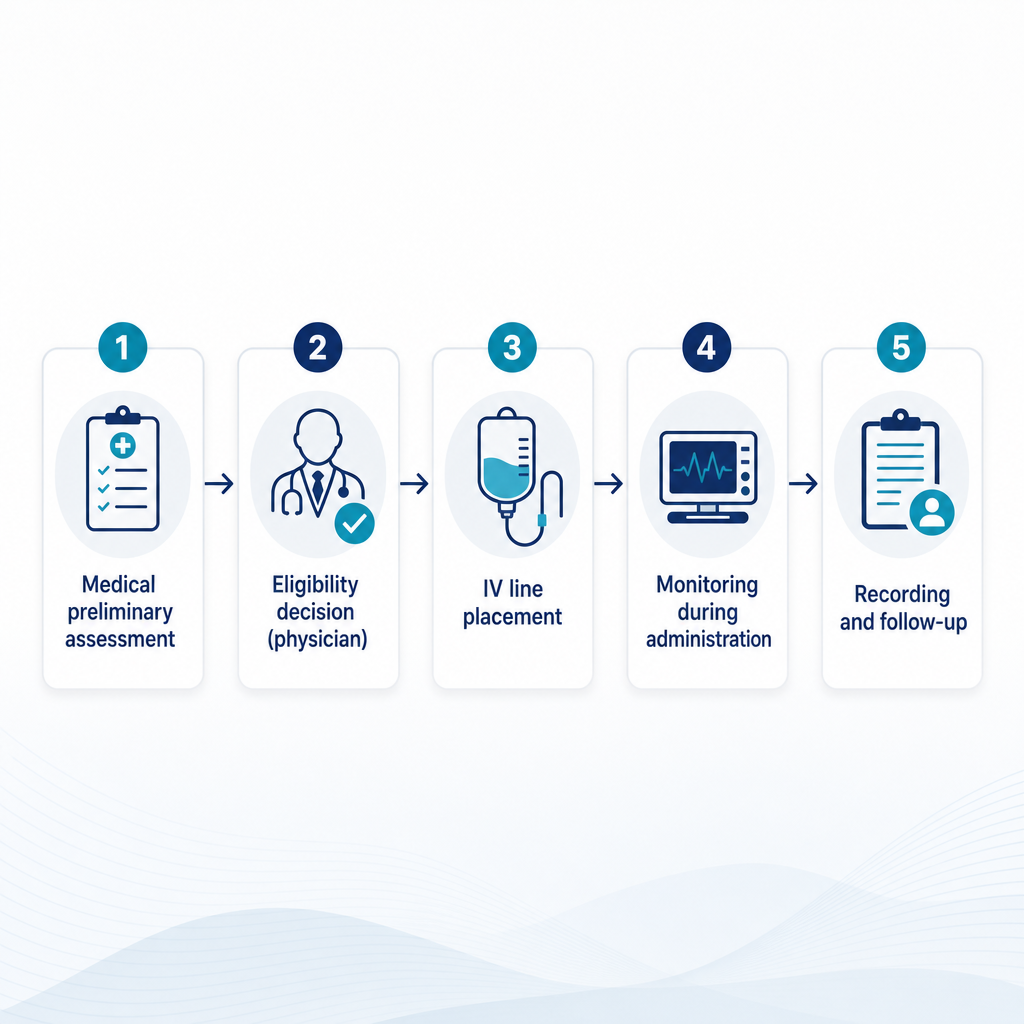 Stages of home IV fluid administration
How does IV fluid administration act in the body?
Fluid administered intravenously reaches the circulatory system directly. For this reason, the effect of the application cannot be explained by a single rule; it can vary according to the content of the fluid, the person's fluid-electrolyte status, heart and kidney functions, age, and accompanying diseases. The same fluid can produce different outcomes in two different patients.
The main purposes overseen by the physician in intravenous fluid administration may include:
- Meeting the portion of the fluid requirement deemed appropriate by the physician,
- Supporting the correction of certain electrolyte imbalances,
- Administering intravenously medical products that are not suitable to take orally or by another route,
- Ensuring the administration of a treatment planned by the physician.
An important distinction is this: not every sign of weakness, headache, fatigue, or fluid loss requires an IV. In intravenous fluid therapy, the person's fluid and electrolyte needs must first be evaluated, and monitored during and after the application. NICE's intravenous fluid therapy guideline recommends that people receiving intravenous fluids be evaluated and regularly monitored by competent healthcare professionals. This approach relates to the fact that, because the fluid passes directly into circulation, incorrect planning can produce rapid effects.
In which situations is home IV fluid service considered?
Home IV fluid administration may come into consideration based on the result of a physician's examination or medical evaluation. Typically, the following conditions become subjects of evaluation:
- Inability to take sufficient fluids orally,
- Fluid loss evaluated by a physician,
- Limited oral fluid intake due to swallowing or feeding difficulties,
- The presence of a treatment planned by the physician to be given intravenously,
- People who have difficulty going to the hospital but whose general condition is deemed suitable for home monitoring,
- Short-term intravenous applications planned by the physician after discharge.
These examples do not mean that an IV will be administered. Whether an IV is necessary is determined by the physician according to the cause of the symptoms, examination findings, medications used, known diseases, and the results of tests deemed necessary.
In people with heart failure, kidney disease, advanced age, fluid-electrolyte imbalance, or serious general health impairment, fluid therapy must additionally be evaluated carefully. Administering fluid in excess or too rapidly can lead to problems such as fluid overload and electrolyte disturbances. For this reason, the "let's hook up an IV so they feel better" approach carries the risk of overlooking the underlying cause.
Scope and operation of the service
The scope of the service varies according to the person's clinical condition and the plan created by the physician. Thinking of the process as stages with distinct tasks makes it easier to understand what is done and why.
Preliminary medical evaluation: Complaints, existing diseases, medications used, known allergies, and previous treatments are evaluated. Findings such as blood pressure, pulse, temperature, respiratory status, and general appearance may also be taken into account.
Suitability decision: The physician decides whether IV fluid administration is necessary and whether it is appropriate to carry it out in the home environment. If the person's condition exceeds the limits of home monitoring, evaluation or transfer to a different healthcare facility may be required.
Intravenous application: In a person deemed suitable, the intravenous line is established by competent healthcare personnel in accordance with healthcare rules. The fluid or medical product to be used is determined according to the physician's order, the person's condition, and the application plan.
Monitoring during the application: Throughout the application, the general condition, the IV site, and the vital signs deemed necessary are monitored. The application rate or plan is evaluated by the healthcare professional according to the clinical response.
Documentation and follow-up: The content and duration of the application, observations, and emerging findings are recorded in the health record. When necessary, a follow-up plan or a recommendation for further evaluation is created. This stage is the part that shows the process consists of more than just inserting a needle.
Roles of the physician and nurse in IV fluid administration
In home health services, roles are not interchangeable. In IV fluid administration, too, the work of the physician and the nurse correspond to different areas of responsibility.
The physician evaluates the general condition, determines the need for an IV and the suitability of the application, plans tests or further evaluation if deemed necessary, decides on the medical necessity of the treatment to be used, and determines the need for post-application monitoring.
The nurse carries out the procedure process in line with the plan created by the physician, performs the intravenous application and monitoring of the IV, observes the vital signs and the IV site, reports developing findings to the physician, and supports the post-application care and observation process.
This division of labor may differ according to the person's clinical condition and the scope of the service. For details on service categories, our home private nursing service and home private physician pages can be reviewed.
Possible risks and findings to monitor
As with every intravenous application, undesirable situations can also occur in home IV fluid administration. Knowing these risks is not for refusing the application, but for understanding what is being monitored and what should be reported. Possible risks include the following:
- Redness, swelling, tenderness, or vein inflammation at the IV site,
- Leakage of fluid into tissues outside the vein due to the IV line dislodging (infiltration),
- Bleeding or bruising at the application site,
- Infection,
- Allergic reaction related to the product used,
- Fluid overload due to administering fluid in excess,
- Electrolyte imbalances,
- Effects on existing heart or kidney diseases.
As stated in resources on intravenous fluids, the leakage of fluid into tissues outside the vein is called infiltration. Fluid overload, on the other hand, can manifest as shortness of breath, edema, or blood pressure changes, especially in people whose heart or kidney functions are impaired.
If shortness of breath, chest tightness, widespread rash, swelling of the face or lips, altered consciousness, marked dizziness, rapidly increasing swelling around the IV site, or severe pain occurs during or after the application, healthcare personnel must be informed and the person must be medically evaluated. In severe or life-threatening symptoms, the 112 Emergency Call Center must be called. For sterilization, which is another component of the safety dimension, the topic of sterilization in home IV fluid applications can be reviewed.
Can every IV fluid administration be done at home?
No. The suitability of home IV fluid service is not determined solely by the person being at home. When deciding, multiple factors are evaluated together: general clinical condition, the medical justification for the need for an IV, heart-kidney-liver diseases, fluid and electrolyte balance, consciousness and respiratory status, allergy history, medications used, the need for monitoring during the application, and whether an intervention and transfer plan exists for emergencies at home.
Conditions such as severe shortness of breath, chest pain, confusion, fainting, signs of shock, uncontrolled bleeding, or rapidly deteriorating general condition should not be treated as situations limited to home IV fluid administration. These findings may require emergency medical evaluation and go beyond the scope of home follow-up.
The difference between IV fluid service and emergency intervention
Home IV fluid service is a health application planned for situations that have been previously evaluated and are thought to be manageable in the home environment. The emergency department or 112 Emergency Health Services, on the other hand, are intended for situations that are life-threatening or require rapid evaluation and advanced medical facilities. The two are not alternatives to each other.
Moreover, getting an IV is not a general application that eliminates the underlying cause. Fever, vomiting, diarrhea, weakness, or dizziness may be related to different health problems. For this reason, deciding only on IV fluid administration without evaluating the cause of the symptoms is not appropriate. Home IV fluid administration is also not a separate diagnostic process that replaces home nursing or home physician services; when necessary, a physician's examination, laboratory investigation, or evaluation at another healthcare facility may be required. To see the full range of service types offered at home, the article on the scope of home health service can be consulted.
Points to consider when getting information
When getting information about home IV fluid service, several topics stand out that help ensure the process is carried out safely and with documentation:
- Whether a physician evaluation was performed before the application,
- On what medical grounds the fluid or medical product to be used is planned,
- The duties and authority of the healthcare personnel who will perform the application,
- Whether allergies, chronic diseases, and regularly used medications were questioned,
- IV line and medical waste safety,
- Which findings will be monitored during the application,
- How to reach the physician and the necessary health services in an undesirable situation,
- Whether the application information is recorded in the patient record.
In our service information, we handle home private physician care, home private nursing, applications under physician supervision, and IV fluid treatments as separate topics; the scope and suitability of IV fluid administration are determined in every case according to the person's medical evaluation. For an evaluation specific to the person's condition, you can review our relevant service topics and share your needs with us.
Frequently Asked Questions
What is home IV fluid service?
It is the administration of fluids or planned medical products intravenously by competent healthcare personnel in the person's environment, in situations deemed appropriate by a physician. Evaluation, monitoring, and documentation are inseparable parts of this service.
Can an IV be administered to everyone?
No. The need for an IV and whether it can be administered at home are determined by evaluating the examination, existing diseases, medications used, and general condition. The decision belongs to the physician.
Does an IV relieve fatigue?
Fatigue can have many causes. IV fluid administration should not be considered a general solution for fatigue without identifying the cause. The necessary medical evaluation is performed by the physician.
What is monitored during home IV fluid administration?
The general condition, vital signs, the IV site, and the response to the application are monitored. Findings such as redness, swelling, shortness of breath, rash, or altered consciousness should be reported to healthcare personnel.
Does home IV fluid administration replace the emergency department?
No. In severe or rapidly deteriorating symptoms, emergency medical evaluation is required instead of a home IV. When necessary, the 112 Emergency Call Center must be called.