Home IV therapy service is the planned administration of intravenous (IV) treatment—in which fluids and medications are delivered directly into the vein—carried out in the patient's own home by licensed nurses upon a physician's decision. The aim is generally to provide fluid-electrolyte support, to contribute to nutrition when oral intake is limited, or to continue certain treatments that must be given intravenously in the home environment. The suitability of the patient's clinical condition is the first requirement for administration in the home setting.
Contents
What home IV therapy service is and what kind of medical practice it is
Intravenous therapy is a treatment route administered by delivering fluids and medications directly into the vein. Clinical sources state that this route is used in situations such as replacing fluid loss (rehydration), supporting individuals who cannot take fluids or nutrition by mouth, correcting electrolyte imbalances, administering certain medications, and providing parenteral nutrition when necessary. The practice we call IV therapy is the most commonly encountered form within this broad framework: delivering fluids intravenously at a controlled rate.
When administered in the home setting, the mechanism is the same; what changes is the environment. An IV line is placed, the appropriate fluid or the treatment planned by the physician is delivered at a specific infusion rate, and throughout the administration the IV site and the patient's general condition are monitored. The IV route is an invasive procedure; because it can lead to problems in the vein and surrounding tissues, infection, or circulatory overload when performed incorrectly, it requires trained healthcare personnel and appropriate monitoring. For this reason, home IV therapy is not a self-administered procedure but a healthcare service based on a physician's decision and carried out under nursing supervision.
This framework also stands out in the official definition of home healthcare services: the provision of medical services that can be delivered in the place where the individual lives, supporting quality of life and reducing the need for hospitalization. IV therapy is regarded as one of the planned and traceable procedures covered by this definition. Whether the procedure can be performed at home depends on the patient's condition being stable and predictable.
Types of IV/serum that can be administered at home and their limits
The IV applications considered at home are not uniform; they are planned with different contents and durations according to the indication determined by the physician. The commonly encountered frameworks are as follows:
- Hydration and fluid support: Providing and maintaining fluid volume in individuals who cannot take adequate fluids by mouth or who are at risk of fluid loss.
- Electrolyte support: Correcting disturbances in electrolyte balance according to the physician's plan.
- Certain intravenous medications: Administering treatments that can only be given intravenously or for which the physician deems the intravenous route appropriate.
- Short-term parenteral nutrition support: Support planned by physician decision in cases where nutritional needs cannot be met orally.
The practical meaning of these distinctions is that not every IV therapy is suitable for the home environment. Applications where the general condition is stable, the intervention is predictable, and intensive monitoring is not required can be carried out at home. In contrast, conditions with emergency criteria such as hemodynamic instability or severe respiratory distress fall outside the scope of home healthcare services; in such cases, the emergency healthcare system and hospital admission are essential. Similarly, certain complex IV regimens that require intensive and continuous monitoring may require hospital conditions.
The phrase "medical services that can be performed on-site" used in home healthcare legislation draws exactly this boundary. Whether an application can be considered performable at home becomes possible when the patient's condition, the manageability of the intervention, and the required intensity of monitoring are evaluated together. This assessment is made individually for each patient.
Who home IV therapy service is considered for
Home IV therapy comes into consideration in cases where frequent trips to the hospital become difficult or where the clinical condition can be monitored at home. The home healthcare literature shows that this service is particularly meaningful for the following profiles:
- Individuals with limited mobility and difficulty in transportation
- Elderly patients who cannot tolerate frequent outpatient visits
- People with chronic illnesses requiring regular medical monitoring
- Patients for whom serum or fluid support is planned for a certain period after discharge
The common feature of these profiles is that the treatment is planned and traceable. Home healthcare is not a field where sudden emergencies are managed; it is a field where care planned by a physician is continued in the home environment. The requirement to seek hospital care is preserved under all circumstances when the patient's condition changes or a new emergency develops.
Having the patient in their own home is also considered valuable in the home care literature in terms of preserving family integrity and allowing the individual to experience a more harmonious process in their own environment. For individuals who need serum on a long-term or frequent basis, we address how the process is organized in a broader framework in our 24-hour home patient care article. Even so, the suitability decision in every case is based on individual assessment.
Physician and nurse collaboration for safe home IV therapy
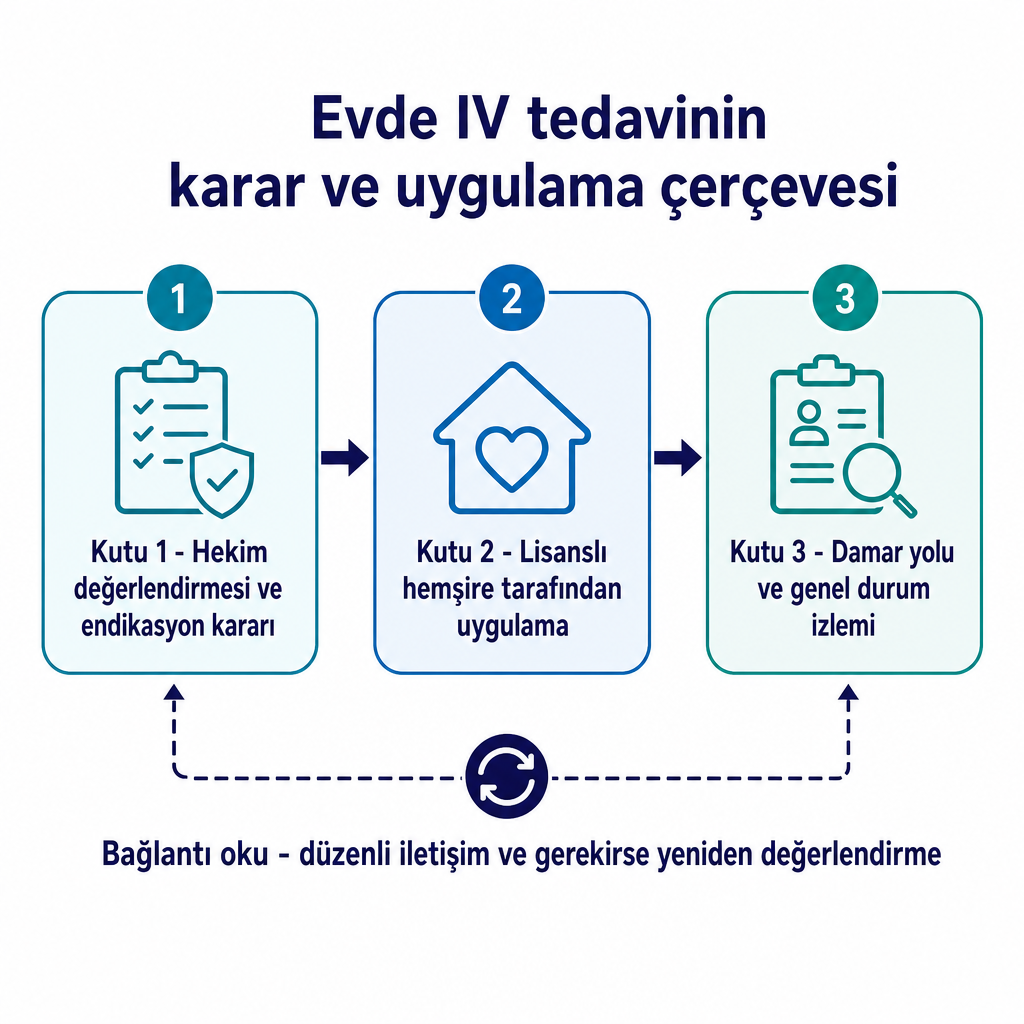
The safety of home IV therapy relies on two professional roles complementing each other. The authority to diagnose, plan treatment, and issue the intravenous therapy order lies with the physician. The physician evaluates the indication, the treatment scheme, the patient's accompanying illnesses, and possible complication risks. We detail how this evaluation is carried out within the scope of our home private physician service.
The nurse's role is administration and monitoring within the framework of this plan. IV fluid administration instructions define responsibilities to the nurse such as observing the IV line and infusion site, assessment before and after administration, and monitoring for signs of complications. We explain the framework of applications such as serum administration, vital sign monitoring, and IV line care on our home private nursing service page.
Another factor that determines safety is the regular communication between the physician making the home visit and the nurse working at home, along with a mechanism for reassessment when necessary. The risks carried by the IV route are grouped under headings such as IV line infection, extravasation, thrombophlebitis, and fluid overload. These risks are managed with trained personnel, appropriate materials, and regular monitoring. Providing general information to the patient and family about observing the IV site and warning signs is also part of the process; this information is not an administration instruction but a principle-level guidance that supports monitoring.
Which criteria stand out in the assessment
When evaluating home IV therapy service, the decision is shaped through several criteria. These are not a sequence of procedures but criteria that determine suitability:
| Criterion | What it determines |
|---|
| Clinical suitability | Whether the patient's condition can be monitored at home and is stable |
| Indication decision | Which IV therapy is planned and for what purpose |
| Monitoring intensity | Whether it requires a short infusion or long-term, frequent monitoring |
| Team coordination | Communication and reassessment between physician and nurse |
| License and oversight | Compliance of the service-providing institution with regulations |
The heading of licensing and oversight holds a special place among these criteria. A Ministry of Health license indicates the institution's compliance with regulations in terms of physical conditions, personnel structure, and record-keeping and oversight processes. We address why this matters for individuals receiving home care in our Ministry of Health approved home care article.
As Özel Dr. Emin Paçacı Home Care Center, we plan home serum applications within the scope of nursing services following a clinical assessment that begins with a physician visit. As a home care center licensed by the Ministry of Health, we carry out our home private physician and home private nursing services in a way that complements each other within the same care process. In our ethical, science-based, patient-centered approach, we adopt the principle that the medical decision belongs to the physician and the administration belongs to licensed healthcare professionals.
On the cost side, there is no single framework: elements such as treatment duration, the IV line and consumables used, the number of visits required, and the monitoring period determine the planning. For this reason, suitability and organization are addressed individually according to the patient's condition. In Turkey, the public home healthcare system provides services for certain patient groups through the national line 444 38 33; private home care institutions operate within a separate organizational framework. The two channels exist side by side, and which is the most appropriate route for your own situation becomes clear through individual assessment. It is recommended that you consult your physician or our team about whether serum therapy is suitable for you and how it will be planned.
Frequently asked questions
Is home IV therapy service safe?
When carried out with appropriate patient selection, a physician's decision, and licensed nurse supervision, home IV therapy is provided as a planned healthcare service. Since the IV route is an invasive intervention, it requires trained personnel and regular monitoring; the suitability decision is made individually for each patient.
Is a physician's decision required for home serum administration?
Yes. Determining the indication, treatment content, and scheme falls within the physician's authority. The nurse performs administration and monitoring within the framework of this plan. The serum content and dose depend entirely on the physician's decision.
Can every serum treatment be performed at home?
No. Conditions where the general state is stable and monitoring is predictable can be carried out at home. Some treatments that carry emergency criteria or require intensive and continuous monitoring require hospital conditions.
What is done if a problem occurs during serum administration?
Home healthcare is a field of planned care; sudden emergencies fall outside this scope. In such situations, emergency mechanisms—primarily the 112 emergency health services—and hospital admission are relied upon.
What is the difference between public and private home healthcare services?
The public home healthcare system provides services for certain patient groups through the 444 38 33 line. Private home care institutions operate within their own organizational framework. The two options exist side by side; which one is appropriate depends on individual assessment.