Home wound care is a multi-stage process carried out through the regular assessment, cleaning, and covering of the wound with appropriate dressing according to the plan determined by the physician; alongside attention to fundamental rules such as hand hygiene, clean materials, a suitable environment, and waste management to reduce the risk of infection. In this article, we address the question "How Is Home Wound Care Performed? Basic Hygiene Rules for Preventing Infection Risk" within a framework based on medical sources: how the wound is assessed, through which mechanism infection develops, and what hygiene principles can be adapted to the home environment. Since the type of wound, infection risk, and care capacity vary from person to person, the determination of the method to be applied relies on physician assessment; the information here, on the other hand, is aimed at understanding the logic of the process.
Contents
What is home wound care, and in which situations does it come up?
Home wound care refers to the regular monitoring and care, in the environment where the person lives, of wounds developing after surgical intervention, wounds due to chronic diseases (such as pressure ulcers and diabetic foot wounds), and wounds arising after trauma. The purpose of the process is not merely to close the wound: keeping the wound clean, protecting the surrounding tissue, reducing excessive pressure and trauma, lowering the risk of infection development, and supporting the normal healing process are all targeted together.
Which wound can be monitored at home is not determined according to a single criterion. The depth and width of the wound, the amount of discharge, the patient's age, mobility, chronic diseases, and general nutritional status are evaluated together. The widely accepted approach in medical sources is that physician and nurse assessment should take priority in high-risk, deep, foul-smelling, rapidly expanding wounds, or those accompanied by diabetes. This distinction is important, because the same care routine may not be suitable for every wound.
How does infection develop? The basic mechanisms of wound healing
Infection arises when microorganisms reach the wound bed, multiply, and the body's defense mechanisms are unable to control this burden. This mechanism explains why hygiene rules are so decisive: frequent contact with the wound area, unsuitable cleaning materials, dirty dressing material, insufficient hand hygiene, and moist, poorly ventilated environments are among the factors that increase the risk of infection. Each of these can be thought of as a link that facilitates the microorganism's reaching the wound or that challenges the defense.
Healing itself is also a staged process. Wound healing consists of the inflammation, proliferation, and remodelling (reconstruction) phases; these phases are supported by tissue oxygenation, adequate blood supply, protection from mechanical trauma, and compliance with hygiene conditions. Reducing pressure, preventing excessive moistening of the wound area, and protecting the tissue from irritating chemicals help these phases proceed healthily. For this reason, hygiene is not an additional measure outside the healing process; it is a direct part of healing.
The role of hygiene in home wound care
An important part of the question of how home wound care is performed relates to complying with basic hygiene rules for preventing the risk of infection. Here, hygiene is not limited in a narrow sense only to the moment of dressing. It is a broad framework encompassing together the hand and body hygiene of the caregiver, the cleanliness of the room, the quality of the materials used, and the control of waste.
In scientific publications, handwashing is emphasized as one of the simplest and most effective practices for reducing microorganisms in wound care. In addition, limiting unnecessary contact with the body region where the wound is located, complying with aseptic conditions as much as possible, and reducing the risk of contamination are counted among the basic components of infection control. Making these principles applicable in the home environment often requires a regular and careful routine rather than expensive equipment.
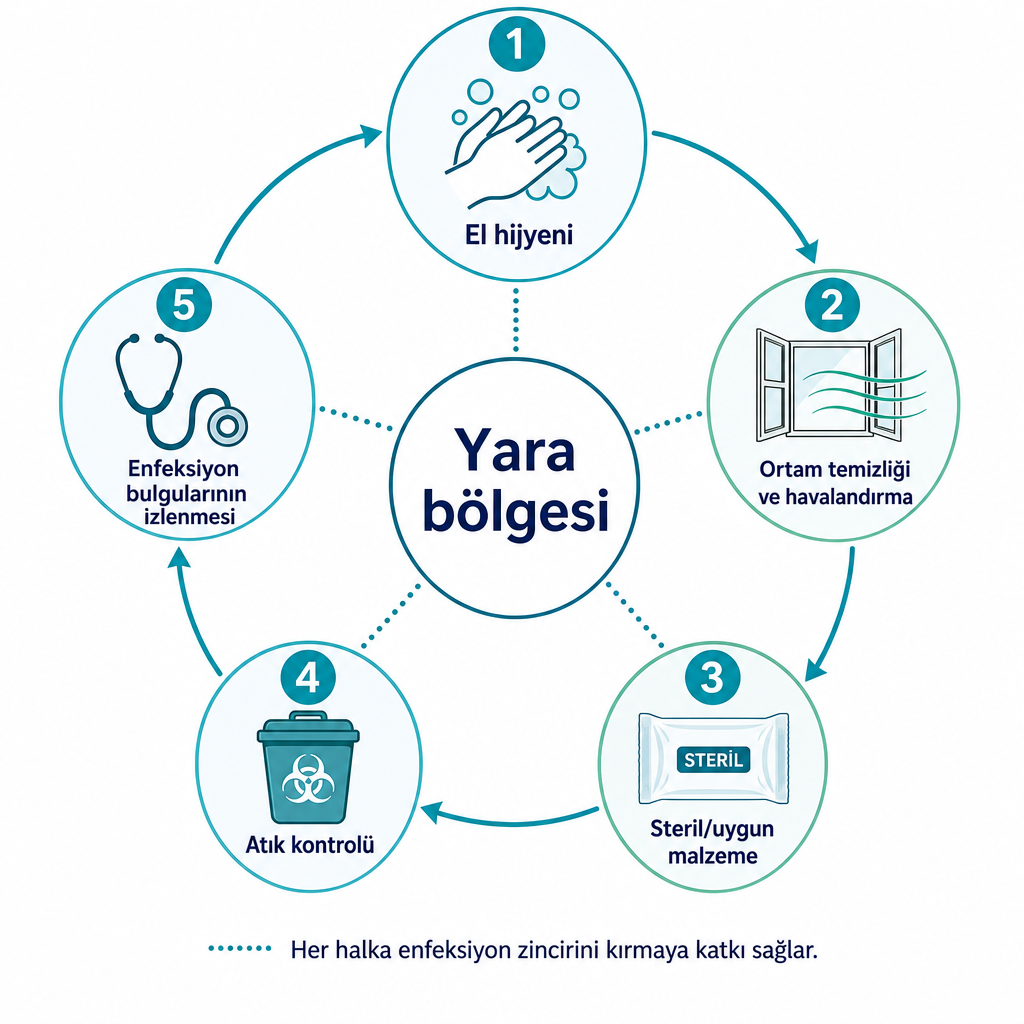 Hygiene rings that break the infection chain
Basic hygiene rules: a framework adapted to the home environment
How is home wound care performed? Basic hygiene rules for preventing the risk of infection are grouped under a few main headings in medical sources: hand hygiene, personal protective measures, arrangement of the environment, materials management, and waste control. When these headings are adapted to home conditions, they form a framework that is easy to apply but has a marked effect.
Hand hygiene and personal protective measures
Hand hygiene is the starting point of infection control. It has been shown that washing hands for an appropriate duration before touching the wound area and after care is completed; washing hands again before using gloves and after removing gloves reduces the risk of infection. Glove use does not replace handwashing; the two complement each other.
If the caregiver has an open wound, crack, or skin lesion on their hands, it is recommended not to make contact or to use an appropriate protective barrier (for example, clean gloves). In home care and elderly care training materials, it is stated that sterile gloves should be preferred in situations where intervention on open wounds, contact with the body's sterile areas, and preservation of the sterility of the materials used are required. Personal protective equipment such as masks and waterproof aprons, on the other hand, are defined as tools aimed at reducing the spread of infection, especially in wounds with heavy discharge that may be considered infected or in situations with a risk of fluid splashing.
Environmental cleaning and room arrangement
Regular ventilation of the room used during care, keeping surfaces clean, and, if possible, using a fixed area designated for care are important in infection control. A dry and clean environment provides a ground unsuitable for the multiplication of many types of microorganisms; therefore, moist, poorly ventilated, and crowded environments are not preferred in wound care.
For wounds known or suspected to be infected, some national sources speak of the concept of full or partial isolation. This may include practices such as using a separate room as much as possible, having the bed and materials used belong only to the relevant person, and appropriately cleaning the environment after care. The aim is to reduce the risk of the infection spreading to other people living in the home or to caregivers.
Dressing materials and sterility
In training modules on wound care, it is stated that using appropriate and sterile dressing materials, preserving the moisture balance of the wound, and, if necessary, controlled cleaning of necrotic (dead) tissue are among the basic principles. Sterile gauze, appropriate wound dressings, and solutions recommended by the physician form the medical framework of material selection.
In home wound care sources, it is emphasized that dressing materials should be preferably single-use, should not be left exposed and waiting for a long time after being taken out of sterile packages, and should be appropriately disposed of after each procedure. The use of the same material on more than one wound area is defined as a practice that increases the risk of contamination. Since the direct application of excessively harsh chemical substances into the wound can cause tissue irritation, delayed healing, and, in some cases, side effects; scientific texts state that wound cleaning should mostly be limited to physiological saline or an appropriate solution selected by the physician. The product and method to be used depend on the plan determined by the physician.
Control of waste and prevention of cross-contamination
Used gauze, bandages, gloves, and other dressing materials are considered risky waste in terms of infection because they have come into contact with body fluids. At home, collecting these materials in a separate container, disposing of them in closed form appropriately as household waste, and regularly cleaning the waste container are counted among the methods that contribute to breaking the infection chain.
Cross-contamination is one of the most easily overlooked points of hygiene. If care is to be provided to another area after applying care to an area known to be infected, it is stated that gloves and, if necessary, other personal protective equipment should be changed. Making contact with different anatomical regions with the same glove or material is a practice that increases the risk of the infection being carried from one area to another.
Informing the patient and caregiver
The information reaching the right people is also part of the quality of care. In sources, it is considered important for the patient and caregiver to understand the drawbacks of unnecessary contact with the wound area, to pay attention to hand hygiene before touching the wound surroundings, and to be able to recognize the signs of infection. Informing patients about not scratching the wound area, not playing with foreign objects, or not applying non-sterile products helps reduce the risk of infection and irritation.
In suspicious situations; for example, when a sudden color change, rapid expansion, severe pain, foul odor, intense discharge, or systemic fever is seen around the wound, it is emphasized in the literature that a culture may need to be taken and appropriate treatment planned. Such evaluations are medical decision processes under the physician's responsibility; symptoms vary from person to person, and it is recommended to consult a physician for assessment. For those who wonder how care processes carried out at home work, the scope of home private nursing practices can be considered as part of this information process.
Decision points in home wound care
When planning home wound care, three basic questions come to the fore: What are the characteristics of the wound? What is the level of infection risk? What is the patient's care capacity and support resources like? These three axes make visible the distinctions summarized in the table below.
| Decision axis |
Relatively applicable in the home environment |
Requiring priority physician/nurse assessment |
| Characteristics of the wound |
New, superficial acute wounds |
Deep, wide wounds; pressure, diabetic foot, vascular insufficiency wounds |
| Infection risk |
Wounds without signs of infection |
Wounds with heavy discharge, foul odor, rapidly expanding, with red and hot surroundings |
| Risk factors |
Patient in stable general condition |
Diabetes, advanced age, weakened immunity, prolonged bedrest, malnutrition |
| Care capacity |
Mobile patient, appropriate materials and support |
Need for frequent dressing changes, advanced discharge, or necrotic tissue cleaning |
Acute wounds, for example newly developed surgical incisions, may require monitoring different from chronic wounds. Pressure ulcers, diabetic foot wounds, and wounds due to vascular insufficiency, on the other hand, are among the wounds requiring special attention in terms of blood supply and pressure management. On the infection risk side, diabetes, advanced age, weakness of the immune system, and malnutrition are frequently noted as risk factors. Care capacity, on the other hand, is shaped by the patient's ability to move, the presence of other caregivers at home, the hygiene conditions of the environment, and access to materials. In situations requiring frequent dressing changes, advanced discharge, or necrotic tissue cleaning, planning professional nursing support may come onto the agenda. These decision points are addressed together with the physician's clinical assessment; the type, frequency, and methods of wound care are determined as a result of medical examination and follow-up. To understand how the process begins, our article explaining what a home doctor examination is can offer a starting point.
Home wound care in the context of Private Dr. Emin Paçacı Home Care Center
As Private Dr. Emin Paçacı Home Care Center, we are a Ministry of Health–licensed home health organization based in Üsküdar, Istanbul; with our licensed team consisting of physicians, nurses, and physiotherapists, we provide home medical assessment, nursing, and support care services. We have structured our services under headings such as home physician examination, private nursing, home physiotherapy, serum/IV applications, wound care, and palliative support.
Home wound care, within this framework, can be part of home private physician services and nursing practices; the assessment and care plan are determined by the physician according to the patient's medical condition. We address wound care not merely as dressing changes; but as a multi-stage process involving the monitoring of the patient's general condition, nutrition, mobility capacity, and infection risk. To see which services can be planned together, you can review our services page.
Frequently Asked Questions
Can home wound care be performed by everyone?
Wound care is considered safer when planned with the type of wound, infection risk, and the patient's general condition taken into account. While trained caregivers may take part in simple, superficial wounds without signs of infection; physician and nurse assessment is recommended in deep, wide, diabetic, or rapidly changing wounds.
How often should the dressing be changed?
Dressing frequency is determined according to the amount of discharge from the wound, the risk of infection, the type of dressing used, and the physician's treatment plan. Opening the dressing unnecessarily often can disrupt the wound's temperature and moisture balance; changing it very rarely can increase the risk of contamination and infection. For this reason, the frequency relies on a medical decision specific to the person and the wound.
What are the signs that suggest there may be a wound infection?
Signs such as increasing redness, swelling, increased warmth, foul odor, color change, intense discharge, increasing pain, general weakness, and fever around the wound are among the indications that may be associated with infection. The presence of one or several of these signs is considered a situation requiring medical assessment.
How do showering or bathing affect home wound care?
Water contact can contribute to the deterioration of the dressing, a change in the moisture balance, and infection risk in some types of wounds. Which situation water is permitted in should be determined by the physician according to the wound type and dressing material. Especially in surgical and chronic wounds, avoiding uncontrolled water contact is a common recommendation.
What kind of relationship is there between home wound care and professional wound care services?
Wound care carried out at home is often a continuation of professional care; the treatment plan initiated at a health institution can be continued with physician and nurse monitoring at home. A home wound care plan is addressed as a person-specific medical process involving the frequency of check-ups, dressing methods, and the monitoring of possible complications.