While the first question when planning home care for an elderly loved one is often age, age alone is not the deciding factor. The conditions for elderly home care are determined by evaluating, together, the person's level of dependency in daily living activities, mobility capacity, existing chronic illnesses, need for medical follow-up, the physical conditions of the home, and caregiver support. Since the phrase "home care" in Turkey is used to cover both daily living support and medical health services, the starting point for understanding which conditions apply is to correctly define the type of service needed.
Contents
What is elderly home care and which needs does it cover?
Elderly home care is the general name for services aimed at helping the elderly person continue their daily life in their own living space, monitoring their health status, and planning the support they need. It refers not to a single application, but to different types of support that come together according to need.
The categories that may come up within this framework are quite different in nature from one another:
- Support with daily living activities and personal hygiene
- Monitoring of nutrition and fluid intake
- Mobility and safe transfer support
- Monitoring of medications in accordance with the physician's plan
- Monitoring of chronic illnesses by healthcare personnel
- Assessment of wound, catheter, or medical device care
- Physiotherapy and movement planning
- Palliative care support
- Informing the patient's relative about the care process
There is a critical distinction here: daily living support and medical services carried out by a physician, nurse, or physiotherapist are not the same thing. The former is more in the nature of everyday assistance and companionship, while the latter covers medical applications carried out within the limits of professional authority. This distinction also directly affects the conditions, because additional clinical criteria and a physician's evaluation come into play for medical services. For details on the difference between the two, the article titled the difference between home health service and home care can be reviewed.
By which criteria are the conditions for elderly home care evaluated?
There is no single age limit or single eligibility criterion that applies to every individual for elderly home care. The evaluation varies according to the nature of the care needed. Especially when medical services are involved, several criteria are considered together.
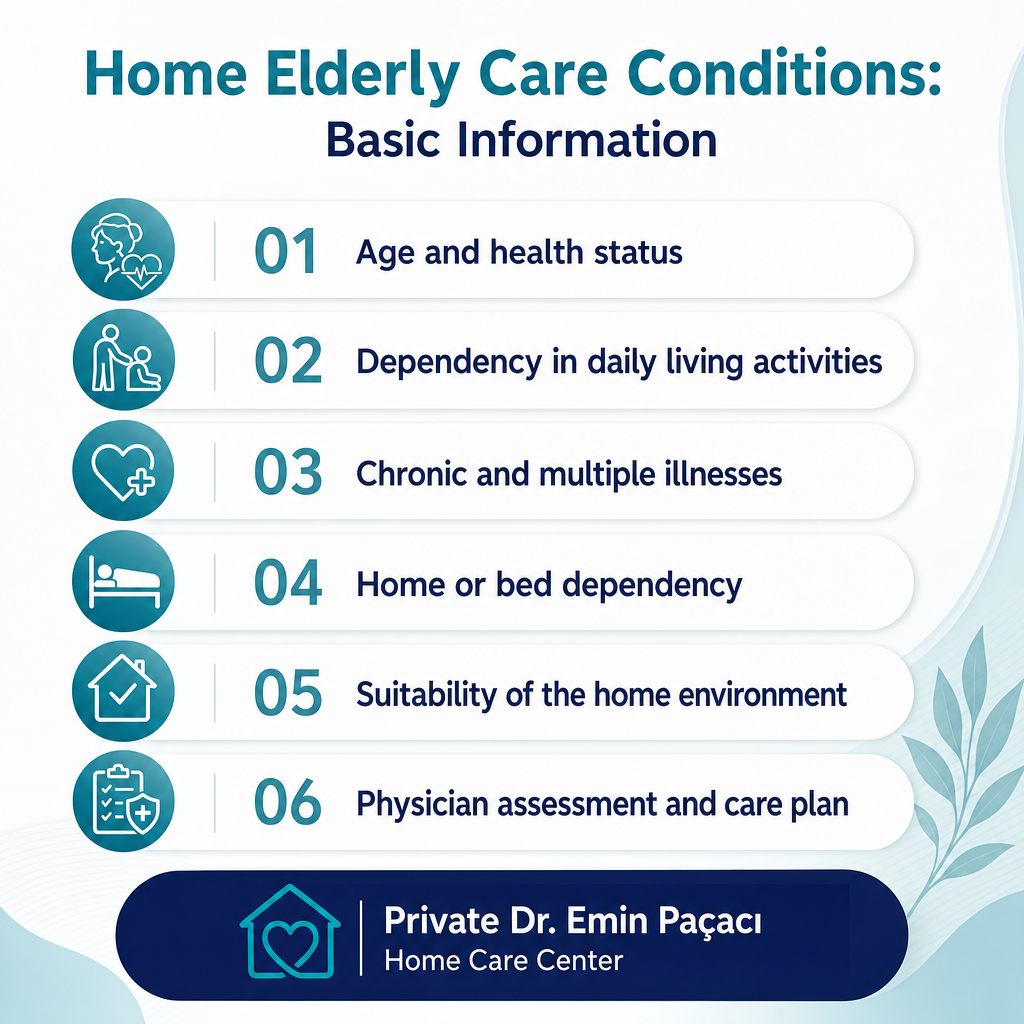
Age and health status are considered together. Advanced age alone does not require continuous medical care; however, with age, mobility limitations, multiple chronic illnesses, dementia, fall risk, or dependency in daily living activities may arise. In the Ministry of Health's home health service regulation, elderly people aged 80 and over who request service, as well as people aged 65 and over who have a chronic illness documented by a health board report and who are fully or severely dependent in terms of daily living activities, may be evaluated within the scope. This evaluation is finalized after the application through examination by the healthcare team.
Dependency in daily living activities is one of the main indicators of the need for care. Consideration is given to how independently the person can perform activities such as turning and sitting up in bed, standing and walking, using the toilet, bathing and personal hygiene, dressing, eating, moving safely within the home, and communicating. Needing help with some of these activities may require the evaluation of home care support; in cases of full or severe dependency, medical follow-up, nursing, or physiotherapy services may also be added to the care plan.
Chronic illnesses and multiple health problems also affect the scope. In conditions such as heart failure, diabetes, stroke, COPD, Alzheimer's disease, dementia, neurodegenerative diseases, and terminal-stage cancer, a need for home health service may arise. However, an automatic decision is not made based on the name of the illness; the person's current clinical condition, mobility capacity, the necessity of medical monitoring, and the care possibilities in the home environment are evaluated by a physician. In the official regulation, these disease groups are listed among the conditions that may be given priority consideration within the scope of home health.
Dependency on the home or on the bed is a separate criterion. The regulation defines home health services as being aimed at individuals who are dependent on a bed, device, or the home due to diagnosed illnesses. For elderly people who have difficulty going outside the home, who require constant companionship, or who have difficulty reaching a healthcare facility, home evaluation may come into consideration. What ultimately determines the scope is the physician's evaluation and the care plan based on it. In public home health services, the first visit is made in the company of a physician; whether the patient is a home health patient is determined as a result of the medical evaluation, and for people deemed suitable, a visit plan can be created on a daily, weekly, or monthly basis.
 Home elderly care assessment criteria
Why is the home environment evaluated separately for care?
When planning home care, not only the patient's condition but also the physical conditions of the home are decisive. The fact that a medical application can be performed under hospital conditions does not mean the same application can be carried out safely in every home. For this reason, the environment is examined as a separate topic.
Among the prominent topics in the evaluation are the location of the bed and the care area, access to the bathroom and toilet, the safety of corridors and passageways, lighting, heat, and ventilation. If a medical device is to be used, electrical and layout conditions, the area where care supplies will be stored, and the appropriate separation of waste additionally come into consideration. Alongside these, the support of the caregiver and the responsibilities they can take on throughout the process are also part of the plan.
The home environment may not be suitable for every medical application. Whether the service to be provided can be carried out at home is evaluated together by considering the necessary equipment, the patient's condition, and the assigned healthcare personnel. This evaluation ensures that the care plan is established in a realistic and safe manner.
Which home health services can be planned together according to need?
Depending on the need, a single service may come into play, or more than one service may be planned together. Which service takes precedence depends on the criteria above being evaluated together.
In home physician care, the person's current health status is evaluated, necessary medical follow-up is planned, and, when needed, referral to the relevant health services is made. Diagnosis and treatment decisions are made by the physician, taking into account the examination and medical history. For details of this framework, the home private physician care page can be reviewed.
Home nursing may include topics such as monitoring care in line with the physician's plan, carrying out certain medical applications, assessing wound and device care, or supporting chronic illness follow-up. The scope of the application is determined according to the patient's condition and the limits of the healthcare personnel's professional authority. For the general scope of the private nursing service, the home private nursing page can be consulted.
Physiotherapy may come into consideration for elderly people with mobility limitations, balance problems, muscle weakness, or loss of function following illness. The program is shaped according to the person's functional status, safe movement capacity, and the physician's or physiotherapist's evaluation. Information about the scope is available on the home physiotherapy page.
Palliative care may be evaluated for people with advanced-stage illness, a heavy symptom burden, or a need for support in the later stages of life. This care may cover communication and support needs directed not only at the patient but also at the family and caregivers. In cases such as wound care, enteral nutrition, urinary catheter, or medical device use, the service plan is created according to the nature of the wound or device, the patient's general condition, and the physician's evaluation; in procedures to be carried out at home, the duties and authority limits of the healthcare personnel are observed.
How do public home health service and private home care differ?
These two structures proceed through different rules and application channels; one does not automatically replace the other. Which one comes into play is determined according to the nature of the need and the application preference.
| Category |
Public home health service |
Private home care / health service |
| Provider |
Units affiliated with the Ministry of Health |
Licensed private institutions |
| Application |
The patient, legal representative, or certain health and care workers |
The institution's own communication channels |
| Contact |
444 38 33 Home Health Services Contact Center and the channels designated by the Ministry |
The institution's own application lines |
| What determines the scope |
The application and admission criteria in the legislation |
The institution's permits, staffing structure, and patient evaluation |
The public home health service is carried out by units affiliated with the Ministry of Health within the framework of the legislation and application channels it sets. The regulation specifies the 444 38 33 Home Health Services Contact Center and other application channels designated by the Ministry for the public home health service. For private home care or home health services, the application is received through the relevant institution's own communication channels; for the service to be provided, the institution's license and scope of operation, the authorities of the assigned personnel, the feasibility of carrying out the service at home, and the patient's medical condition are evaluated together. For the general framework of the public service, the article titled what does home health service cover can be a useful guide.
What information can be prepared before the evaluation?
For the care need to be properly evaluated, having certain information ready in advance makes the process easier. This information helps clarify which service is appropriate and how the plan will be established.
- The patient's identity and contact information
- Current diagnoses and previous medical reports
- Discharge documents
- Current medication list and medical devices used
- Allergy information
- Mobility and dependency status
- Previous surgeries or hospital admissions
- The patient's relative's contact information
- Difficulties encountered during home care
Which documents may be needed can vary depending on whether the application is made within the scope of public home health service, private health service, or social support. For details on the subject, the list of documents required for home care can be reviewed.
Where do the limits of home care begin?
Home care may not be sufficient or appropriate for every health problem; knowing this limit is just as important for a safe process as the eligibility criteria. If there is a rapid change in the patient's condition, a change in consciousness, severe shortness of breath, newly developing chest pain, uncontrollable bleeding, a serious fall, or similar emergency findings, emergency health services must be sought.
The evaluation of the home care team does not replace an emergency room or hospital evaluation. Since symptoms can vary from person to person, for newly emerging or rapidly worsening findings, it is recommended to consult a physician for evaluation; when necessary, the patient is referred to an appropriate healthcare facility or transfer support is planned.
Which service categories are available at our center?
On the service page we have published, in addition to home private physician care, home private nursing, and home physiotherapy, there are categories such as home palliative care, wound care and follow-up, blood tests by physician's request, acute and chronic patient follow-up, postoperative follow-up, nurse companionship support, and medical status evaluation. The service's suitability for the patient is considered within the framework of the criteria addressed in this article, taking into account both the medical evaluation and the feasibility of carrying out the service at home.
Which service or combination of services is appropriate varies according to the person's current health status and home conditions. When the nature of the need, the level of dependency, and any previous diagnoses are shared, the appropriate evaluation path and service options can be addressed more clearly.
Frequently Asked Questions
Is there an age limit for elderly home care?
In terms of daily living support, there is no single age limit for every service. In public home health services, people aged 80 and over who request service, as well as chronic patients aged 65 and over who meet certain conditions, are additionally specified in the legislation.
Can every elderly individual benefit from home health service?
No. Age, illness, level of dependency, the need for medical service at home, and the evaluation of the healthcare team are all taken into account together. In public services, the eligibility decision is made after the first visit and medical evaluation.
Can home care be considered for dementia or Alzheimer's patients?
In these patients, the care need is evaluated by taking into account cognitive status, mobility capacity, daily living activities, safety requirements, and accompanying illnesses. In terms of home health service, these illnesses are among the conditions that may be given priority consideration.
Are home care and home health the same thing?
No. Home care refers to daily living support, while home health refers to medical services provided by a physician, nurse, or other healthcare personnel. A person may need both types of support during the same period.
Who makes the home care decision?
In cases requiring medical service, the evaluation and care plan are created by the physician with the opinions of the relevant healthcare team. Informing the patient or their legal representative and obtaining consent are also important parts of the process.