Home physiotherapy for a stroke patient is the process of carrying out the physical therapy and rehabilitation of a person experiencing movement limitations after a stroke, within the environment where the patient lives, under the planning of a physician and physiotherapist. The aim is to support functional capacity, reduce complications related to the musculoskeletal system, and contribute to independence in daily living activities. Home care legislation in Turkey defines rehabilitation and physiotherapy within the scope of home care services.
In this article, we present in a neutral framework what home physiotherapy is, through which mechanisms it works, the distinctions between periods and types, and what you need to pay attention to as a relative of a stroke patient. Application details such as exercise sequences and day-by-day programs are not the subject of this guide; the decision about the process and planning belongs to the physician for each patient.
Contents
What home physiotherapy is and how it works
Home physiotherapy is the version of the physical therapy and rehabilitation logic applied in the clinic that has been carried into the patient's home. After a stroke, the aim is not only to work on muscle strength; physical therapy and rehabilitation aim to increase function in stroke patients, control pain, reduce musculoskeletal complications such as contracture and deformity, and support independence to the extent possible.
The fundamental mechanism behind the process relies on the nervous system's capacity for re-adaptation. Planned and repetitive movements create a stimulus that supports muscle strength, balance, and coordination; this is why physiotherapy is a core intervention area that supports muscle strength, balance, coordination, and daily living activities in stroke. The critical point here is that the movements are not random but selected according to the patient's clinical condition.
The picture is also clear in terms of legislation. Home care services are defined as the fulfillment of medical needs, including rehabilitation, physiotherapy, and psychological treatment in line with physician recommendations, by a health team in the environment where the patient lives. In other words, home physiotherapy, by definition, is not a standalone exercise session but a process constructed on the axis of medical evaluation and teamwork.
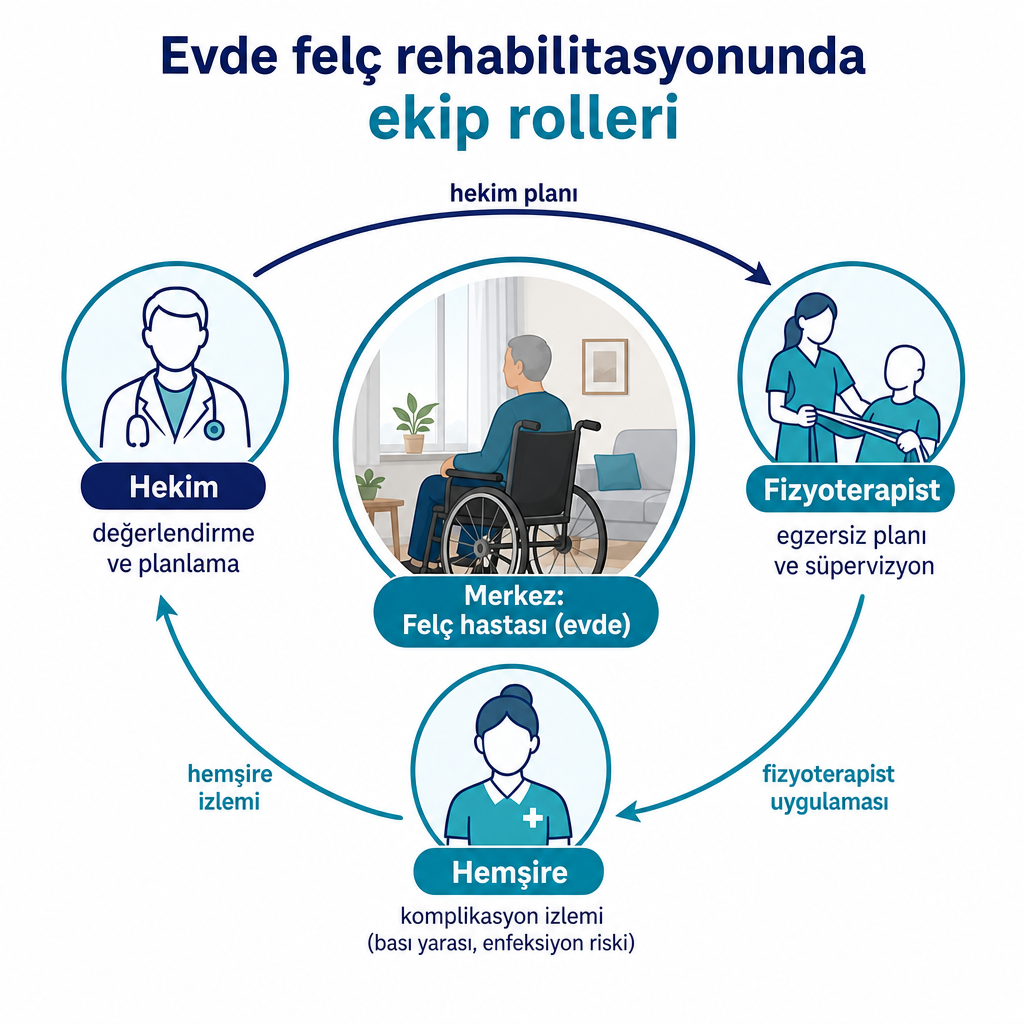
We also approach our home physiotherapy service with this holistic logic: physician evaluation, a plan by the physiotherapist adapted to the home environment and the patient, and nursing follow-up when necessary. Within this framework, our home physiotherapy service aims to make a sustainable rehabilitation plan possible in the home environment for individuals with movement limitations after stroke.
Period and type differences in stroke rehabilitation
Stroke rehabilitation is not one-size-fits-all; which period the patient is in determines the nature of the work applied. Conceptually, a distinction is made between the acute, subacute, and chronic periods. In the early period, the priority is generally to preserve the range of joint motion and prevent complications through positioning and passive movements; in later periods, active exercises, balance and coordination work, gait training, and functional work aimed at daily living activities may become more prominent.
The types of work also differ from one another. While passive exercises are carried out with the help of the physiotherapist in situations where the patient cannot initiate movement, active exercises come into play as the patient begins to use their own muscle strength. Work aimed at balance and coordination aims to reduce the risk of falling, while functional work aims to support daily skills such as turning in bed, sitting, and standing up. These distinctions are conceptual; which work is appropriate for which patient depends entirely on clinical evaluation.
Here, it is also necessary to address a common misconception: home physiotherapy is not "repeating exercises found on the internet at home." Since inappropriate or excessive exercise practices in stroke individuals can increase the risk of pain, muscle damage, falls, and additional complications, it is recommended that rehabilitation be planned by a professional team. The fact that the same movement can be beneficial for one patient and risky for another shows why the distinction between period and type is important.
The framework of the public home health system and private home physiotherapy
One of the most confusing topics for families is which channel home physiotherapy can be accessed through. Home health services can be provided through facilities belonging to the Ministry of Health, universities, municipalities, and private health institutions. In other words, both public home health units and licensed private home care institutions can provide services in this area.
The functioning and financing of the two channels differ. Public home health units require that the patient who will receive home physical therapy already be within the scope of home health service and that the physiotherapy program has been planned by a specialist physician (Physical Medicine and Rehabilitation). On the financing side, the Social Security Institution covers physical therapy and rehabilitation practices designated within the scope of home health within the health service providers affiliated with the Ministry of Health; this access is subject to the patient meeting the criteria and the referral-report processes being completed in accordance with legislation.
The financing of home physiotherapy services obtained through privately licensed home care institutions may work differently from the public scope and may vary according to private contract or private insurance conditions. For this reason, it makes sense for families to evaluate public application channels and private service options separately. Our Ministry of Health home care services guide, in which we address the functioning of public home health services and the legislative framework in more detail, is a resource that can be consulted by those who want to clarify this distinction.
Why it matters for families with a stroke patient relative
The fact that home physiotherapy is not only a practical convenience but also a clinically defensible option answers the real question for families. A study examining the effectiveness of a home exercise program after discharge in hemiplegic patients reports that home-based rehabilitation supported by regular outpatient check-ups can provide functional benefit close to the level of in-hospital rehabilitation. This finding indicates that home-based rehabilitation can be a meaningful option as long as physician follow-up and physiotherapist supervision continue.
This does not mean that home physiotherapy is automatically appropriate for every stroke patient. The relevant studies were generally conducted in patients who are clinically stable, whose vital signs are under control, and for whom a safe home environment can be provided; moreover, since evidence regarding the long-term outcomes of home rehabilitation in hemiplegic patients in Turkey relies on studies with limited samples, caution is required when generalizing. The decision belonging to the physician for each patient is therefore not merely a formality but a clinical necessity.
In the Turkish context, the importance of home physiotherapy is increasing. The fact that home care legislation clearly covers rehabilitation and physiotherapy, together with advanced age and mobility limitations, increases the need for access to home health services. Especially in large cities such as Istanbul, considering the patient's transport difficulties and the burden on the caregiver, a home physiotherapy process organized with physician follow-up can be a functional alternative for families.
One point needs to be distinguished: the focus of this article is the rehabilitation period. The acute symptoms of stroke and acute stroke management are a separate clinical topic and require emergency intervention; in the case of new symptoms such as sudden speech disorder or unilateral loss of strength, emergency health services must be sought without losing time.
What to consider when making a decision
Whether home physiotherapy is appropriate for a stroke patient emerges from the joint evaluation of several topics. The topics below are not a sequence of steps but decision criteria that can be focused on when talking to the physician and physiotherapist.
- Clinical stability: Whether the patient's general condition and vital signs are suitable for sustainable rehabilitation in the home environment.
- Suitability of the home environment: Physical conditions such as stairs, space width, safe walking path, and risks of falls, pressure sores, and hygiene.
- Caregiver support: The presence and continuity of a relative who can support the patient between sessions.
- Access channel: Whether the patient meets the public home health criteria and the separate evaluation of public and private service options.
- Team integrity: The roles of the physician, physiotherapist, and nurse being defined and complication monitoring being planned.
Most of these criteria exceed the scope of a single professional group. Monitoring risks such as contracture, pressure sores, falls, and aspiration in a stroke patient requires medical monitoring and nursing care as much as physiotherapy. Indeed, the legal definition of home care also constructs physiotherapy not alone but together with rehabilitation, nursing, and medical monitoring. That is why for us the process is planned together with home private medical care evaluation and, when necessary, home private nursing follow-up; those who want to see all our service topics together can reach the holistic framework from our services page.
The next step is generally not to prepare a program on your own, but to prepare the right questions: which period the patient is in, which work may be prioritized, which safety measures are required in the home environment, and who will carry out the follow-up. Since symptoms and needs vary from person to person, it is recommended that the evaluation and rehabilitation plan be prepared by a physician and physiotherapist; you can contact us for an evaluation appropriate to your patient's condition, home circumstances, and the region you are in.
Frequently Asked Questions
Who is home physiotherapy suitable for a stroke patient?
In general, it can be evaluated in patients whose clinical condition is stable, whose home environment is safe, and who have caregiver support. The suitability decision depends on the physician and physiotherapist evaluation for each patient.
Does home physiotherapy replace rehabilitation in the hospital?
A study reports that home-based rehabilitation supported by regular physician check-ups can provide functional benefit close to in-hospital rehabilitation. However, which environment is appropriate is determined by the physician according to the patient's condition.
Is home physiotherapy covered by SGK?
SGK covers physical therapy practices designated within the scope of home health within the health service providers affiliated with the Ministry of Health, when the criteria and referral-report processes are completed. Since the financing of private services may work differently, it is recommended that this matter be separately confirmed.
Is a physician evaluation required for home physiotherapy?
Home care legislation defines physiotherapy as a service carried out in line with physician recommendation; public home health units also require the program to be planned by a specialist physician. For this reason, professional evaluation is the foundation of the process.
Can we do the exercises at home by ourselves?
Since inappropriate or excessive exercise can increase the risk of pain, muscle damage, and falls, it is recommended that rehabilitation be planned under physiotherapist supervision. Detailed application should be carried out with expert guidance within the framework of a patient-specific plan.