The Myths and Facts About Insulin Injection and Blood Sugar Monitoring are two of the most uncertainty-inducing topics in diabetes management: the dose delivered under the skin and the value read from the fingertip. Both directly affect treatment decisions; therefore, even habits that seem minor in practice can disrupt blood sugar control. The physician plans the treatment scheme and follow-up; the role of the patient and their relatives is to clarify the points where uncertainty arises during injection and measurement together with healthcare professionals. Below, we explain the commonly encountered misconceptions in these two areas along with their mechanisms; we convey which findings may require consulting a physician for reassessment.
Table of Contents
Why is technique so decisive in insulin injection?
Insulin is a hormone that regulates blood sugar and, for many individuals with diabetes, is administered via injection under the skin (subcutaneous). Here, the importance of technique relates to whether or not the medication reaches the targeted tissue. Errors in application can lead to administering the wrong dose, the medication going into the wrong tissues (for example, into the muscle), infection, and hardening of the subcutaneous fat tissue (lipohypertrophy).
The common result of these technical deviations is that the same dose of insulin shows different absorption profiles. If the medication is absorbed faster than expected, blood sugar may drop suddenly; if it is absorbed slowly or incompletely, it may remain high. In other words, fluctuations in blood sugar toward hypoglycemia (drop) or hyperglycemia (remaining high) are often related not only to the disease but also to the details of application. For this reason, tailoring the technique to the individual is a matter of clinical education.
Myths and facts about insulin injection
Most of the misconceptions about injection stem from the assumption that "it goes under the skin anyway." However, every detail—from site selection to needle use, from pressure to preparation steps—can change the amount of dose absorbed.
"It is safer to inject at the same spot every time." One of the most common errors seen in research is selecting a very small area and concentrating injections in the same region. Repeated injections can lead to lipohypertrophy under the skin; the absorption of insulin is impaired in this hardened tissue. As a result, different responses to the same dose are obtained and blood sugar fluctuates. Therefore, the selection and rotation of the injection site is a topic that the physician and nurse evaluate together.
"Using an insulin needle a few times is harmless." It has been reported that a significant portion of people who administer insulin reuse their needles. However, reuse can cause deformation at the needle tip, deterioration of the lubricating layer, and loss of sterility, thereby increasing the risk of dosing errors, pain, bleeding, lipohypertrophy, and local infection. Many guidelines define insulin needles as single-use.
"The faster and harder I inject insulin, the more effective it is." Observations show that a significant portion of patients do not sufficiently consider the pressure and speed they apply. Very high pressure or improper technique can increase the likelihood of insulin going into the muscle tissue, creating absorption different from what is expected. This, in turn, can lead to undesirable outcomes such as a sudden drop in blood sugar or a failure to drop to the targeted level.
"Every injection that goes under the skin is technically correct." One of the most common deficiencies among pen users is not holding the pen in the skin for a sufficient duration after injection. Holding the pen for a short time can result in the full planned dose not being delivered and effectively receiving a lower dose. Similarly, details such as angle, needle length, and skin fold also affect dose and absorption; tailoring these details to the individual requires clinical education.
"Pre-injection preparation details are unimportant." Steps such as not priming the pen, not disinfecting the vial or pen tip, and not removing air bubbles from the syringe are often skipped. These omissions can lead both to deviation in the amount delivered and to an increased risk of infection at the site. It is important for individuals who regularly use insulin to review the preparation process together with their physicians and nurses for safe application.
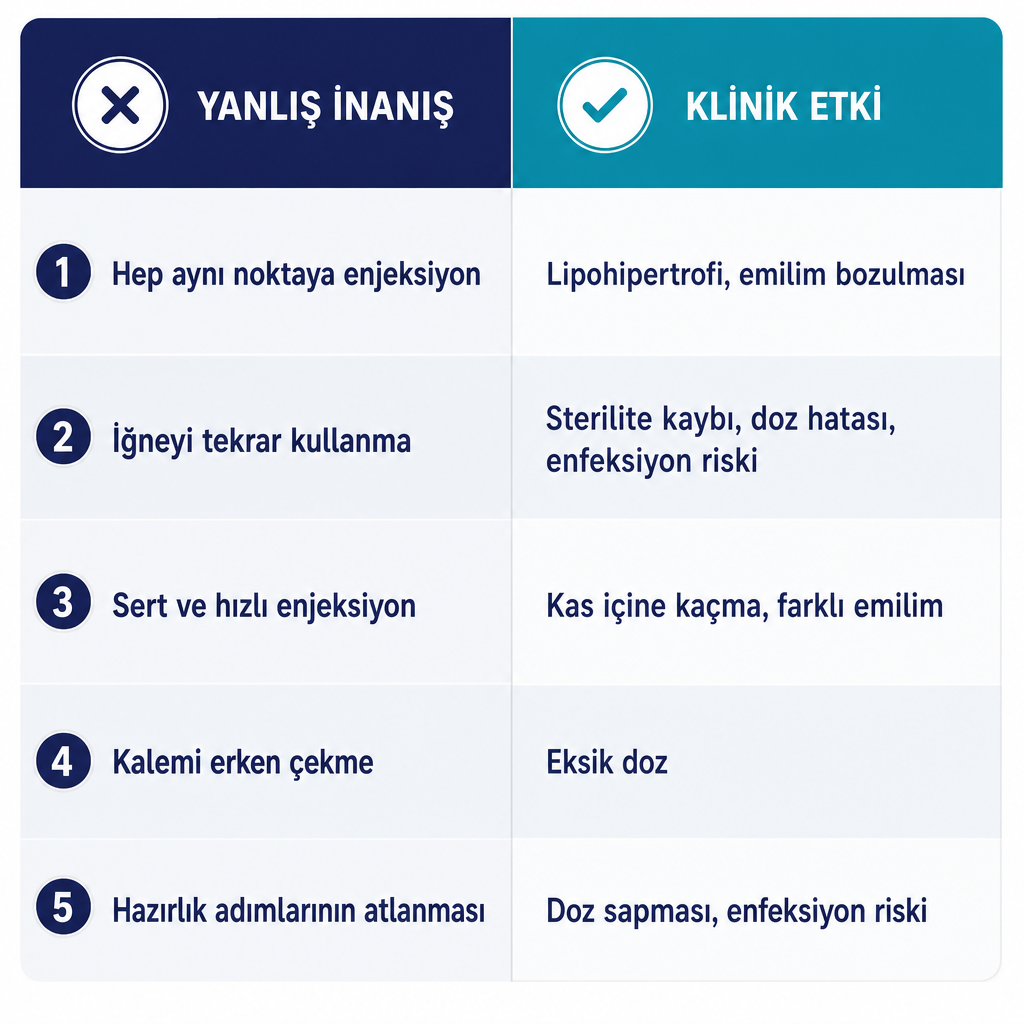 Common misconceptions in injection and their clinical impact
Myths and facts about blood sugar monitoring
Home blood sugar monitoring, fingertip measurements, or monitoring with different devices is a source of information that directly feeds treatment decisions. Even errors that seem minor in the measurement process can change the result, leading to the misdirection of insulin doses and other decisions.
"Every measurement device gives values close to one another." The accuracy of devices is affected by variables such as strip manufacturing differences, the storage conditions of strips, usage duration, and aging. Environmental factors such as ambient temperature, humidity, and altitude can also change performance. For this reason, using only devices approved by authorized institutions and demonstrated to be accurate is necessary for results to be clinically interpretable.
"Hand hygiene does not significantly affect the result." Errors in hand hygiene and drying before testing can change the measurement. The presence of glucose-containing fluid residues on the finger or measuring before complete drying after cleaning with alcohol can show the value as higher than it is. This can lead to unnecessary insulin administration or make an existing elevation appear mild.
"The expiration date and storage conditions of strips are not very important." Changes in manufacturing and storage conditions limit measurement accuracy. Using strips that have passed their expiration date, been stored in a humid environment, or been exposed to extreme heat or cold can cause the device to show a value different from the actual one. Clinical guides recommend storing strips in their own containers, protected from moisture and heat.
"Even if there is very little blood, the device gives a result somehow." An insufficient blood sample can lead to improper filling of the strip and measurement errors. Even though the device sometimes shows a "valid" value with an incomplete sample, this value may not reflect the actual blood sugar. The amount of blood, the strip's instructions for use, and the technical specifications of the device are topics that must be evaluated together.
"Device or strip errors do not greatly affect treatment decisions." Measurement errors can lead to incorrect calculation of insulin doses and deviations in decisions. If the value appears higher than it is, an unnecessarily high dose; if it appears lower, the current elevation not being adequately treated may occur. When suspicion of a systematic error arises, it is important for the physician to review the monitoring strategy by evaluating the laboratory measurement together with the device measurement.
How do the clinical consequences of errors accumulate?
In large-scale reporting analyses, it has been shown that a significant portion of insulin-related safety events are associated with incorrect dose, omission or delay of the dose, and use of the wrong insulin product. Among the causes of incorrect dose are erroneous prescribing, misreading of "unit" abbreviations, insufficient blood sugar monitoring, and the resulting dose adjustment errors.
In the home environment, different errors accumulate: administering insulin at the wrong time relative to mealtime, not taking it out of the refrigerator early enough, not disinfecting the vial or pen tip, not removing air bubbles, and reusing the needle are frequently reported examples. The real risk is the overlapping of the two areas: when device- and strip-related errors in blood sugar measurement combine with injection errors, treatment begins to be shaped not according to the actual blood sugar curve but according to erroneous values. This cycle explains why habits that seem individually insignificant need to be monitored systematically.
How do the physician, nurse, and patient's relative take part?
The type of insulin, dose, frequency of administration, and target blood sugar ranges are determined by the physician according to the patient's clinical condition. Standard insulin safety protocols and nurse-led hypoglycemia prevention algorithms are used to increase the safety of treatment. When home monitoring is involved, injection technique, the measurement process, and recording of findings can be addressed within the framework of an education and monitoring plan created jointly by the physician and nurse.
In licensed home care services, within the treatment framework recommended by the physician, we can inform the patient and their relatives about injection and blood sugar monitoring and observe the application. Within our home physician service, the doctor evaluates the injection and measurement process from a clinical perspective; within private home nursing, the nurse can perform applications such as injection, IV fluids, and dressing changes in the home environment upon the physician's recommendation. You can see all of these topics together on our services page. Such structured monitoring can contribute to reducing injection and measurement errors, especially in individuals with mobility limitations, advanced age, or visual and cognitive problems.
Complementing blood sugar monitoring, in chronic diseases the importance of regular vital sign monitoring such as blood pressure, pulse, and temperature can also be addressed as part of the monitoring plan.
Which situations may require reassessment?
The following examples can be considered as situations that may require consulting a physician for reassessment regarding insulin injection and blood sugar monitoring:
- Observing very high or very low values repeating within a short period in blood sugar measurements.
- Noticing new findings such as hardness, swelling, color change, or pain at the injection sites.
- Symptoms such as unexpected feelings of faintness, sweating, or palpitations becoming more frequent after insulin administration.
- The measurement device giving inconsistent results across different measurements or experiencing technical problems related to strips.
Symptoms and findings may vary from person to person; therefore, the final assessment in every case belongs to the physician, and the treatment and monitoring plan is arranged individually.
Frequently Asked Questions
How many times can I use my insulin needle?
Insulin needles are defined as single-use in most guidelines; reuse can cause deterioration of the needle tip, loss of sterility, and dosing errors. The need for reuse or the method of application should be evaluated by the physician, taking into account the person's clinical condition.
My device shows very different values at different times; what does this mean?
The values given by the device can be affected by factors such as the date and storage conditions of the strips, ambient temperature, hand hygiene, and the amount of blood sample. When such inconsistencies are noticed, comparing the device measurement with a laboratory measurement at a time deemed appropriate by the physician and, if necessary, reviewing the choice of device or strip is an appropriate approach.
Hardness or swelling has formed at the injection site; does this affect treatment?
These tissue changes, called lipohypertrophy, can change the absorption rate and amount of insulin. Reporting any newly noticed hardness or swelling to the physician and reassessing the injection area plan is clinically important.
In which situations does professional support for home insulin injection and blood sugar monitoring come into consideration?
In situations such as mobility limitation, chronic disease burden, or visual or cognitive problems, professional support for injection and measurement education and monitoring may be needed. In licensed home care services, physicians and nurses can provide clinical contribution to the home injection, blood sugar monitoring, and general monitoring processes in line with the treatment plan determined by the doctor.
Can I change my insulin dose myself based on the measurement?
Blood sugar values are an important parameter in treatment decisions; however, dose changes must be made by a physician who evaluates the insulin type, other medications, and the general clinical condition together. Since self-adjusting the dose can increase the risk of hypoglycemia or hyperglycemia, measurement results should be conveyed to the physician and changes should be planned after medical evaluation.