Istanbul home care service is a structured set of services aimed at providing examination, medical care, rehabilitation, and psychosocial support in the home environment where the person lives, for individuals who have difficulty accessing health services or who have mobility limitations. In this field, two concepts are often mentioned together: home health and home care. Both are defined within the relevant legislation, overlap in practice, and are carried out in Istanbul by both public institutions and licensed private health facilities. In this article, we present, within a neutral framework, the mechanisms through which the process operates, who is evaluated under this scope, and which criteria are taken into account when making decisions.
Contents
How the concepts of home care and home health differ
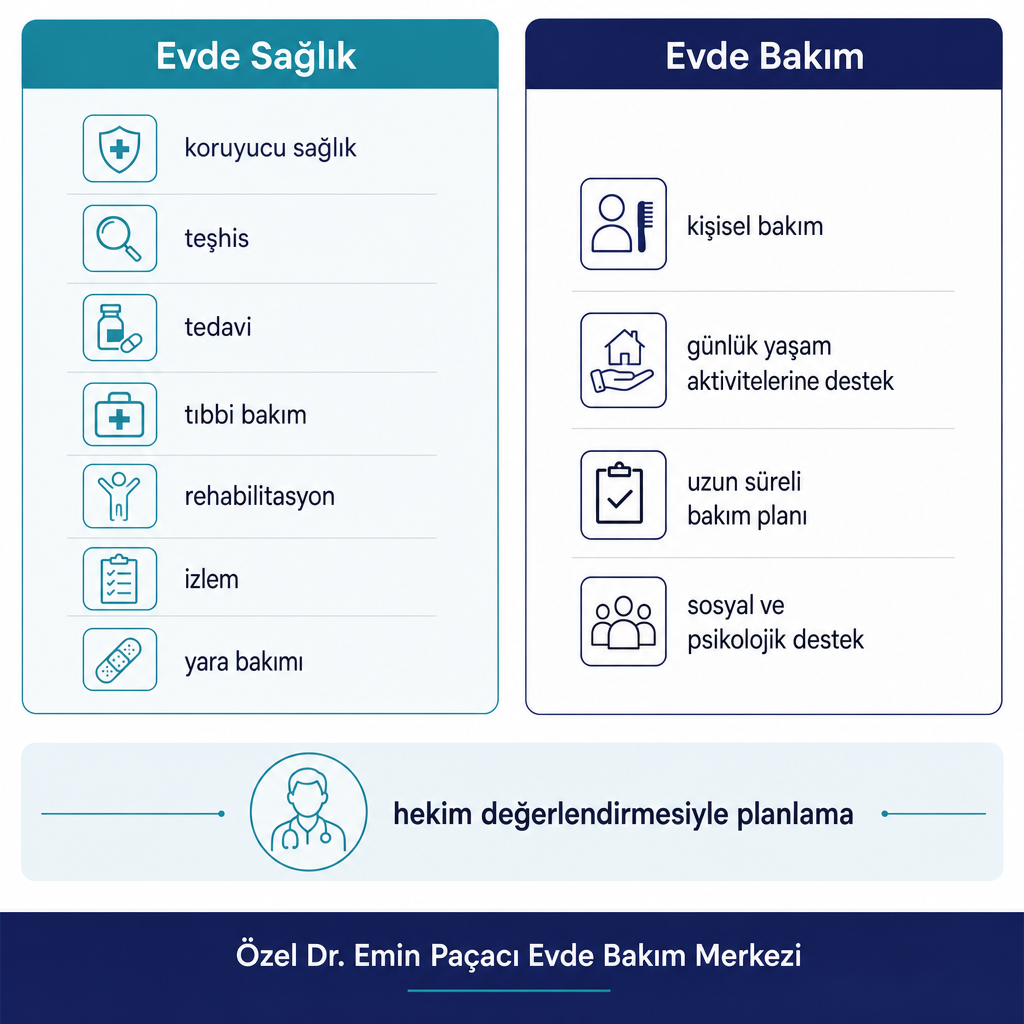
In Turkey, the legislation defines the concepts of "home health service" and "home care service" as interrelated but differently focused areas. Home health service is described as a holistic health service that covers the provision of preventive health, diagnosis, treatment, medical care, rehabilitation, and follow-up practices in the place where the person lives their life. Within this framework, clinical practices such as examination, testing, analysis, treatment, medical care, and wound care are handled together with social and psychological support services.
The regulation regarding home care services, on the other hand, mainly determines the procedures and principles of care and support-oriented services. Personal care, support for daily living activities, and long-term care plans come to the fore within this scope; the aim is to carry out these services in harmony with the general structure of the health and social care system. In practice, the two areas often merge: it is common for a patient requiring clinical follow-up to also need daily care support. For families looking into the topic for the first time, the content in which we convey the basic information about home care service complements this distinction in more detail.
In the case of Istanbul, the Provincial Health Directorate Home Health Services Provincial Coordination Office and the home health units of public hospitals are reference points in terms of the organization and coordination of publicly sourced services. The home health and care programs run by municipalities also support this structure at the local level.
 Scope comparison of home health and home care
Which patient groups are evaluated under this scope in Istanbul
In the legislation and the informational texts of public institutions, example criteria are listed for the groups that can benefit from home health services. Among these are elderly individuals and those with severe mobility limitations, patients who are fully or severely bedridden, persons dependent on a device or the home due to chronic illness, patients who need medical care for a certain period after discharge, and individuals with terminal-stage palliative care needs.
These examples show which clinical profiles are frequently evaluated within the home health and care framework. However, each individual's situation is different; comorbidities, functional status, and symptoms vary from person to person. Therefore, a patient's suitability for home care is determined by physicians as a result of clinical evaluation. Since symptoms vary, it is recommended to consult a physician to clarify the suitability of home care.
How publicly provided home health works
In Istanbul, publicly sourced home health services are carried out through the Home Health Services Provincial Coordination Office within the Provincial Health Directorate and its affiliated units. This service aims to provide examination, testing, analysis, treatment, care, follow-up, and rehabilitation practices, together with social and psychological support, in the person's living environment. The Provincial Coordination Center ensures coordination between home health units and the relevant public hospitals; for example, the home health units of training and research hospitals contribute to the follow-up of patients who need home medical care after discharge.
Applications are received within the framework of home health coordination conducted through the National Call Center via the number 444 38 33 or through channels that direct to the provincial coordination center, and are transferred to the relevant units at the provincial level. Local administrations also support this structure: on the Istanbul Metropolitan Municipality's home health pages, it is stated that applications can be made through the Alo 153 Solution Center and the online application form, and that after the application, assessment teams visit the patient at home to examine suitability for the service criteria. Thus, publicly sourced home health is provided within a structure where central coordination and local units work together.
The structure of private home care services
Current legislation stipulates that home health and palliative care services be carried out within certain rules at the Ministry of Health, universities, municipalities, and private health facilities. For private health facilities, the provisions regarding licensing, the scope of the service, the record-keeping system, and professional responsibilities are related to the relevant regulation and the Basic Law on Health Services.
In Istanbul, licensed private home care and home health facilities typically plan services under several main headings:
- Physician examination and medical evaluation in the home environment
- Private nursing services at home; procedures within the nursing field of duty, such as medication administration, wound care, and chronic disease monitoring
- Physiotherapy and rehabilitation practices at home
- Palliative care and home-based monitoring processes for advanced-stage illnesses
- Multidisciplinary practices such as wound care, nutrition, and mobilization support
As Private Dr. Emin Paçacı Home Care Center, in our Üsküdar-based structure, we provide medical evaluation, nursing, and rehabilitation-focused services in the home environment with teams composed of physicians, nurses, and physiotherapists. Alongside the headings of private physician care at home, private nursing care at home, and physiotherapy at home, subfields such as palliative care, wound care, and swallowing tests and swallowing rehabilitation are also included in our service list. This scope shows that home care is not merely limited to basic examination and nursing, but carries a multidisciplinary structure that also includes rehabilitation and palliative areas.
Private centers can be positioned in a complementary manner to the framework provided by public home health services; in the same city and within the same legislative framework, they operate with different organizational models. Which model is clinically appropriate is decided by physicians when the patient's diagnosis, functional status, social environment, and access to available public services are evaluated together.
The home care process: assessment, plan, and follow-up
In practice, the process generally operates along three axes: clinical assessment, care planning, and follow-up.
Clinical assessment. The request for home care often arises for reasons such as an existing diagnosis, discharge status, or an increase in mobility limitation. The health professional reviews the patient's medical needs, risk factors, and home conditions together through examination and evaluation. At this stage, vital signs, nutritional status, comorbidities, the medical devices used, and drug therapy are handled as part of the patient's general health condition.
Care planning. The plan is a patient-specific framework created together by physicians, nurses, physiotherapists, and, when necessary, psychosocial support teams. The frequency of examinations, nursing follow-up, physiotherapy program, palliative care need, and, when necessary, the conditions for re-admission to the hospital can be defined within this plan. The physical characteristics of the home environment are also part of the planning; stairs, room layout, bed, and assistive equipment are evaluated together with the family in terms of the patient's safety and comfort.
Follow-up and reassessment. Home care is not a static plan but a dynamic process that is updated according to changes in the patient's clinical condition. During follow-up visits, the physician and nurse evaluate the findings; if necessary, they change the plan or refer the patient to be reassessed under hospital conditions. Transitions between wellness and exacerbation periods in chronic illnesses, and symptom management and quality-of-life-focused goals in palliative care, are particularly monitored at this stage.
At every stage, treatment and care decisions are made by physicians and relevant health professionals within the framework of professional responsibility; the burden and expectations of family members and the patient's preferences are evaluated together with clinical indicators. You can find the practical details on how the process is initiated in our guide that explains the home care application step by step.
Criteria that can be considered when making a decision
When deciding between Istanbul home care service and hospital- or institution-based care, evaluation is generally made in several areas.
| Assessment area |
What is examined |
Who decides |
| Medical need |
Need for sudden intervention, advanced intensive care, invasive procedures |
Physician |
| Functional status |
Mobilization, daily living activities, in-home safety |
Physician, team |
| Social environment |
Family/caregiver support, communication, transportation conditions |
Physician, family |
| Legislation and structure |
In which type of institution and under which record-keeping system the service is carried out |
Institution, coordination |
Medical need. Situations requiring sudden intervention, advanced-level intensive care, invasive procedures, or comprehensive diagnostic evaluations are often associated with the hospital environment. Home care, on the other hand, focuses on continuing daily care and follow-up at home for patients who have been diagnosed and whose clinical condition is relatively stable or monitored within a palliative framework. This distinction is made through a physician's evaluation for each individual.
Functional status. The patient's level of mobilization, capacity to perform daily living activities, and in-home safety situation are decisive in planning. For patients who are fully or severely bedridden, home health and care is a common option in functional terms; nevertheless, this is interpreted by the physician according to the individual clinical picture.
Social environment and care support. The role of family members and caregivers is significant. Regular communication, understanding of care instructions, and access to the correct application channels in emergencies contribute to the safe conduct of the process. In large cities like Istanbul, transportation times, the location of the home, and access to public services can also be part of the decision-making process.
Legislation and service structure. Current regulations define in which types of institutions and under which record-keeping and coordination rules the service is carried out. This framework helps in selecting the model suitable for the patient's needs in a system where public units and private facilities coexist.
Since symptoms and needs vary from person to person, which services are appropriate and how frequently they will be applied within the scope of Istanbul home care service are determined through a physician's evaluation. If you would like to discuss how a care plan suitable for your situation can be structured, we can guide you by evaluating the patient's diagnosis, functional status, and home conditions together.
Frequently Asked Questions
What is the fundamental difference between home care and home health in Istanbul?
Home health is a holistic health service that covers clinical practices such as preventive health, diagnosis, treatment, medical care, rehabilitation, and follow-up. Home care, on the other hand, offers a health and social care-focused framework that also includes the dimension of long-term care and support for daily living activities. The two services overlap in practice; which framework is appropriate is determined through a physician's evaluation.
How is an application made in Istanbul for public home health service?
For public home health services, the patient or their relatives can call the National Call Center at 444 38 33; applications are directed to the Provincial Coordination Center and the relevant home health units. Applications to the Istanbul Metropolitan Municipality program are received through the Alo 153 Solution Center or the online form, and assessment teams visit the patient at home to examine suitability.
How is the scope of the home care service determined?
The scope is determined according to the care plan created by evaluating the patient's diagnosis, clinical condition, functional capacity, home conditions, and level of social support together. The plan may include the frequency of physician examinations, nursing follow-up, physiotherapy need, palliative care goals, and other health services deemed necessary.
Does home health service replace hospital care?
Home health takes on a complementary role to hospital care under certain clinical conditions. While part of the examination, treatment, and follow-up processes is moved to the home environment, situations requiring emergency intervention or advanced-level intensive care are carried out under hospital conditions. Which will be prioritized in which situation is decided by the physician for each individual.
In what situation do private home care centers come into play?
Licensed private centers can contribute to the planning of services such as home physician examination, nursing, and physiotherapy for individuals who have a chronic illness, need post-discharge follow-up, or have difficulty accessing health services due to mobility limitations. They work within the same legislative framework as the public system, with a different organizational model; which service will be provided from where is evaluated together by the physician and the family.