The importance of regular vital sign monitoring (blood pressure, pulse, temperature) in chronic diseases stands out in terms of tracking the course of the disease with objective data and detecting possible complications early. In chronic disease screening and monitoring guidelines, these measurements are routinely evaluated to identify risk factors, make an early diagnosis, plan appropriate treatment, and reduce the development of complications. Rather than reaching a conclusion based on a single high or low value, it is essential to observe the change over time and support the physician's clinical assessment. Below, we present in an informative framework what this monitoring means, through which mechanisms it works, and how decision points are established.
Contents
What do vital signs measure in chronic disease?
Vital signs refer to fundamental physiological measurements that sustain life, such as blood pressure, pulse (heart rate), body temperature (fever), and often respiratory rate. These values provide a practical view of how the circulatory, respiratory, and metabolic systems function. In chronic disease screening and monitoring programs, these signs are routinely evaluated to identify risk factors, make an early diagnosis, and track the course of the disease.
In conditions such as hypertension, diabetes, cardiovascular diseases, and chronic respiratory diseases, the regular recording of vital signs helps to understand whether target values are under control. While blood pressure and pulse provide clues about heart rhythm, circulatory load, and response to treatment, monitoring body temperature is a valuable indicator for early detection of infections, especially in diabetes and immune-weakening diseases. For this reason, vital signs should be considered not as a standalone diagnostic tool, but as a continuous stream of data that supports the physician's clinical assessment.
Through what mechanism does regular monitoring make a difference?
The real value of regular measurement lies not in a single day but in accumulation. A value measured on one morning shows the situation at that moment; whereas values recorded over weeks reveal a trend. This trend makes visible the response to treatment, whether the effect of the medication is sufficient, and the impact of daily lifestyle habits. As emphasized in the guidelines, the aim is to observe the change over time and support the physician's decision-making process rather than reaching a conclusion based on a single value.
In home health and home care resources, the regular measurement of vital signs and their recording in the patient file—so that during subsequent visits comparisons can be made with previous values and the response to treatment can be observed objectively—is described as an important practice. For example, an upward trend in blood pressure values that emerges over a few weeks can provide a far more meaningful warning than a single high measurement. These records make it possible for the physician to have an objective reference at hand while reviewing the plan during follow-up visits.
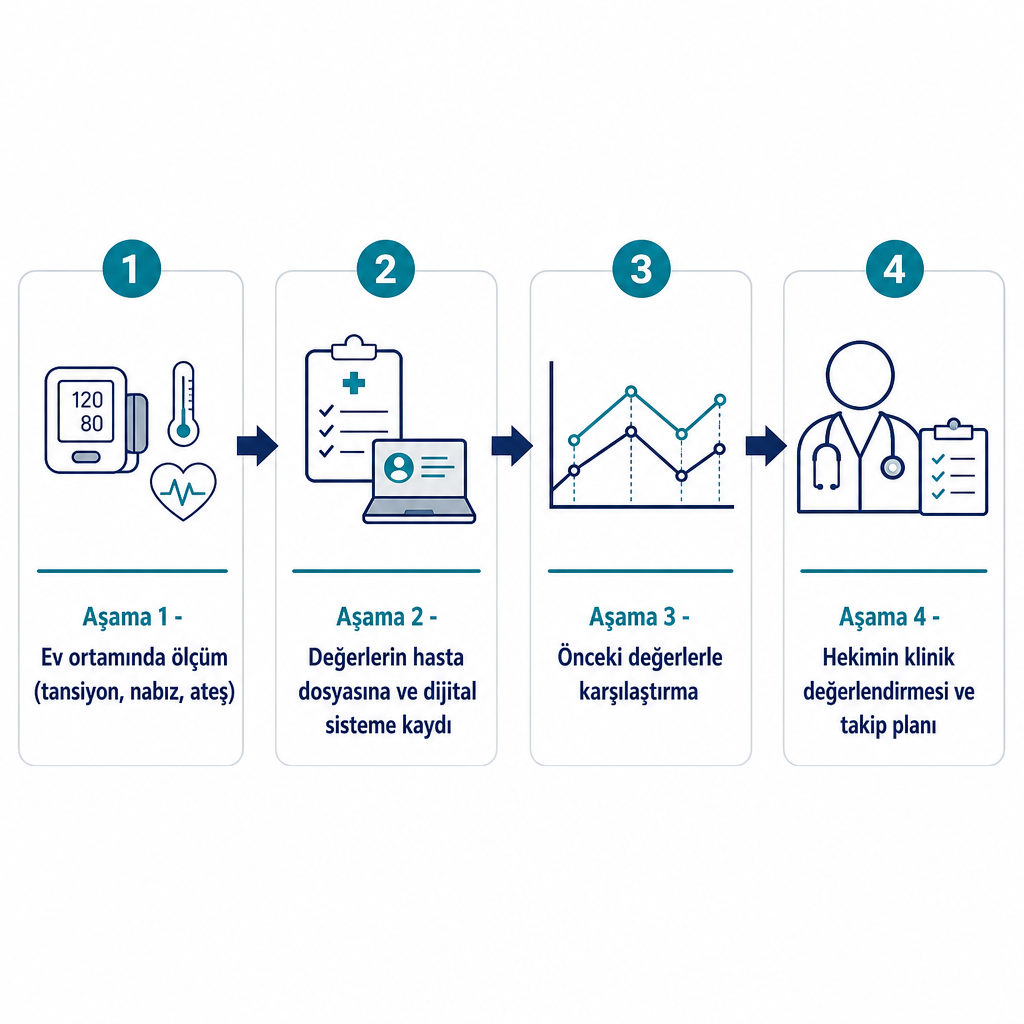 Data flow in vital sign monitoring
The role of measurement in the home setting and conditions for reliability
In Turkey, the monitoring of chronic diseases is planned through primary health care services and disease management platforms; family physicians determine the follow-up plan and target values for patients. Within the scope of these plans, patients or caregivers are advised to measure blood pressure and pulse at home, to record the values in digital systems such as e-Nabız when necessary, and to share them with the physician. It is stated that entering the patient's own measurements (weight, blood pressure, etc.) into the system is beneficial in terms of long-term monitoring and treatment planning.
The reliability of measurements depends on how the measurement is performed. Official guidelines address technical points such as resting briefly before blood pressure measurement, avoiding smoking and caffeine, and keeping the arm at heart level. It is also stated that the pulse should be counted for at least 30 seconds, and that blood pressure measurement should be performed with appropriate devices and repeated when necessary. When these conditions are not met, the values obtained may be misleading; therefore, measurement performed according to technique is as important as the recording itself.
Regular recording of measurements taken at home allows one to see the trend over time rather than a single measurement; this offers important decision support for the physician when adjusting treatment. Recording in the patient file makes it easier for values from different times to become comparable.
In which situations does monitoring particularly stand out?
In some chronic conditions, regular vital sign monitoring is considered an integral part of disease management. The following headings summarize which signs' monitoring stands out in which condition; however, the individual plan is always determined by the physician.
| Condition |
Prominent signs |
Contribution of monitoring |
| Hypertension |
Blood pressure, pulse |
Understanding target value attainment, medication response, and lifestyle impact |
| Heart failure and heart diseases |
Blood pressure, pulse, weight, edema |
Monitoring changes in circulatory load and possible exacerbations |
| Diabetes, obesity, metabolic syndrome |
Vital signs, blood sugar, weight |
Evaluation together with lifestyle data within the framework of the family physician plan |
| COPD and chest diseases |
Respiratory rate, oxygenation, fever |
Monitoring infection indicators and respiratory status |
In home care educational materials for chronic diseases, an approach is described in which, when an abnormal sign is detected, the situation is clarified with rapid and consecutive measurements before proceeding to treatment; then, after control is achieved with short-interval monitoring recommended by the physician, the intervals are extended. Particularly in elderly individuals, those with multiple chronic diseases, and those with limited mobility, regular monitoring at home makes it easier for health professionals to track the course of the disease and to plan necessary changes in a timely manner. Our article titled the musculoskeletal effects of a sedentary lifestyle in elderly individuals, which addresses the additional burden that inactivity creates in this group, offers a complementary context to the picture requiring monitoring.
Measurement frequency, targets, and the decision to consult a physician
How and how often vital sign monitoring in chronic diseases will be carried out is determined by the physician according to the type of disease, the person's age, accompanying illnesses, and the treatments used. In conditions such as hypertension, the frequency of check-ups and whether measurements will be performed at home or at a health facility are planned in line with the relevant clinical protocols and the physician's individual assessment. In disease management platform applications, physicians can personalize follow-up intervals based on the patient's blood pressure values, treatment plan notes, and lifestyle goals.
Regular recording of measurements taken at home creates decision support that the physician can use when adjusting treatment by showing the trend rather than a single value. Marked changes in recorded values compared to previous measurements; accompanying findings such as shortness of breath, pressure in the chest region, or a change in consciousness are, in some cases, considered clinical signs that may require urgent evaluation. In the presence of such symptoms, it is recommended to consult a physician.
Since these symptoms and what to do in which situation may vary from person to person, it is important that personal risks and accompanying illnesses be evaluated by your physician. In other words, measurement frequency, target range, and the threshold for consultation are based not on a general picture, but on a follow-up framework planned specifically for the individual.
Vital sign monitoring in home physician and nursing services
As Özel Dr. Emin Paçacı Home Care Center, within the scope of our home care services in Istanbul, we provide medical services such as home physician visits, home private nursing, physiotherapy, palliative care, and wound care. Within our home private physician service there is a heading of chronic disease monitoring (blood pressure, blood sugar, respiration, etc.); this heading shows that vital sign monitoring in individuals with chronic diseases is included systematically under physician supervision.
As we state on our Services page, our home physician and nursing practices are structured to support the monitoring and care process of patients who have chronic diseases, are bedridden, or have limited mobility. In these practices, the measurement, recording, and sharing of vital signs with the physician can be regarded as an example of clinical practice consistent with the regular monitoring approach found in national chronic disease monitoring guidelines.
In such services, the aim is to monitor vital signs within the framework of a follow-up plan determined specifically for the individual and to ensure that the data obtained contributes to the physician's assessment. The evaluation and treatment decision belong to the physician; since symptoms may vary from person to person, the monitoring plan and consultation thresholds are always determined individually.
Frequently Asked Questions
What are vital signs, and what do they mean in daily life?
Vital signs are fundamental physiological values such as blood pressure, pulse, body temperature, and often respiratory rate. These values provide practical information about the functioning of the circulatory, respiratory, and metabolic systems.
In which chronic diseases is regular monitoring of blood pressure, pulse, and temperature necessary?
Regular monitoring of vital signs is emphasized in national guidelines and information notes in chronic conditions such as hypertension, cardiovascular diseases, diabetes, and obesity; as well as in COPD and other chest diseases. The individual plan is determined by the physician.
Who determines the measurement frequency?
The measurement frequency and follow-up interval are determined for each individual in line with chronic disease screening and monitoring guidelines and the family physician's clinical assessment; in disease management platform applications, these plans are recorded.
Why is it important to record measurements taken at home?
Recording each measurement in the patient file and comparing it with previous values contributes to the objective monitoring of the response to treatment and the course of the disease. In this way, the trend over time can be seen rather than a single value.
Even if vital signs appear normal, is regular physician follow-up necessary?
In chronic disease management, even if vital signs remain normal; in diseases such as hypertension, diabetes, and the like, periodic check-ups planned with the family physician and the relevant specialist are recommended in terms of long-term follow-up and evaluation of treatment adherence.