The importance of home care in chronic illness is not limited to simply providing healthcare in a home setting. Regular monitoring of a person living with a long-term illness, adapting the care plan to daily living conditions, directing the patient's relatives toward the right tasks, and ensuring coordination among different healthcare professionals when necessary form the essence of this approach. Needs vary from person to person in diabetes, hypertension, heart failure, COPD, stroke, dementia, and neurological diseases; therefore, the decision for home care depends not only on the name of the illness but also on the person's mobility level, daily living activities, current medical needs, home conditions, and physician assessment.
In this article, we address, within an informative framework, why home care becomes prominent in chronic conditions, which services it may cover, which criteria are taken into account when making decisions, and in which symptoms home monitoring may not be sufficient.
Contents
What does chronic illness mean?
Chronic illnesses are generally health problems that persist for a long time and may require regular monitoring and care. Their course changes from period to period; symptoms, functionality, and care needs may increase or decrease over time. This variability makes chronic illness management different from tracking a single symptom.
In the assessment, several topics are often considered together: symptoms and functional loss related to the illness, the level of dependency in daily living activities, nutrition, movement, and sleep patterns, monitoring of the treatments and care practices used, risks such as falls, infection, pressure sores, or fluid loss, the information needs of the patient and the patient's relatives, and coordination with different health services when necessary.
The World Health Organization emphasizes the importance of delivering care in chronic conditions in a coordinated manner across different levels of health services and among healthcare workers. Regular and coordinated care can contribute to monitoring symptoms, functionality, and continuity of care.
Why does the importance of home care become prominent in chronic conditions?
Chronic illness management does not consist solely of check-ups performed at a healthcare facility. A person's mobility throughout the day, nutrition and sleep patterns, the assistive devices they use, and care support are also part of the assessment. Assessment conducted in the home environment can help these difficulties be seen in a more holistic way. For example, the movement, repositioning, nutrition, or personal care needs of a person who is bed-bound or home-bound are assessed not only at the moment of examination but together with the conditions of their living space.
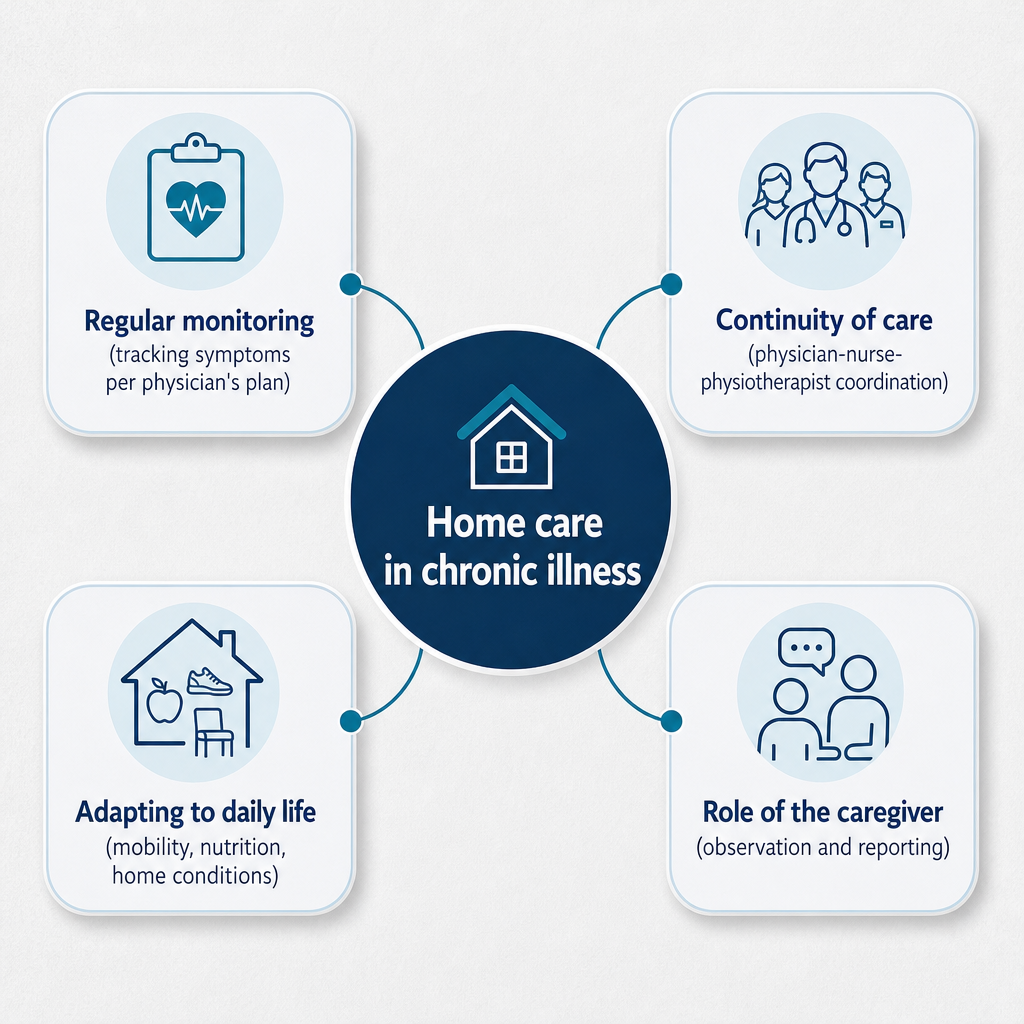 Functions of home care in chronic illness
In some chronic illnesses, monitoring of blood pressure, pulse, temperature, blood sugar, or respiratory findings may be required at intervals deemed appropriate by the physician. However, how and how often measurements are taken varies according to the type of illness, the person's general condition, and the current care plan. The U.S. Centers for Disease Control and Prevention points to the importance of people with chronic illness monitoring their health status at home and sharing new or worsening symptoms with their healthcare team. This monitoring does not mean the person adjusts their own treatment; the measurements and symptoms need to be interpreted by a healthcare professional. For frequently confused points regarding insulin and blood sugar monitoring, the content titled common misconceptions in insulin injection and blood sugar monitoring can be reviewed.
In chronic illnesses, assessment by a physician, nurse, physiotherapist, dietitian, or other healthcare workers may be needed at different times. Regular sharing of information and keeping the care plan up to date support coordination among services. The service information we publish includes topics such as home physician care, nursing, physiotherapy, wound care, palliative care, and acute/chronic patient monitoring; which of these come into play is determined according to the person's condition.
Chronic illnesses can lead to restricted mobility, decreased muscle strength, balance problems, or the need for support in daily living activities. Especially in people who remain bed-bound for a long time, movement capacity and the need for repositioning should be assessed by the healthcare team. The need for physiotherapy is determined according to factors such as the type of illness, musculoskeletal condition, balance, walking capacity, pain, use of assistive devices, and the level of safe mobility. For the scope, the home physiotherapy page can be reviewed.
Family members can take on an important role in care; however, the tasks of the patient's relatives and the tasks of healthcare workers are not the same. A patient's relative can assist with daily living support, observation, and communication. Matters such as medical assessment, treatment changes, medication adjustment, injection, wound care, or device use require assessment by authorized healthcare professionals. A good care plan clearly addresses which symptoms the patient's relative should report, which tasks they can take on, and in which situations professional support will be needed. For nursing needs, the scope on the private home nursing page can be reviewed.
Who can be considered for home health services in Turkey?
Under the legislation in Turkey, people who are device-, bed-, or home-bound due to diagnosed illnesses, or who have difficulty accessing health services due to old age, can be considered within the scope of home health services. The regulations list people with diabetes, heart failure, stroke, COPD, Alzheimer's and dementia, neurodegenerative diseases, terminal-stage cancer, and multiple chronic illnesses among the groups that can be prioritized for assessment.
These statements do not mean that every person with a chronic illness is automatically eligible for home health services. Eligibility is determined by the person's medical condition, level of dependency, conditions for accessing a healthcare facility, and physician assessment. The Ministry of Health's definition of home health services covers the provision of examination, testing, analysis, treatment, medical care, monitoring, and rehabilitation services—together with social and psychological counseling when necessary—in the person's home.
Readers wondering how chronic monitoring works in practice can also look at the guide explaining how the home monitoring process works in chronic illness.
Which services can home care in chronic illness cover?
Depending on the person's needs, one or several of the following services may come into play. The scope is not automatically determined by the diagnosis; physician assessment, the person's consent, the suitability of the home environment, and situations requiring referral to a healthcare facility are considered together.
| Service title |
Main focus |
How it is determined |
| Home physician assessment |
Examining the general condition and creating a monitoring plan |
Through physician examination |
| Nursing care |
Procedures and care monitoring in line with the physician's plan |
With physician order and care plan |
| Physiotherapy |
Assessment of movement, balance, muscle strength, and functionality |
With physiotherapist and physician assessment |
| Wound care |
Care plan according to wound type and general condition |
Through clinical assessment |
| Palliative care |
Holistic handling of symptoms and care needs in advanced illnesses |
Through team assessment |
| Care coordination |
Referral to the relevant facility and planning of tests when necessary |
According to the need |
These topics do not replace one another; different combinations may be needed in the same person at different periods. For example, readers wondering about the framework for carrying out intravenously administered treatments at home can review the content explaining what home IV antibiotic treatment is.
Which criteria are taken into account when deciding on home care?
When assessing the suitability of home care in chronic illness, certain questions serve as a guide. These do not replace a person-specific decision; they only show which information is important:
- Does the person have physical difficulty going to a healthcare facility?
- To what extent do they need support in daily living activities?
- Is regular physician, nursing, or physiotherapy monitoring required?
- Is there a wound, device, or mobility restriction that needs to be monitored at home?
- Are the current symptoms stable, or are they of a nature that may require urgent assessment?
- Is there sufficient space, hygienic conditions, and the possibility of safe movement at home?
- Does the patient and the patient's relative understand the care plan and give consent?
- Is there a plan for access to the hospital or emergency health services when necessary?
This framework reflects only a general approach. The person-specific decision is made by the physician assessing the patient and the relevant healthcare team. Readers wondering about the scope of a home doctor examination can look at the content titled Information about home doctor examination in Üsküdar.
In which symptoms may home monitoring not be sufficient?
Some findings may require urgent medical assessment without waiting for the care plan. The following situations should be carefully evaluated in this regard:
- Newly started or worsening shortness of breath
- Chest pain, fainting, or change in consciousness
- Sudden weakness in the face, arm, or leg; speech impairment
- Uncontrolled bleeding
- Severe and newly started pain
- Rapid deterioration of the general condition together with high fever
- Serious fall or head trauma
- Bruising, cold sweating, or signs of marked circulatory impairment
- Inability to take fluids, recurrent vomiting, or signs of marked dehydration
The significance of symptoms may vary according to the person's age, diagnoses, and general condition. In case of a suspected emergency, the 112 Emergency Call Center in Turkey should be contacted.
Frequently asked questions
Can everyone with a chronic illness benefit from home care?
No. The need for home care is determined according to the type of illness, the person's functional status, mobility restriction, difficulty accessing a healthcare facility, and physician assessment.
Does home care replace hospital check-ups?
Not always. Some tests, advanced imaging, interventional procedures, or urgent assessments must be performed at a healthcare facility. The home care team makes a referral to the relevant healthcare facility when it deems necessary.
Are home care and home health services the same thing?
Daily living support and medical health services are different from each other. Home health services may cover services carried out by healthcare professionals, such as examination, medical care, monitoring, testing, and rehabilitation. The differences are explained in the content titled The difference between home health services and home care.
Which topics can be addressed in a home physician assessment?
The person's general condition, the course of their chronic illnesses, current symptoms, care needs, movement capacity, and monitoring plan can be assessed. Medical decisions are made after examination and physician assessment.