The short answer to the question of how home monitoring is carried out in chronic illness is this: it is the planned and documented monitoring, implementation, and, when necessary, updating of the clinical condition of a patient who has been diagnosed and whose treatment has been arranged, within the home environment. This process is not merely occasional home visits for check-ups; it is a comprehensive monitoring system that involves measuring, recording, and sharing within the team the parameters determined by the physician at specific intervals. When considering home monitoring for a loved one with a chronic illness, the decision is made by jointly evaluating the patient's medical condition, mobility capacity, home conditions, and caregiver resources. In this article, we explain in an informative manner what this process means, its legal framework in Turkey, its core components, and which criteria guide the decision.
Contents
What does home monitoring in chronic illness mean?
In definitions of home health services, it refers to meeting the needs of individuals with chronic illness who are often bedridden for examination, testing, laboratory analysis, treatment, medical care, and rehabilitation within the home environment. Home monitoring in chronic illness is a part of this definition: it covers the follow-up, implementation of the arranged treatment of a diagnosed patient, and the education of both the patient and the caregiver.
The point that clarifies the distinction is this: home monitoring is more than "coming home for a check-up." It involves monitoring, recording, and sharing with the physician the parameters determined according to the clinical condition (for example, blood pressure, pulse, temperature, respiration, nutritional status, mobility capacity) at specific intervals. In this way, the current treatment is maintained safely, new findings are noticed in a timely manner, and coordination is ensured with other levels of the health system when necessary.
The practical meaning of this approach is that a chronic illness is managed not with a single examination, but with monitoring spread over time. For example, topics such as weight and edema monitoring in a patient with heart failure, nutrition and blood sugar monitoring in a patient with diabetes, and the preservation of mobility capacity in a neurological illness are kept under continuous observation by being tied to a plan.
Legal framework and coordination in Turkey
In Turkey, home health services are carried out within the framework of the regulation concerning services provided by the Ministry of Health and its affiliated institutions. These regulations provide for examination, testing, laboratory analysis, treatment, medical care, and rehabilitation to be delivered at home in facilities that provide home health services; they also provide for health education to be offered to the patient and caregivers.
In the regulations concerning the provision and coordination of home health and palliative care services, emphasis is placed on carrying out services in an integrated and documented manner with other health services, and on operating quality and oversight processes. Record-keeping, in-team communication, and the inclusion of different specialties in the process when necessary during the home monitoring of an individual with a chronic illness are determined by this framework.
For applications to public home health services, the Home Health Services Communication Center line numbered 444 38 33, available throughout Turkey, is used; applications made through this line are forwarded to the relevant teams. This structure aims to organize home health services, especially for bedridden individuals and those with chronic illness. Private home care and home health services, on the other hand, are provided by a legally licensed health institution, with physician evaluation included in the process. For details on the preconditions under which home monitoring is appropriate, you can refer to the article in which we explain the requirements for home health service.
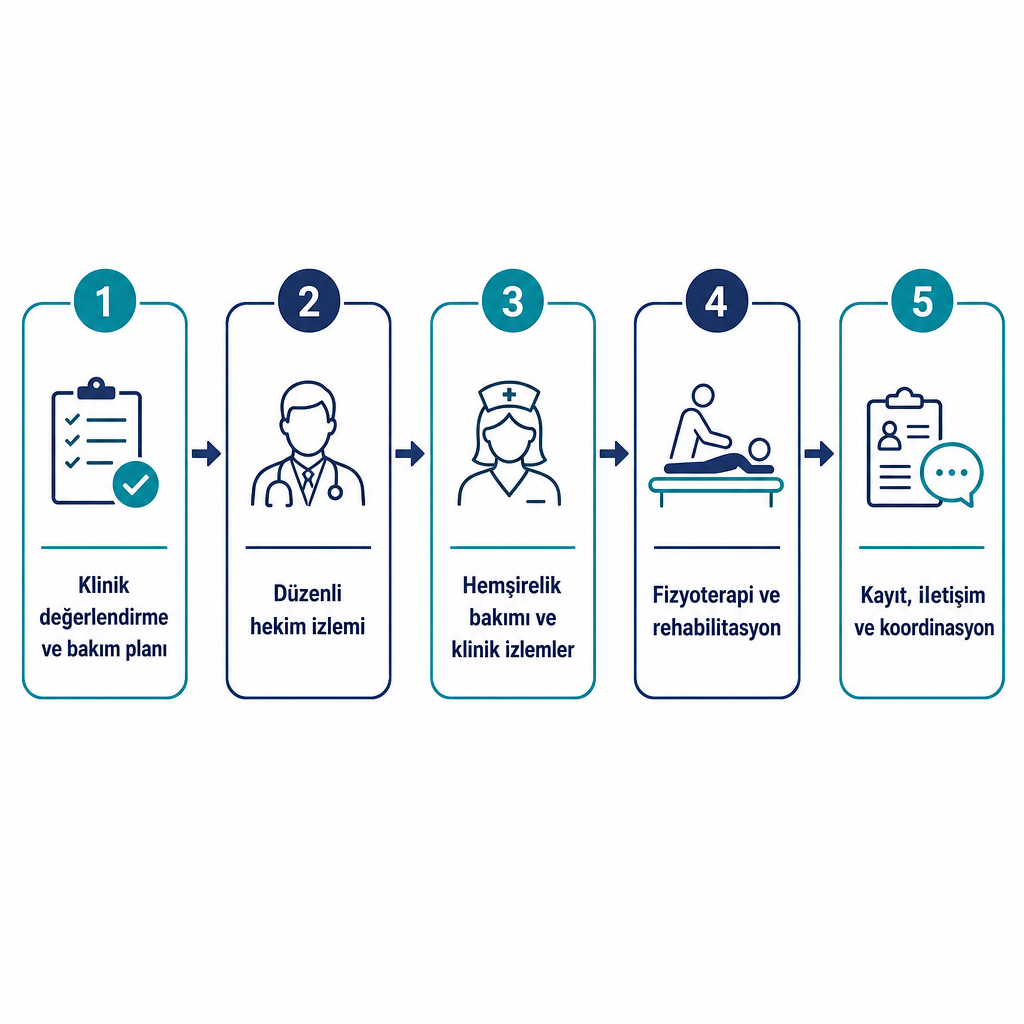 How the home monitoring process in chronic illness works
Core components of the process
Home monitoring in chronic illness proceeds through several main components that complement one another. Each component assumes a different clinical responsibility and is tied to a shared plan.
Clinical evaluation and care plan
The process begins with the physician evaluating the existing diagnosis, treatment regimen, accompanying illnesses, and home environment conditions. Because the focus of services provided at home is the follow-up and implementation of the arranged treatment of a diagnosed patient. As a result of the evaluation, it is determined which parameters (vital signs, laboratory checks, wound status, mobility capacity, respiratory function) will be monitored at what frequency, in which situations feedback will be given to the physician, and when the patient should be referred to a health facility. This plan is shared both with the team and the family and is reviewed over time.
Regular physician monitoring
Within the scope of private home physician services, regular physician follow-up and doctor monitoring integrated into the care plan can be planned for chronic patients. Visits are structured according to the patient's condition as a one-time evaluation, periodic check-up examinations, or regular monitoring for the chronic patient. These visits include physical examination, review of the medication regimen, inquiry into side effects and new complaints, ordering tests that can be performed at home if deemed necessary, and updating the care plan. The physician may decide to refer the patient to a hospital or direct them to other specialties when necessary. You can examine the private home physician framework in this context.
Nursing care and clinical monitoring
The follow-up and implementation of the treatment of a diagnosed patient, and the education of the patient and caregiver, are the fundamental components of nursing practices. In home monitoring, the nurse performs tasks such as measuring vital signs, administering medication and injections, maintaining wound care, and monitoring nutrition and fluid intake. The nurse can also educate family members on topics such as position changes, hygiene, and skin checks in patients at risk of pressure ulcers; this is consistent with the regulation's heading of "education of the patient and caregiver." We address this scope on our private home nursing service page.
Physiotherapy and rehabilitation
The definition of home health service states that rehabilitation practices can also be provided at home. In chronic neurological, cardiac, or orthopedic illnesses, home physiotherapy and rehabilitation support can be important in terms of preserving mobility capacity and adapting to daily living activities. The scope and duration of the practice are determined according to the evaluation of the physician and physiotherapist; rather than a fixed template, it is shaped according to the patient's functional goals.
Record-keeping, communication, and coordination
The regulations emphasize record-keeping, quality, and coordination processes. Every examination, measurement, intervention, and clinical observation performed on the chronic patient is recorded; these records are regularly evaluated by the physician and team. In situations involving more than one professional (physician, nurse, physiotherapist), in-team communication is decisive for the harmonious implementation of changes in the care plan. When necessary, coordination is established with the family physician, the public home health unit, or hospital units.
For which chronic patients does home monitoring come up?
In the definitions of the home health units of public hospitals, it is stated that this service is designed to meet the needs of bedridden patients and those with chronic illness within the home environment. Accordingly, home monitoring may come up especially in the following situations:
- Dependence on a bed or wheelchair,
- Chronic illnesses with recurrent hospital admissions that require long-term care,
- The need for frequent clinical monitoring due to neurological rehabilitation, palliative care, or advanced-stage chronic illnesses,
- The carrying out of continuous applications such as home wound care, enteral nutrition, or oxygen therapy.
Because the diagnosis is central, for patients whose chronic illness diagnosis has not been clarified or whose active diagnostic process is ongoing, a diagnostic evaluation is expected to be performed first at an appropriate health facility. Home monitoring aims to ensure continuity in patients who have been diagnosed and whose treatment has been arranged; it does not replace the active diagnostic process. The suitability of each patient is determined by the physician according to the clinical condition.
Decision criteria that determine the home monitoring plan
How home monitoring in chronic illness will be planned is directly related to several core criteria. The table below summarizes the main headings that affect the decision and their practical meanings.
| Decision criterion |
What is looked at in practice |
Who makes the decision |
| Medical condition |
Whether the diagnosis has been made and the treatment arranged |
Physician |
| Functional status |
Bed dependence, mobility restriction |
Physician, physiotherapist |
| Home environment |
Hygiene, safety, application conditions |
Team evaluation |
| Presence of a caregiver |
A person who will receive training and provide support |
Team and family |
| Required applications |
Examination, injection, IV, wound care, physiotherapy |
Physician |
These criteria are not considered independently of one another. For example, even if the home environment is suitable, if there is no caregiver or if the clinical condition requires frequent and advanced interventions, the plan is structured differently. You can see the clinical importance of sterilization in the safe conduct of home injection and IV applications in the article in which we address it in detail. The evaluation and treatment decision is made by the relevant physician; because symptoms and needs vary from person to person, the plan for each patient is created by considering the clinical condition, living conditions, and care resources together.
Home monitoring of chronic patients in the context of our center
As the Private Dr. Emin Paçacı Home Care Center, our services include headings such as home acute/chronic patient monitoring, home palliative care, home wound care and monitoring, and home physiotherapy. This structure allows the roles of physician, nurse, and physiotherapist to come together around a shared plan during the home monitoring process of individuals with chronic illness.
Within the scope of private home physician services, options such as regular physician follow-up for the chronic patient and doctor monitoring integrated into the care plan are defined. This framework aims for the home monitoring process to be planned in a physician-centered manner, and for nursing and physiotherapy practices to be carried out in harmony with this plan. By examining all of our services, you can see with which professional roles and under which headings home monitoring in chronic illness can be carried out.
Since each patient's condition is different, the appropriate monitoring plan can only be clarified through physician evaluation. When you share information such as the patient's diagnosis, current treatment, mobility capacity, and home conditions, we can evaluate the framework suitable for you together.
Frequently Asked Questions
Is home monitoring suitable for every patient with a chronic illness?
Although home health service is designed especially for bedridden individuals and those with chronic illness, the suitability of each patient is evaluated by the physician according to the clinical condition, mobility, home environment, and presence of a caregiver. Not a single criterion, but the entirety of these headings is decisive.
How often are vital signs monitored in home monitoring?
There is no fixed frequency. The interval of measurements such as blood pressure, pulse, and temperature is determined according to the patient's diagnosis, the medications they use, and the physician's clinical evaluation. The approach is to create a personalized monitoring plan rather than a standard schedule.
What is the difference between home health service and home care service?
Home health is a clinical service covering examination, testing, laboratory analysis, treatment, medical care, and rehabilitation. Home care, on the other hand, can include support for daily living activities, self-care, psychosocial support, and the organization of long-term care. Medical responsibilities lie with the physician and nurse; care responsibilities lie with the caregivers and support teams.
Can public home health services and private home care services be used together?
The regulations provide for services to be carried out in coordination with other levels of health care. Therefore, public home health services and private home physician/nursing services can be used simultaneously or sequentially according to clinical necessity and physician evaluation. What matters is that record-keeping, communication, and responsibilities are clear.
How do you apply for home health service?
For applications to public home health services, the Home Health Services Communication Center line numbered 444 38 33, available throughout Turkey, is used, and the information provided is forwarded to the relevant teams. For private home care and home health services, it is important that the relevant center is a legally licensed health institution and that physician evaluation is included in the process.