One of the most frequently asked questions during recovery after neurological diseases is this: Where should rehabilitation be carried out? When we examine the topic of The Importance of the Home Environment and Scientific Approaches in the Neurological Rehabilitation Process, we see that international guidelines and systematic reviews converge on a common point: In appropriate patients, home-based rehabilitation is similar to center-based programs in terms of daily living activities and independence, and in some cases can provide better functional outcomes in the short term. A program worked on in one's own kitchen, one's own hallway, and one's own bathroom has the potential to facilitate the transfer of learned skills into daily life. The decision about where and at what intensity rehabilitation will be continued is always personalized and based on physician evaluation.
Contents
What neurological rehabilitation and the home environment mean
Neurological rehabilitation is a multidisciplinary process aimed at reducing the losses in movement, balance, speech, cognitive function, and daily living activities that arise in conditions such as stroke, traumatic brain injury, spinal cord injuries, Parkinson's disease, multiple sclerosis, and peripheral nerve injuries. When the exercises, functional activities, and speech and cognitive work applied in this process are planned in the environment where the person carries out their real life, this can provide additional contribution in terms of transferring learned skills into daily life (generalization) and the sustainability of the program.
Home-based rehabilitation has been found to be as effective as center-based rehabilitation on mobility, daily living activities, and independence, especially in community-dwelling adults after stroke, and in some studies superior in the short term. The American Heart Association's adult stroke rehabilitation guideline recommends considering home- or community-based rehabilitation options for patients whose post-discharge living environment has been evaluated and found suitable. This approach positions the home environment not as an obstacle to rehabilitation but as a tool when carefully planned.
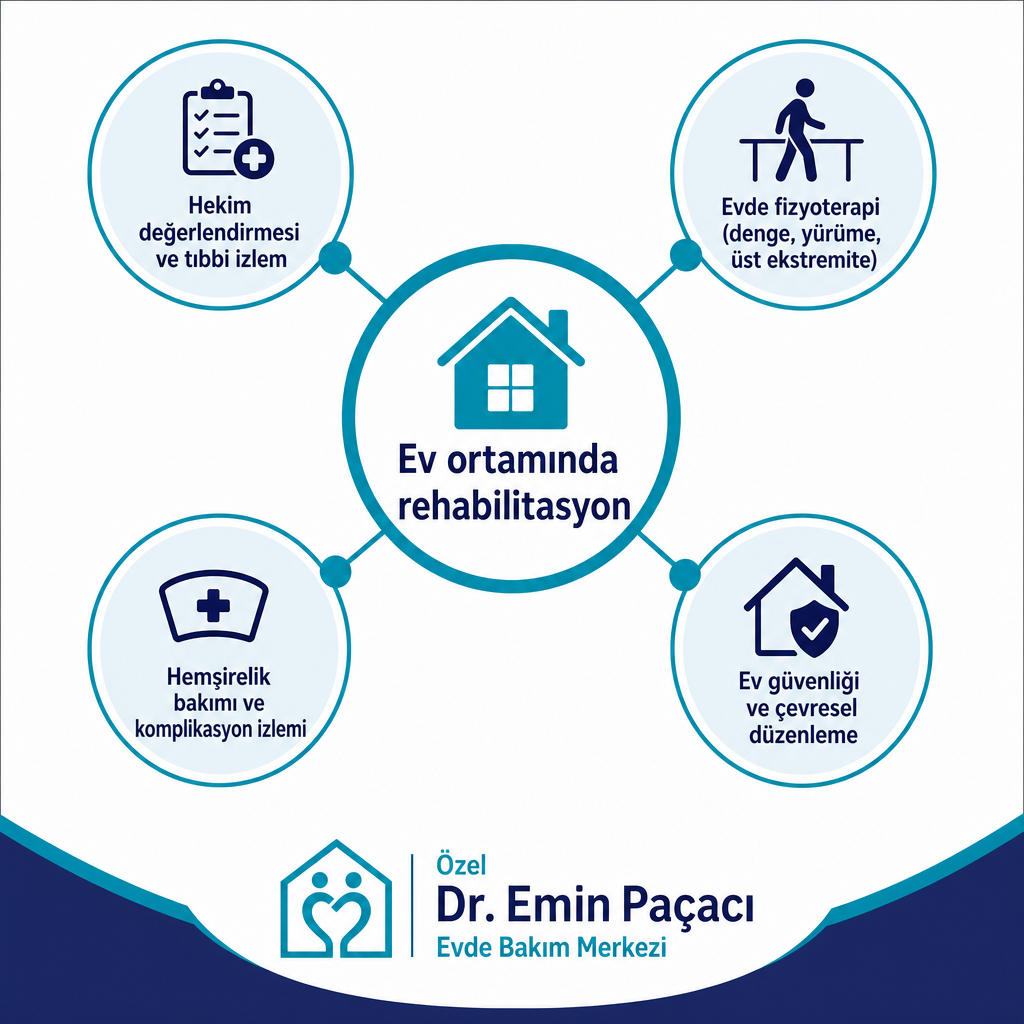 Fundamental components of neurological rehabilitation at home
Scientific findings supporting home-based rehabilitation
Systematic reviews and clinical studies conducted in patients after stroke show that home-based rehabilitation can yield comparable or, in the short term, better results than center-based rehabilitation in terms of the ability to perform basic daily living activities (such as bathing, dressing, transfers). Structured and intensive programs applied at home stand out as approaches worth evaluating in terms of the potential to increase the level of independence and reduce the need for care.
Home programs focused on daily living activities (such as kitchen tasks, going up and down stairs, walking within the home) have been reported to have positive effects on short-term independence when compared with less structured usual follow-up. In reviews on upper extremity rehabilitation, it has been shown that physiotherapist-supervised or technology-supported exercise programs that patients can apply on their own can increase arm function and the sense of using the arm in daily activities.
Technology-supported home applications are also a part of this picture. It has been reported that telerehabilitation programs conducted through video conferencing and digital games under physiotherapist supervision can provide non-inferior results in arm function and motor performance compared to treatments of similar duration applied in the clinical setting. These findings indicate that professional rehabilitation follow-up from home may be safe and feasible in appropriate patients; however, every method is evaluated according to the patient's clinical condition.
The relationship of the home environment with clinical goals
One of the fundamental goals of neurological rehabilitation is for the person to be able to perform daily tasks such as dressing, personal care, meal preparation, toilet, and bathing activities as independently as possible in their own environment. Working on these activities directly at home—in a real kitchen, a real bathroom, and among the person's own furniture—can reduce the disconnect between therapy and daily life. Thus, the settling of learned skills into the daily routine can become easier.
In motor, balance, and gait training, the home environment offers a concrete advantage. Balance and gait work can be planned on real routes such as the hallways, stairs, bathroom entrance, and the path up to the front door that the person uses at home. In individuals with balance impairment, especially the elderly, balance exercises applied together with in-home modifications aim to create a holistic framework for reducing fall risk.
The home also serves as a natural laboratory for cognitive work. Goals related to orientation, attention, memory, and executive functions can be structured through tasks such as preparing a shopping list, planning the day, organizing a cabinet, and using the phone. These tasks, which support cognitive reserve by using the person's own life habits, can transform therapy from an abstract exercise into a familiar daily experience.
Safety, fall risk, and environmental modifications
When planning neurological rehabilitation at home, safety is a priority. In people with stroke, Parkinson's disease, peripheral neuropathy, imbalance, and muscle weakness, fall risk may increase inside and around the home. For this reason, environmental assessment is addressed as a prerequisite of the rehabilitation program.
The prominent headings within the framework of clinical approaches are as follows:
- Reducing the accumulation of objects that may cause tripping in walkways, and arranging loose rugs and cables
- Ensuring adequate lighting on stairs and in hallways
- Reviewing solutions such as grab points and seating surfaces to reduce the risk of slipping in the bathroom, if deemed appropriate after medical evaluation
- Evaluating steps and thresholds that create obstacles at home entrances and exits according to the individual's mobility
The scope of such modifications is not a standard list; it is determined by the physician and the rehabilitation team according to the patient's clinical condition. Every change should be planned taking into account the individual's safety and medical requirements. The general approaches on the subject of methods to reduce loss of balance in the elderly and fall risk at home can help in understanding why environmental safety is so decisive in neurological patients.
Professional roles in home neurological rehabilitation
Home neurological rehabilitation is planned within a framework where different professional roles work together. The assessment and treatment decision belongs to the physician; the content of the program differs for each patient.
Physician evaluation forms the basis of the process. In home care services, the physician's role is to evaluate the patient's neurological and systemic condition, review accompanying diseases and medication treatments, monitor complication risks, and place the rehabilitation team's clinical goals within a medical framework. During the neurological rehabilitation process, physician evaluation at home helps decisions about the duration, content, and intensity of rehabilitation to be made according to the person's clinical condition. We evaluate how this approach works within the scope of our home private physician service.
Home physiotherapy carries the applied pillar of neurological rehabilitation. In stroke and other neurological diseases, home physiotherapy consists of individualized programs focused on muscle strength, joint range of motion, balance, gait, transfers, and upper extremity functions. Within this scope, functional exercises such as balance and gait work on in-home routes, getting up from a chair, and in-bed movements, along with work involving fine and gross motor skills for the upper extremity, can be planned by evaluating medical suitability. Studies show that home-based physiotherapy programs can provide functional gains similar to center-based programs in appropriate patients. Our home physiotherapy service aims to carry out these programs in the home environment.
Nursing care, on the other hand, maintains the continuity of rehabilitation. During the neurological rehabilitation process, home nursing provides important support in terms of monitoring pressure ulcer risk, nutritional status, fluid balance, medication administration, device use (such as feeding tube, urinary catheter), and signs of infection. The nursing team is responsible for early detection of changes in medical condition that may affect the continuity of rehabilitation (such as fever, signs of infection, new neurological complaints) and reporting them to the physician; we explain the details under our home private nursing service.
In recent years, developments in the field of home neurological rehabilitation have been reported with technologies such as telerehabilitation, virtual reality, interactive games, and low-cost brain-computer interface systems. There is early evidence that simple-to-use, low-cost brain-computer interface systems are feasible and safe for motor rehabilitation at home. Such approaches should be evaluated by the physician and the rehabilitation team, taking into account the patient's cognitive state, motivation, home infrastructure, and caregiver support.
The regulatory framework for home healthcare services in Turkey
In Turkey, home health and home care services are defined and supervised by regulations and directives issued by the Ministry of Health and relevant institutions. According to the legislation, home health service covers the medical services that can be provided in the place where a person carries out their life, for individuals who have become bed-, device-, or home-bound due to diagnosed diseases. Private institutions are obligated to obtain an operating license from the Ministry to provide home care and health services, and to comply with the provisions of the regulation on matters of personnel, records, and supervision.
Within this framework, as the Private Dr. Emin Paçacı Home Care Center, we are a home care institution operating in Üsküdar/Istanbul with the permission of the Ministry of Health. With our team consisting of licensed physicians, nurses, and physiotherapists, we provide services such as home medical evaluation, nursing, physiotherapy, palliative care, and wound care. The evaluation of the home environment during the neurological rehabilitation process and the planning of home care services are carried out within the limits set by the legislation and under physician responsibility. We detailed the general framework between public and private services in our article what you need to know about Ministry of Health home care services.
These regulations require home health service to be provided not haphazardly but within a defined medical framework. In a multi-component process such as neurological rehabilitation, this framework is decisive for both patient safety and the continuity of care.
Decision criteria between home, center, or hybrid model
The decision on whether to continue neurological rehabilitation at home, in a center, or with a hybrid model should be made by the physician, taking into account the individual characteristics and living conditions of the patient. Guidelines recommend that the environment in which the patient lives be evaluated by a professional team in the post-discharge period, and that home- or community-based rehabilitation options be considered for patients found suitable.
In this evaluation, the following headings are generally taken into account:
| Evaluation heading |
Elements examined |
| Medical stability |
Accompanying diseases, cardiac/respiratory status, infection risk |
| Neurological picture |
Consciousness and attention, balance, mobility, communication |
| Home environment |
Stairs, bathroom, lighting, obstacles, accessibility |
| Family and caregiver support |
Level of daily assistance, education and compliance |
| Transportation conditions |
Possibility of regular travel to and from external centers |
These headings are not independent of each other; they are evaluated together. For example, even if the home environment is suitable, if medical stability has not been achieved, the model decision may change; similarly, in a patient with transportation difficulty, family support and safe home conditions may bring the home-based approach to the fore. Since symptoms and requirements vary from person to person, individuals with a neurological diagnosis are advised to consult a physician and obtain a medical evaluation about the location and scope of rehabilitation.
Frequently Asked Questions
Who may home neurological rehabilitation be suitable for?
Home neurological rehabilitation can generally be considered for individuals who are medically stable, whose consciousness and communication are appropriate to the level of the disease, whose home environment can be made safe, and who have a certain level of family or caregiver support. Studies conducted in community-dwelling adults after stroke show that home-based rehabilitation is feasible in many situations and can be beneficial in terms of functional outcomes. The suitability decision is always based on individual physician evaluation.
What is the scientific difference between neurological rehabilitation performed at home and that performed in a center?
Systematic reviews report that home-based rehabilitation can yield results similar to center-based rehabilitation in adults after stroke in terms of daily living activities and level of independence, and in some studies better results in the short term. Some guidelines evaluate home- or community-based rehabilitation as an alternative to or complement to center-based programs in appropriate patients. When deciding which model to prefer, the patient's clinical condition, home conditions, and team resources are considered together.
Which safety headings come to the fore when adapting the home environment for neurological rehabilitation?
The prominent headings are reducing objects that may create obstacles in walkways, ensuring the adequacy of lighting, and arranging risky areas such as stairs, bathroom, and hallway. These elements are taken into account especially in neurological patients at fall risk. The scope of modifications should be determined by the physician and the rehabilitation team according to the patient's clinical condition.
What is the role of family members in the home neurological rehabilitation process?
Home rehabilitation gains a more holistic structure with the active participation of family members in the process. The family plays an important role in matters such as maintaining a safe environment, providing support in exercises and activities, organizing appointments and medical follow-up, and preserving motivation. The professional team can support this role by offering the family information and education appropriate to the patient's condition.
How is the decision for home neurological rehabilitation made?
The decision is made based on the medical evaluation performed by the physician, neurological findings, the safety and accessibility status of the home environment, family and caregiver support, and the service opportunities in the region. In appropriate patients, guidelines recommend that home- or community-based rehabilitation be considered as an option. Since symptoms and requirements vary from person to person, it is important to consult a physician and obtain a detailed evaluation to determine the appropriate model.