In patients whose blood oxygen level is persistently low, oxygen therapy—applied to reduce the respiratory burden and ensure tissues receive adequate oxygen—is today a form of treatment that can be sustained at home in many chronic respiratory and circulatory diseases. What Should Be Known About Oxygen Therapy and the Use of Home-Type Oxygen Devices is often not merely a matter of how to turn a single device on and off; who sets the flow rate, where the device should be placed in the home, how fire and electrical safety will be ensured, and which symptoms should prompt a visit to the physician are topics that need to be considered together. In this article, drawing on national chest disease guidelines and educational resources, we examine the basic logic of home oxygen therapy, device options, safety principles, and decision criteria within an informative framework.
Table of Contents
What is oxygen therapy and why is it adjusted "like a medication"?
Oxygen therapy is the controlled administration of supplemental oxygen to people whose arterial oxygen pressure (PaO₂) and oxygen saturation (SpO₂) have fallen below normal due to respiratory or circulatory system diseases. The aim is to ease the burden on the respiratory muscles and ensure that the organs receive adequate oxygen.
A fundamental point must be emphasized from the outset: in treatment, oxygen is regarded like a medication. Its dose—that is, the amount of liters delivered per minute (L/min)—the duration of administration, and the method are determined by the physician according to the type and severity of the disease and blood gas findings. National chest disease guidelines state that long-term oxygen therapy, particularly in patients who develop chronic respiratory failure, is based on arterial blood gas and saturation measurements.
This approach differs markedly from the notion that "anyone who is short of breath receives oxygen." The decision to start, stop, or change the dose of oxygen therapy is made according to individual symptoms, tests, and clinical evaluation; it is not considered medically appropriate for the patient to decide on their own. The principle highlighted in educational materials is "administration at the lowest necessary concentration and for the shortest time," because oxygen at a higher concentration than needed also carries its own risks.
In which situations does home oxygen therapy come into consideration?
Home oxygen therapy most often comes into consideration in chronic obstructive pulmonary disease (COPD), some interstitial lung diseases, advanced heart failure, and other conditions leading to long-term hypoxemia. In the guidelines, blood oxygen pressure at rest remaining below certain thresholds (such as PaO₂ < 55 mmHg) or saturation remaining persistently low is counted among the basic criteria for long-term oxygen therapy.
Not every home oxygen use has to be long-term. In some patients, shorter-term, episodic oxygen support within the post-infection period, the postoperative process, or palliative care may also be evaluated by the physician. Which scenario applies depends not only on momentary shortness of breath but on measurable findings.
What influences the decision is, as much as the device itself, the patient's living conditions. Daily life activities, level of movement, nighttime sleep and possible nocturnal hypoxemia, accompanying diseases, and the physical conditions of the home environment are considered together. For example, the suitable device type may differ for a patient who largely sits at home during the day versus a patient who regularly goes outside.
Home-type oxygen devices and their working mechanism
One of the most commonly used devices in home oxygen therapy is the home-type oxygen concentrator. These devices draw in ambient air, reduce the nitrogen concentration with the help of the filter and adsorbent materials inside (such as zeolite), and produce a gas mixture containing a higher proportion of oxygen. The resulting oxygen is delivered to the patient via nasal cannula or mask at the L/min rate set on the device.
Concentrators run on electricity and are mostly designed for continuous use; however, the operating time, rest intervals, and maintenance requirements are planned in line with the manufacturer's instructions and the recommendations of the physician and technical service. Some devices provide a fixed "continuous flow," while others operate in a "pulse" mode sensitive to the patient's breathing; which mode is appropriate is evaluated by health professionals according to the patient's breathing pattern and medical need.
Alongside stationary concentrators, portable concentrators or oxygen tanks may also be used for more mobile patients. Which option is appropriate is determined by the physician according to the patient's mobility, the level of oxygen need, and the safety conditions in the home.
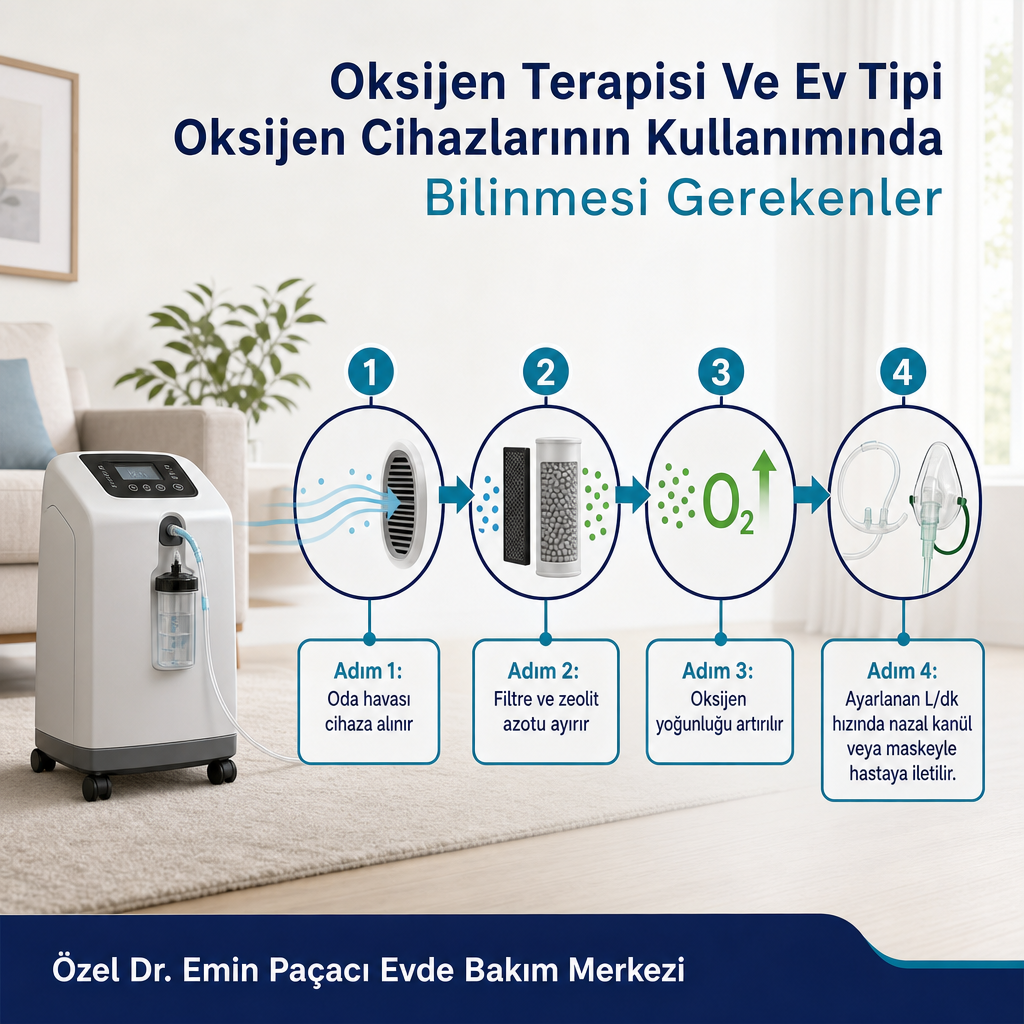 Working flow of a home-type oxygen concentrator
Decisive principles in safe use
In home oxygen therapy, the safety of the home environment is as decisive as medical effectiveness. The following topics are the basic principles that should be emphasized when the device is brought home.
Flow setting and the physician's plan
Having the oxygen flow rate and the daily or weekly duration of use determined by the physician is a fundamental rule for both the effectiveness and the safety of treatment. Increasing or decreasing the flow by the patient on their own, especially in people with chronic respiratory failure, may be associated with undesirable effects such as carbon dioxide retention, headache, and drowsiness. For this reason, every change in the flow setting should be made under the supervision of the physician and, when necessary, a chest disease specialist.
Fire and heat safety
Oxygen does not start a fire, but it markedly accelerates an existing one. For this reason, not smoking in the areas where the device is used or stored and not keeping open flame sources such as candles, stoves, heaters, and lighters is a basic safety rule. Keeping the device and the accessories carrying oxygen at a certain distance from heat sources reduces the risk of the plastic material melting and fire. Flammable substances such as alcohol-based solutions, solvents, and aerosol sprays should not be kept near the device.
Positioning and ventilation
For the concentrator to work efficiently, it is important to keep it in a cool, dry, and well-ventilated area. The device's air intake and outlet openings should not be blocked; it should not be placed too close to walls, curtains, or furniture. Placing the device on soft surfaces such as a bed, pillow, or thick carpet is not recommended, as it may increase the risk of tipping over and of the air intake being blocked. Narrow, stuffy environments where doors and windows are completely closed can also reduce device performance.
Electrical and cable safety
Since concentrators run on electricity, electrical safety is a natural part of the treatment. It is recommended that the device be powered from a sound, grounded outlet and that the cable not be left crushed, pinched, or under excessive tension. Some international guidelines advise against using concentrators with an extension cable and against running multiple high-current devices from the same outlet. When wear, burn marks, or a loose connection is noticed on the cable, it is appropriate to pause use of the device and request a technical evaluation.
Tubing, nasal cannula, and humidification
The length of oxygen tubing and cannulas is determined according to manufacturer and physician recommendations; excessively long tubing may increase the risk of pressure drop and entanglement. It is recommended that the tubing not be cut, not be randomly extended with an attachment piece, and be positioned so that it will not kink and become pinched. Some devices have a humidification chamber to reduce drying of the airways; regularly renewing and keeping the water in this chamber clean is recommended for both the healthy operation of the device and for reducing the risk of microbial buildup. However, the type of water to be used and the frequency of replacement should be shaped according to the manufacturer's instructions and nurse information. Our article titled the clinical importance of sterilization in injection and serum administrations in the home setting addresses in more detail why the hygiene of materials used at home is important.
Risks associated with oxygen therapy and symptoms requiring attention
Although oxygen is indispensable for life, its high-concentration and long-term use during treatment may carry certain risks. Educational materials state that, to prevent oxygen toxicity, the approach of "administration at the lowest necessary concentration and for the shortest time" is adopted, and that physicians therefore carefully adjust the dose and duration.
In some patients who receive high-concentration oxygen for a long time, problems such as irritation of the lung tissue, absorption atelectasis, and impairment in gas exchange may theoretically arise; for this reason, uninterrupted clinical monitoring is important. In people with chronic respiratory failure, uncontrolled administration of oxygen can raise the carbon dioxide level in the blood, and this may be associated with drowsiness, headache, and changes in consciousness.
Another more mechanical but frequently encountered point is the areas where the cannula and tubing contact the skin and mucosa. Dryness, irritation, or pressure-related redness may be seen at these points; nursing guidelines emphasize regular observation of these areas and repositioning the apparatus when necessary. Since electrical or mechanical malfunctions can cause the device to deviate from the expected flow rate and reduce the effectiveness of treatment, it is recommended that usage training and technical service processes be clarified from the outset when the device is obtained.
The role of the physician, nurse, and home care team
Home oxygen therapy is often addressed not alone but as part of a broader home health and care plan. The physician evaluates the oxygen need according to the diagnosis, blood gas results, saturation measurements, and the patient's general condition, determines the device type and flow rate, and plans its relationship with other medications and treatments. Evaluations carried out within the framework of home doctor service ensure that this decision is based on individual findings.
The nurse plays a role in monitoring the daily use of the device, in the placement of the cannula and tubing, in checking the skin and mucosa, and in monitoring vital signs. Private home nursing services provide the basis for carrying out this monitoring regularly. The physiotherapist, meanwhile, can support the functional capacity of the patient receiving oxygen therapy through breathing exercises, positioning, and movement plans; the scope of home physiotherapy can be planned together with the treatment in this respect.
As Private Dr. Emin Paçacı Home Care Center, we evaluate our home medicine, nursing, and physiotherapy services within a single care plan. In a patient receiving oxygen therapy, the coordination of these three areas can be decisive not only for the safe use of the device but also for the sustainability of the treatment.
How is the use of a home oxygen device evaluated?
The use of a home oxygen device comes into consideration when the physician evaluates multiple factors together. The following criteria show why the decision is individualized:
- The type, stage, and expected course of the disease (for example, COPD, interstitial lung disease).
- Arterial blood gas results (PaO₂, PaCO₂) and oxygen saturation values.
- The level of shortness of breath at rest and during exertion, nighttime sleep, and possible nocturnal hypoxemia findings.
- The patient's daily life activities, mobility, whether they live alone, and caregiver support.
- The home environment's electrical safety, ventilation, and fire safety conditions.
By evaluating these elements together, the duration of oxygen therapy, the device type (stationary or portable), the target saturation range, and the frequency of follow-up are planned. In the evaluation, the patient's previous treatment responses, accompanying heart diseases, and medication use are also taken into account. For device placement and safety arrangements during the transition home after discharge, our article titled how to arrange the home health environment after discharge offers a complementary framework.
Since symptoms and needs vary from person to person, individual decisions and detailed planning regarding home oxygen therapy always rest on physician evaluation. It is recommended to consult a physician to create a plan suitable for the patient's condition.
Frequently asked questions
How is the decision to use a home oxygen device made?
The decision is made by a chest disease or relevant specialty physician after clinical examination, blood gas and saturation measurements, and the stage of the disease have been evaluated. The feeling of shortness of breath alone does not require starting device use; it must always be supported by medical investigation.
Can I increase or decrease the flow rate myself?
Oxygen is regarded as a therapeutic agent requiring dose adjustment, and changes in the flow rate require physician supervision. Especially in patients with chronic respiratory failure, uncontrolled increasing of the flow can increase the risk of carbon dioxide retention and oxygen toxicity, so adjustments should be made by a health professional.
Where should I place the home oxygen concentrator?
The device should be positioned in a cool, dry, and well-ventilated room, somewhat away from walls, curtains, and furniture, and in such a way that the air intake and outlet are not blocked. Placing it on a bed or soft surfaces is not recommended, as it may increase the risk of tipping over and of the airflow being obstructed.
Can one smoke at home while using oxygen?
Because oxygen accelerates burning, smoking in the room where the device is located and around the tubing and cannula creates a serious fire risk. International guidelines recommend a complete ban on smoking and other open flame sources in areas where oxygen therapy is administered.
What happens if the device breaks down or there is a power outage?
Since concentrators run on electricity, long power outages stop the device's oxygen production. In such situations, how to act should be planned in advance by the physician according to the patient's clinical condition and explained to the family.