What to pay attention to at home after orthopedic surgery such as a hip or knee replacement (prosthesis, etc.) actually rests not on a single rule but on carrying out several headings together: protecting the wound site, managing pain according to the physician's plan, moving in a controlled manner, reducing the risk of falls and clots, and recognizing warning signs early. The aim of this process is to continue the post-discharge period safely and in an orderly way, to support regaining mobility, and to distinguish possible complications at an early stage. How quickly the process progresses varies according to the type of surgery, the type of prosthesis, the person's age, and accompanying illnesses; therefore, the measure of each step is determined by the responsible physician.
Contents
Basic goals of home care
After prosthesis surgery, patients generally need help and regular monitoring for a while in the period following discharge. Grouping the goals of home care into a few concrete headings makes it easier to understand which measure serves what purpose: protecting the wound site and reducing the risk of infection, managing pain according to the physician's plan, increasing joint range of motion and muscle strength in line with the physiotherapy program, arranging the home environment to reduce the risk of falls and trauma, and reducing the risk of complications related to circulation and respiration.
The common point of these goals is to make the plan given by the physician at discharge applicable in a regular manner in the home environment. For example, "mobility" is not a goal on its own; it gains meaning within the framework of the distance, frequency, and assistive device determined by the physiotherapist. Likewise, wound care is not a general cleaning habit but a process tied to the interval and technique recommended by the surgeon. For this reason, the headings below should be read not as a list of instructions but as a framework showing in which areas the physician's plan takes concrete form.
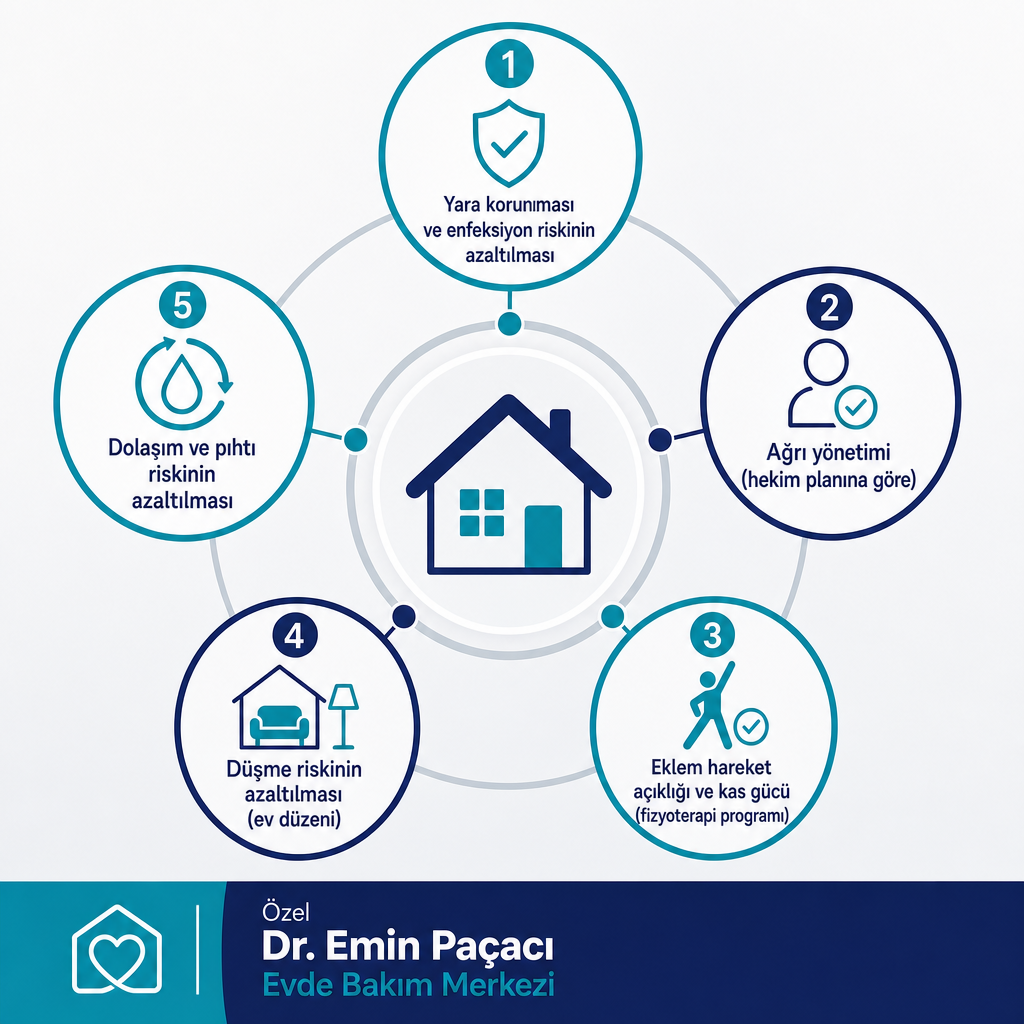 The five basic goals of home care after prosthesis
Making the home environment safe
In the early period after prosthesis surgery, falling is a significant risk both for the newly operated area and for overall recovery. Making the home environment suitable for moving safely with assistive devices such as a cane, walker, or crutches helps reduce this risk. The arrangements highlighted in guidelines are practical and easy to apply.
- Removing loose or small rugs, or securing them with a non-slip base, reduces the likelihood of tripping and falling.
- It is recommended to remove obstacles such as cables, coffee tables, and chairs from walking paths.
- Having a night light or easily accessible lighting in the hallways and rooms to be used when going to the toilet at night increases safety, especially for people using pain relievers.
- If stairs must be used, a handrail or a sturdy gripping surface helps maintain balance.
- Simple arrangements such as non-slip mats and grab bars in the bathroom can reduce the risk of falling.
Going up and down stairs for a long time can be challenging in the early period for some hip and knee replacement patients. For this reason, if possible, it is recommended that the rooms where more time will be spent during the first days be gathered on the same floor. The measure of home arrangement also varies from person to person; how to establish a safe area of movement in patients with limited mobility is a subject to which the physiotherapist working at home can also contribute.
Things to watch for in wound care and hygiene
Care of the surgical incision area is one of the prominent headings in terms of reducing the risk of infection. The basic approach emphasized in guidelines is keeping the wound site clean and dry and planning the dressing change intervals according to the surgeon's recommendation. Regarding bathing and contact with water, it is stated that prolonged immersion in a bathtub, the sea, or a pool is generally postponed until the incision area is fully closed; and that permission to shower is often shaped according to the physician's written discharge instructions.
It is stated that products such as creams, lotions, or powder should not be applied to the wound area unless the physician recommends it. Findings such as redness, discharge, foul odor, increasing pain, or fever at the wound site are considered warning signs of infection, and in this case it is advised to consult a physician. In most patients, wound care can be carried out with professional home wound care and dressing follow-up support; however, the dressing technique, frequency, and follow-up plan are determined by the surgeon or the relevant physician. In cases planned by the physician, in addition to dressing, safe IV and serum applications may also be among the procedures arranged in the home environment.
Pain management and medication use
A certain level of pain and tenderness after orthopedic surgeries is considered normal; a person-specific plan is created before discharge to manage this pain. It is essential that pain relievers and other medications be used as prescribed by the physician and for the recommended duration. Information is provided about side effects of medications such as drowsiness, constipation, or stomach complaints; if these complaints increase, notifying the physician is recommended.
Some guidelines state that, if the physician deems it appropriate, taking a pain reliever a certain time before exercise or physiotherapy sessions can make movement easier. The use of pain relievers or sedative medications together with alcohol is emphasized as harmful in international guidelines. Drug treatment is person-specific; the dose, duration, and drug combinations must be determined and monitored only by the responsible physician. This article does not include medication names, doses, or usage schedules; since this information varies from person to person, it is arranged by the physician.
Movement, walking, and physiotherapy
Especially in joint prostheses, controlled movement and early mobilization are defined as one of the basic elements of functional recovery. The physician and physiotherapist plan a gradual walking and exercise program according to the type of surgery; in this program, the walking distance, frequency, and assistive devices to be used are determined in detail. In knee and hip replacements, exercises aimed at increasing joint range of motion and supporting muscle strength are considered in most guidelines to be a fundamental part of the recovery process.
In home rehabilitation programs, exercises are personalized according to the patient's functional level and recovery pace; when necessary, they can be applied several times during the day. A gradual return to walking without a cane and to daily activities is mostly planned according to the joint assessment made by the physiotherapist and surgeon. While for some patients outpatient or center-based physiotherapy is sufficient, for people with limited mobility or difficulty leaving home, home physiotherapy programs can be used. In these applications, functional activities such as safe walking, going up and down stairs, and getting out of bed are worked on; similar home environment principles also apply in neurological rehabilitation processes.
Measures against circulation, swelling, and clot risk
Measures against the risk of circulation and clot formation (deep vein thrombosis, etc.) in the period after hip and knee replacements are one of the important headings of international guidelines. Many guidelines state that exercising the leg muscles with short walks performed as often as the physician recommends during the day reduces the risk of clots and stiffness. For swelling in the leg, supporting the leg on the prosthesis side so that it is occasionally above heart level is a practice recommended in some guidelines.
Cold application to the wound area and its surroundings at certain intervals is defined as a supportive method aimed at reducing edema and pain; however, its duration and frequency are determined according to the physician's written instructions. Findings such as increasing pain in the calf, marked swelling on one side, and sudden shortness of breath are counted among the warning signs in guidelines that may require urgent evaluation. Preventive treatments against clot risk (for example, blood thinners) are planned by surgeons according to the individual risk profile; the duration and content of these treatments are entirely the physician's responsibility.
Nutrition, fluid intake, and digestion
Adequate nutrition and fluid intake in the period after orthopedic surgery are counted among the basic factors that contribute to bone and soft tissue healing. It is emphasized in various care guidelines that a protein-rich diet provides the building blocks necessary for tissue repair. It is stated that foods containing calcium and vitamin D can be supportive in terms of bone health, especially after joint prostheses; however, if a supplement or medication use is needed, it is stated that this should be planned by the physician.
Adequate fluid intake is important both for balancing circulation and for reducing constipation. Since pain relievers and immobility can increase the risk of constipation, it is stated that a fiber-rich diet and movement under the physician's supervision are supportive. The nutrition plan should be arranged individually by a dietitian and physician, taking into account accompanying illnesses such as kidney failure or diabetes.
Daily life and need for support
In the first days after major orthopedic surgeries, the need for help with daily activities such as dressing, bathing, using the toilet, and preparing meals is common. Some guidelines state that having a relative or caregiver at home for the first few days after discharge can be beneficial both for safety and for psychological comfort. Having tasks such as shopping, heavy housework, laundry, and cleaning taken over by relatives for a while allows the patient to focus only on the activities determined by the physician and physiotherapist.
Assistive tools such as toilet raisers, chairs that make sitting and standing easier, and long-handled dressing aids are among the supports frequently used by hip and knee replacement patients. For some patients, monitoring vital signs, continuing wound care, and continuing patient-relative education can be planned with private home nursing support. The aim of these services is to contribute to the regular application of the discharge plan determined by the physician in the home environment.
When physician evaluation is needed
Attending the planned check-ups after surgery on time is important for evaluating the course of the recovery process. In patient information guidelines used worldwide, it is prominent that a physician should be consulted in the following situations. This table is not a self-diagnosis tool but a summary reminding which findings should be conveyed to the physician for evaluation.
| Finding group |
Prominent signs |
| Wound and infection |
Increasing redness, swelling, warmth, discharge, or foul odor |
| General condition |
Measured or felt rise in fever |
| Pain |
Pain that does not decrease even at rest or that gradually intensifies |
| Circulation/clot |
Sudden pain in the calf, marked swelling on one side, sudden shortness of breath, or chest pain |
| Prosthesis |
Unexplained locking on the prosthesis side, sudden restriction of movement, or a feeling of dislocation |
It is emphasized that these findings may appear at different levels in each patient and that the evaluation and decision must definitely be made by the physician. Since symptoms vary from person to person, it is recommended to stay in communication with the responsible physician and rehabilitation team in every situation of doubt.
The role of professional support teams at home
In the period after orthopedic surgery, teams consisting of physicians, nurses, and physiotherapists can contribute to adapting the discharge plan to the home environment. Visits within the scope of private home physician services can serve to evaluate vital signs, wound healing, and general clinical condition, and to review the medication and follow-up plan. Home nursing services focus on safely maintaining procedures planned by the physician, such as wound care, dressing, injections, or serum applications.
In home physiotherapy applications, the exercise program determined for the patient is adapted to the home environment and safe movement is worked on. As a home care institution licensed by the Ministry of Health, we too can plan to carry out such processes in the patient's own home with licensed physicians, nurses, and physiotherapists. However, the scope in which these supports are needed is determined by the joint decision of the orthopedic specialist who performed the surgery, the family physician, and other relevant branch physicians. In order for us to create a plan suitable for the patient's condition, sharing the type of surgery, discharge notes, and current needs is helpful.
Frequently Asked Questions
After orthopedic surgery, is complete rest or movement more important?
Guidelines state that remaining completely immobile can increase muscle weakness, joint stiffness, and clot risk; and that controlled movement programs planned by the physician are preferred. What level of rest and movement is needed is determined by the physician according to the type of surgery and individual risks.
How should my bathing arrangement at home be after a hip or knee replacement?
It is recommended to avoid prolonged contact of the surgical incision area with water until the wound is completely closed; permission and timing for showering are stated in the surgeon's discharge notes. Non-slip mats and grab bars in the bathroom are among the safety measures frequently recommended in guidelines.
Is home physiotherapy necessary after every orthopedic surgery?
While for some patients outpatient or center-based rehabilitation is sufficient, home physiotherapy may be preferred for individuals with limited mobility or accompanying illnesses. The decision is made by the orthopedist who performed the surgery and the physiotherapist, taking into account the patient's functional level and home conditions.
Is it normal to have mild redness and swelling at the wound site?
Mild swelling and tenderness in the early period can be seen in some patients; however, an increase in redness, warmth, discharge, foul odor, or accompaniment by fever is considered a warning sign of infection. When such findings develop, consulting a physician for evaluation is recommended.
When can one drive after an orthopedic prosthesis?
The time for driving varies according to the type of surgery, the type of prosthesis, the necessity of using the leg, and the medications used. Many guidelines emphasize that driving should not begin without evaluating whether reflexes have become adequate and whether pain control is appropriate; and it is stated that the final decision should be made by the surgeon.