Supportive Approaches to Enhancing Patient Comfort in the Palliative Care Process is a framework designed to help you systematically support the daily comfort of a loved one living at home with a serious and progressive illness, together with the physician and healthcare team. This process is not a one-time intervention; it is a care journey based on regular reassessment that may last weeks, months, or longer depending on the patient's clinical condition. Since the scope and frequency are always determined by the physician's assessment, you can read the following headings not as an implementation instruction, but as a map of the topics you will discuss with the healthcare team.
Contents
Dimensions of patient comfort in palliative care
Palliative care focuses on supporting the quality of life of the patient and family through the early recognition and relief of physical, psychosocial, and spiritual problems arising from life-threatening illnesses. The aim here is not to eliminate the disease, but to preserve the best possible quality of daily life by reducing the burden of symptoms and stress that come with the illness.
Thinking of comfort solely as the reduction of pain is incomplete. Multidimensional symptoms such as shortness of breath, nausea, fatigue, sleep disturbances, loss of appetite, anxiety, and spiritual distress are evaluated together. Most of these symptoms feed off one another: poor sleep increases fatigue, increased fatigue reduces mobility capacity, and immobility raises the risk of pressure sores and constipation. Comfort means addressing these cycles together.
The process is carried out with a multidisciplinary team approach consisting of a physician, nurse, physiotherapist, psychosocial support specialists, and, when needed, spiritual counselors. Monitoring the patient in their own home environment can support the continuity of symptom control and comfort. In this picture, family members are seen not as outside observers, but as stakeholders who take on the fundamental elements of daily care. You can find the general framework of the topic in more detail in our article explaining the scope of home palliative care.
The three dimensions of comfort are intertwined in practice:
- Physical comfort: Keeping symptoms such as pain, shortness of breath, nausea, constipation, sleep, and fatigue under control through regular assessment and the physician's plan; incorporating proper positioning, protection of pressure points, oral and skin care, and nutrition and fluid intake into the daily plan.
- Psychosocial comfort: Recognizing that anxiety, loneliness, and family tensions directly affect the patient's comfort; providing a safe communication environment where the patient can express their emotions and participate in decision-making processes.
- Spiritual and cultural comfort: Reflecting the patient's beliefs, values, and outlook on life into the care process; providing access to their preferred sources of spiritual support and allowing time for their personal rituals.
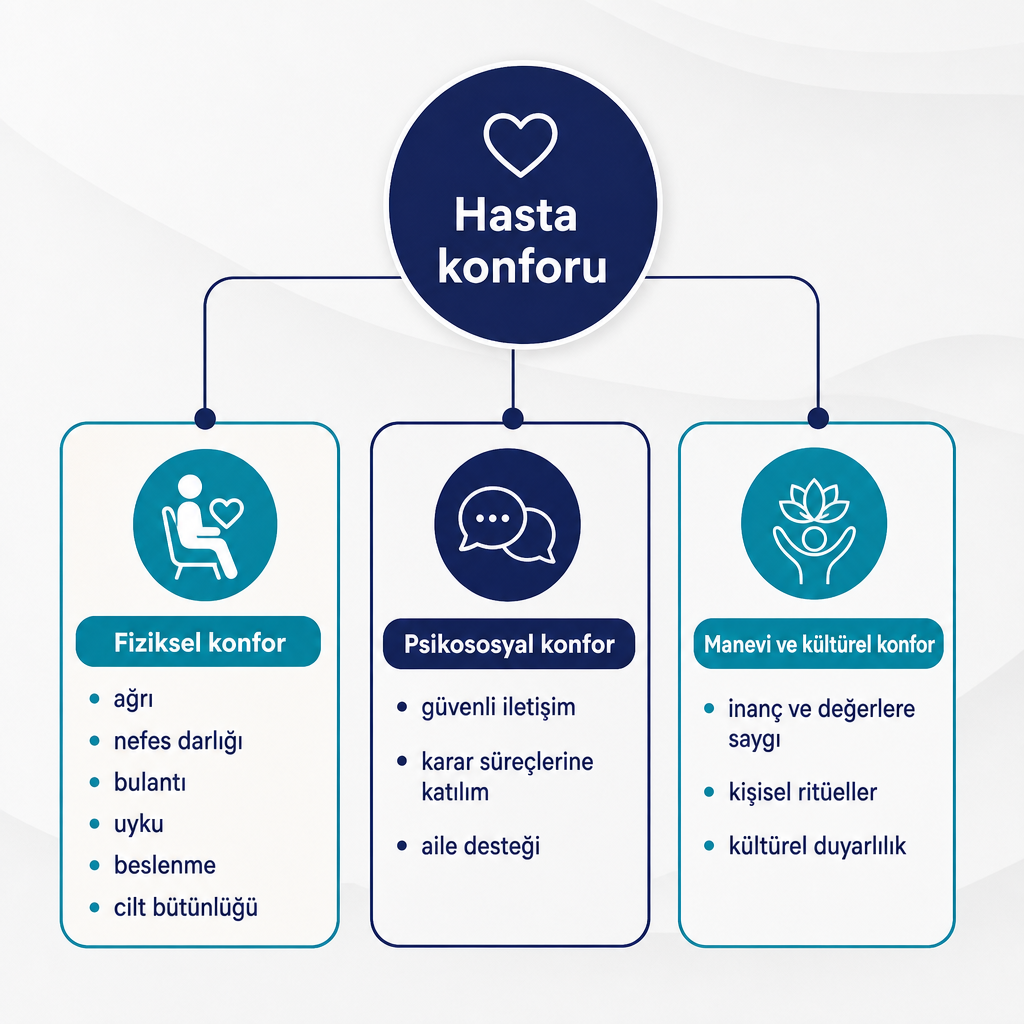 The three dimensions of comfort in palliative care
Preparation checklist before starting the process
Before starting the home palliative care process, reviewing a few topics together as a physician and family makes the process more predictable and can help detect symptom changes earlier. The following list gathers the topics that are useful to discuss in the initial meetings:
- The stage and prognosis of the disease should be evaluated by a physician in terms of palliative care.
- Treatment goals (such as symptom control, preservation of functions, end-of-life care) should be discussed together with the patient and family.
- The home environment should be reviewed in terms of safety, hygiene, and accessibility; points such as stairs, the bathroom, and the toilet should be taken into account.
- Responsibilities for care, follow-up, communication, and emergency contact should be clarified within the family.
- Information should be obtained about the healthcare institutions the patient can turn to for routine examinations, check-ups, and hospitalization when needed, as well as about home health and palliative care units.
- Communication channels and follow-up frequency with the physician, nurse, and other healthcare professionals should be planned in advance.
This preparation, in addition to improving daily care, also answers from the outset the question of who to reach and how in unexpected situations. If you are wondering how to plan nursing support, you can review our article explaining how to request a home nurse.
Step by step: The flow of supporting comfort at home
Thinking of home care within a sequence that progresses together with the healthcare team provides a practical approach. The following steps summarize a flow in which decisions rest with the physician, but the family's role in observation and support is prominent.
- Clinical assessment. The initial assessment performed by the physician; it includes a physical examination, symptom inquiry, and joint review of the psychosocial situation and family resources.
- Individualized care plan. Short- and medium-term care goals are set in line with current symptoms, functional status, and the patient's personal preferences.
- Symptom management. A medical treatment plan for symptoms such as pain, shortness of breath, nausea, constipation, sleep disturbance, and fatigue is created by the physician; the family takes on the role of observation and support in the daily implementation of this plan.
- Adaptation of daily living activities. Routines for nutrition, personal care, mobilization, and rest are arranged according to the patient's energy level, respiratory capacity, and comfort level.
- Environmental arrangement. Noise, light, temperature, and bed arrangement are configured to meet sleep, rest, and safety requirements.
- Integration of psychosocial and spiritual support. Regular communication, safe time slots in which the patient can express their emotions, and, when needed, access to psychological or spiritual support resources are planned.
- Regular reassessment. Through check-ups performed by the physician and healthcare team at set intervals, the symptom burden, comfort level, and family resources are reassessed; the plan is updated when necessary.
The functioning of these steps together transforms the plan from a static document into a process that adapts to the patient's changing needs. You can evaluate how movement and respiratory exercises that preserve functional comfort are planned by taking a look at our home physiotherapy service.
Common challenges and how to address them
A long care process brings with it recurring difficulties. Recognizing these in advance helps strengthen observation and communication before a problem grows.
| Challenge |
Early sign |
Supportive approach |
| Late detection of symptom changes |
Increase in symptoms or a new symptom |
Regular observation and recording; reviewing the plan with a physician's assessment when changes occur |
| Pain not being expressed |
The patient not voicing their discomfort |
Open-ended questions and a safe communication environment |
| Caregiver burnout |
Physical and emotional fatigue in the family |
Task sharing, support mechanisms, and professional psychosocial help if needed |
| Difficulty with nutrition and hydration |
Reduced appetite, difficulty swallowing |
Assessment of the nutrition plan by the physician; respect for the patient's preferences |
| Pressure sores and skin problems |
Remaining in the same position for a long time |
Position changes, appropriate support surfaces, and regular skin observation |
Difficulty with nutrition requires separate attention in patients fed via a tube or PEG; for patients in this situation, we have discussed the points to consider at home in enteral feeding in detail. In any case, consulting a physician for assessment when significant changes or new problems arise supports the safe and systematic conduct of the process.
What can be done at home, when to consult a physician
In home palliative care, the boundary between the areas the family can naturally take on and the areas that are the responsibility of healthcare professionals is clear. Knowing this boundary both protects the patient's safety and prevents the family from experiencing unnecessary anxiety.
Among the areas the family can take on as a supporter are helping the patient find positions in which they are comfortable, adjusting the room temperature and light and sound levels in a way that enhances comfort, assisting with daily care while respecting the patient's limits, and giving the patient who wishes to express their emotions space to rest and talk.
By contrast, the medical treatment plan, medication adjustments, invasive procedures, and enteral or parenteral feeding applications are the responsibility of the physician and relevant healthcare professionals. In situations such as a significant increase in symptom severity, shortness of breath, sudden changes in consciousness, uncontrolled pain, or problems that significantly affect nutrition and hydration, consulting a physician for assessment is recommended.
Home physician and nurse visits, together with physiotherapy, can be an important component in the symptom control and support of the daily comfort of palliative care patients. The scope and frequency of these services are determined according to the patient's clinical condition and the physician's assessment. You can find details of the home private physician care and home private nursing services we offer with our Üsküdar-based team on the relevant pages.
Frequently Asked Questions
What is the difference between palliative care and curative treatment?
Palliative care focuses on reducing the burden of symptoms and stress associated with life-threatening illnesses and does not aim to eliminate the disease. While curative treatments aim to eliminate the cause of the disease, palliative care prioritizes quality of life and comfort.
How long does the palliative care process last?
The process can last weeks, months, or longer depending on the type and course of the disease and the patient's clinical condition. The duration is planned individually according to the physician's assessment, treatment goals, and symptom burden.
For which patients is home palliative care suitable?
In national guidelines, individuals experiencing physical, psychosocial, and spiritual problems due to chronic, progressive, or incurable diseases are defined as palliative care patients. These patients can be monitored within the scope of home health and palliative care under appropriate conditions and by physician decision.
What is the role of family members in palliative care?
The family is recognized as a natural part of the care team in the areas of daily care, symptom observation, communication, and emotional support. In the multidisciplinary approach, family resources and care capacity are evaluated and integrated into the plan.
Who makes the decisions during the care process?
Clinical assessment, the treatment plan, and care goals are the responsibility of the physician and are addressed together with the multidisciplinary team, the patient, and the family. Since symptoms vary from person to person, consulting a physician for assessment is recommended when new symptoms or difficulties arise.