The answer to the question of how to obtain a medical board report varies depending on the purpose for which the report is requested. In applications such as disability assessment, disability retirement, appointment of a guardian, military service procedures, entry into a job or position, private security, or a firearms license, the type of report required, the specialties to be examined, and the evaluation criteria may differ. In the general framework, the process consists of the following stages: clarifying the purpose of the report, applying to an authorized healthcare institution, examinations by the relevant specialties, evaluation by the medical board, and issuance of the report through the e-Report system. Checking the current appointment and document requirements of the relevant hospital before applying helps the process move forward without unnecessary repetition.
Contents
What is a medical board report and how does it differ from a single-physician report
A medical board report is an official health report issued as a result of a person's health condition being evaluated by more than one specialty. It is also commonly referred to as a committee report. What distinguishes it from an examination report issued by a single physician for a specific purpose is that the evaluations of the relevant specialties are combined through a board decision according to the purpose of the application.
At medical board units, adult disability reports, special needs reports for children, disability retirement, work accident, appointment of a guardian, military procedures, and various status-indicating reports may be issued. The distinction here is important in practice: while a single-physician report is based on a narrower-scope examination, a board report is the product of an evaluation that considers the findings of multiple physicians together with the intended use of the report. Which document is required is determined by the institution requesting the report; choosing a report type based on one's own assumption may lead to the application being rejected from the outset.
In which situations is a medical board report requested
A medical board report comes into play in different areas depending on the purpose of the application and the request of the relevant institution. The main use cases are as follows:
- Adult disability assessment
- Special Needs Report for Children (ÇÖZGER)
- Disability retirement or permanent incapacity for work assessment
- Work accident and occupation-related status reporting
- Appointment of a guardian and court procedures
- Military service and military institution procedures
- Application to become a private security officer
- Firearms license application
- Entry into a job, position, or education
- Status-indicating reports requested by official institutions
Two reports issued for the same person may not be interchangeable in terms of content and scope if their purposes differ. For example, the examination scope and evaluation criteria of a report used for disability assessment are not the same as those of a status-indicating report requested for the purpose of starting a job. For this reason, the first step is to clarify which procedure the report will be used for.
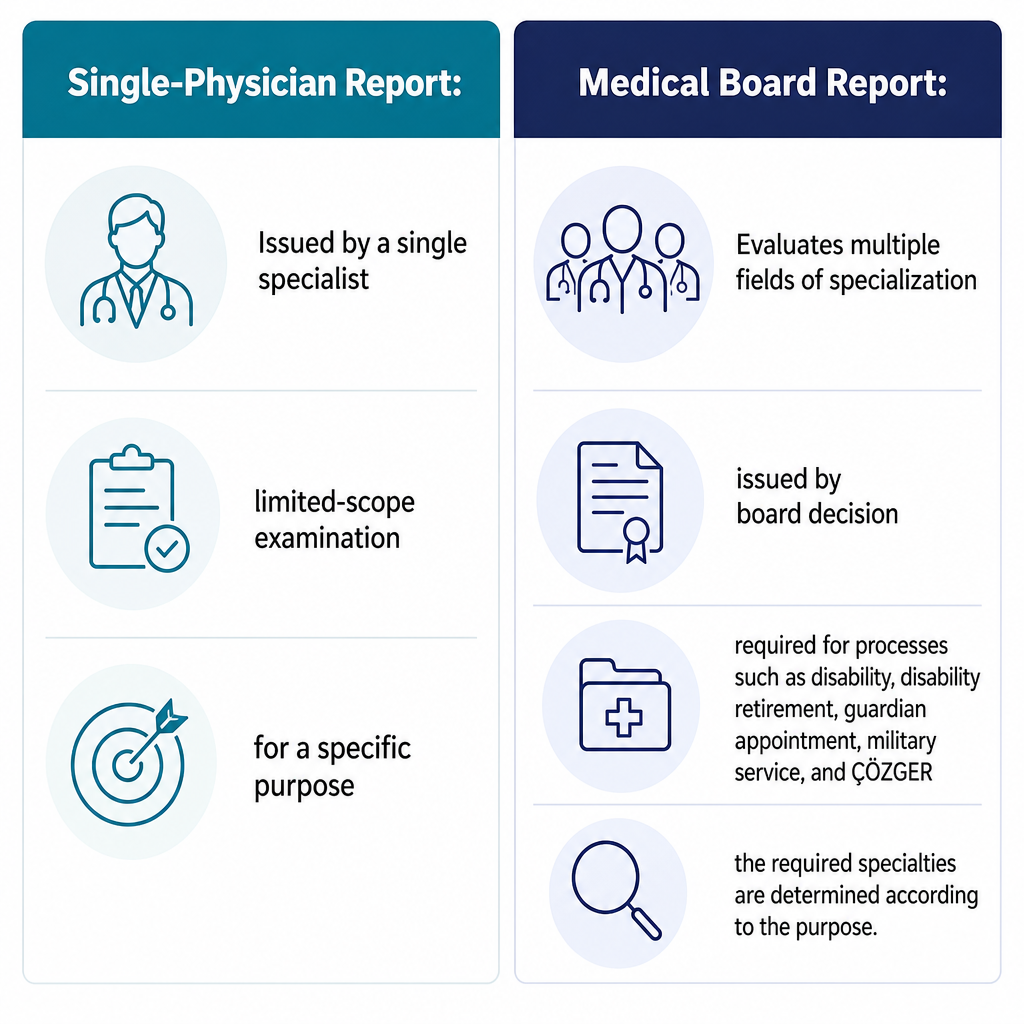 Key differences between a single-physician report and a medical board report
Where is the report obtained and how is an appointment made
A medical board report is obtained from healthcare institutions authorized to issue the relevant type of report. Before applying, you should find out whether the institution you will apply to issues the required type of report, by which method the board appointment is given, which specialties are required, which documents are requested, and whether the report is delivered electronically or in print.
At public hospitals, medical board appointments are mostly made through the Central Physician Appointment System (MHRS) or by calling 182. However, the appointment method may vary depending on the hospital and the type of report; for some procedures, an official referral letter may be required. Therefore, instead of relying on a general appointment rule, checking the medical board announcement of the hospital you will apply to is a safer starting point.
Although services such as physician examination, nursing assessment, or physiotherapy may be provided in the field of home care, the issuance of an official medical board report depends on the board and legislative processes of the healthcare institution authorized to prepare the relevant type of report. Home healthcare services and official medical board reports are separate procedures. For those who want to see this distinction in more detail, the content titled the difference between home healthcare services and home care may be a helpful guide.
Documents prepared before applying
Documents vary depending on the purpose of the report and the practice of the healthcare institution applied to; a single list should not be considered valid for all hospitals. Nevertheless, the following documents come into play in the majority of applications:
| Document |
What it is for |
| Turkish ID card or valid identification |
Identity verification |
| Official referral letter or institutional cover letter |
Official basis for the report's purpose |
| Application petition or board application form |
Record of personal applications |
| Recent epicrises and specialist reports |
Conveying medical history |
| Lab, imaging, and pathology results |
Supporting clinical findings |
| Previous medical board reports |
Continuity of assessment |
| Photograph depending on the report type |
Mandatory for some report types |
Some hospitals may require a photograph taken within the last six months, or a different number of photographs for disability reports. For people with a chronic illness, limited mobility, or tests performed in the past, preparing the relevant documents with their originals or in the form requested by the institution helps ensure that medical information is conveyed completely during the assessment. In applications made with missing documents, the examination or board day may be postponed; this is one of the most common reasons that prolong the process.
How the process works from application to report delivery
Although the process follows a standard sequence, the content of each stage varies depending on the purpose of the application. In practice, the following flow is seen:
- The purpose of the report is determined. It is clarified which procedure the report will be used for. If a referral is given by the institution, the purpose and requested statements in the referral letter are taken into account; in personal applications, the form or petition obtained from the board unit is used.
- Appointment and registration are made. An appointment is made using the method determined by the relevant hospital, and on the appointment day, the registration unit is approached with the necessary documents. Depending on the person's health condition, a legal guardian or legal representative may be required for the application; representation and signature requirements are additionally evaluated, especially in procedures involving children, incapacitated persons, and those subject to a court decision.
- Examinations by the relevant specialties are completed. Referral to the relevant outpatient clinics is made according to the purpose of the application and the person's condition. The same specialties are not examined in every application; the required specialties are determined according to the report type, existing illnesses, and the board's practice.
- The medical board assessment is carried out. After the specialty examinations are completed, the file is reviewed by the board. In the case of multiple illnesses or loss of function, the assessment may be carried out according to the calculation and combination rules specified in the legislation. For this reason, it is not a correct approach for a person to calculate their own rate by looking only at the name of the diagnosis.
- The report is issued through the e-Report system. The report may be created in the healthcare institution's electronic system and issued with the electronic signatures of authorized physicians. Some public hospitals report that completed e-Reports can be viewed through e-Government.
When receiving the report, the name and surname, Turkish ID number, the purpose for which the report was issued, the decision and explanation sections, the validity period, and, if applicable, the rate, special needs level, or restrictions should be checked. If a typo or an identity information error is noticed, the relevant unit of the institution that issued the report should be contacted; waiting for the correction may delay the procedure for which the report will be used.
The difference between an adult disability report and ÇÖZGER
The Disability Medical Board Report for Adults is issued to assess the disability status of people aged 18 and over according to the legislation. The Special Needs Report for Children (ÇÖZGER), on the other hand, is used to determine the special needs level of children under 18 and the validity conditions of the report.
A ÇÖZGER application is made by the child's parent or guardian. As a result of the assessment, the child's level of need, the special education areas they can benefit from, and the validity period of the report may be determined. Since these two reports are not the same document, when applying on behalf of a child, it should be verified from the outset whether ÇÖZGER is required instead of the adult disability report. Age, the purpose of the application, and the type of document requested by the institution making the request are the three fundamental criteria that determine which report will be issued.
Appealing a report and practical points for people with limited mobility
A person who believes there is an error in the content of the report, their legal representative, or the relevant institution may appeal within the specified period. Appeals against disability medical board reports are made within 30 days from the delivery or notification of the report to the person; appeals that exceed the time limit may not be accepted. The Istanbul Provincial Health Directorate's notice also states this period as 30 days. Since the authority to apply to and the procedure to follow in the appeal process may vary depending on the report type, it is important to learn the current procedure from the provincial or district health directorate.
If an appeal is being considered, the delivery or notification date of the report should be recorded, the grounds for the appeal should be clearly written, a copy of the report along with the relevant medical documents should be kept, and the current procedure should be learned from the health directorate to which the application will be made. Since the appeal period may vary depending on the report type, relying only on general information is not recommended.
The process is often challenging for people who have difficulty moving, are bedridden, or have a chronic illness. Since the report application and board examination may include the specialist examinations the board deems necessary and identity verification, it is carried out according to the registration and examination process determined by the authorized healthcare institution. For these people, home physician examination, nursing assessment, or medical follow-up services may be additionally planned; however, these services do not by themselves replace a medical board report. To understand the scope of home healthcare services, our pages titled home private physician care and home private nursing may help distinguish which service meets which need. Compiling medical documents before the board application and regularly monitoring the current clinical condition reduces the likelihood of encountering missing information on the application day.
Frequently Asked Questions
Is an MHRS appointment required to obtain a medical board report?
At many public hospitals, board appointments are given through MHRS or 182. However, for some report types there may be an official referral letter or the hospital's own application method. It is recommended to review the medical board announcement of the relevant hospital before making an appointment.
Are you examined by all specialties for a medical board report?
No. The specialties to be examined are determined according to the purpose of the report and the person's health condition. The specialties deemed necessary are created through the medical board system during registration.
Can old reports be used in a medical board application?
Old reports, epicrises, lab tests, imaging, and pathology results can help explain the medical history. However, whether an old report can replace a new report is decided within the framework of the institution applied to and the relevant legislation.
Does a medical board report appear on e-Government?
Some reports issued electronically can be viewed through e-Government or the relevant health systems. The viewing method may vary depending on the report type and the electronic record process of the institution that issued the report.
Are a medical board report and a health report the same thing?
No. A health report may be issued by a single physician for a specific purpose. A medical board report, on the other hand, is an official report created with the assessment of more than one specialty and a board decision. The required type of document is determined by the institution requesting the report.