The answer to the question of how to obtain a medical report follows a clear sequence in most cases: you determine which report you need, make an appointment at an authorized health institution, undergo an examination with your ID and required documents, and the report is issued based on the physician's assessment. While single-physician reports can often be completed on the same day as the examination, board reports decided by multiple specialties may extend over several days depending on appointment and test workload. For some types of reports, a contribution fee, charge, or a fee determined by the institution may come into play; most approved reports are processed through the e-Report system and can be viewed via the e-Nabız account. Below, you will find the steps that break down the process by purpose, a preparation checklist, and common mistakes all in one place.
Contents
What is a medical report, and when is it required?
A medical report is an official document that certifies a person's health suitability for a specific job, activity, or situation, issued by a physician following an examination and, when necessary, tests. The areas in which it is requested are quite broad: employment onboarding, driver's licenses, sports activities, firearm licenses, marriage procedures, disability status, and the enrollment processes of certain educational institutions are among the most common.
Reports essentially come in two forms. A single-physician report is issued based on the assessment of a single specialty. A medical board report, on the other hand, requires the joint decision of multiple specialties. Which form is required is determined by the requirements of the institution requesting the report and the relevant legislation. Knowing this distinction from the start allows you to both make the right appointment and avoid unnecessary repeat applications.
Preparation before the appointment: checklist
The required documents may vary from institution to institution; in all cases, the current information provided by the institution being applied to should be taken as the basis. The following points provide a practical starting point for most report types before going to the appointment:
- Turkish ID card or national identity card
- A passport-size photo, if required
- The purpose of the report and where it will be submitted (institution name, employer, school, etc.)
- The special form or petition requested by the institution (a short text explaining the report type and intended use)
- Existing chronic illnesses, regularly used medications, and previous discharge/test reports
- Medical support products such as eyeglasses and hearing aids for driver and sports reports
- e-Government password information (to view e-Nabız and e-Report records)
Compiling the documents before the day of the appointment increases the likelihood of completing the process on the same day for single-physician reports. A missing ID, photo, or petition may delay the issuance of the report.
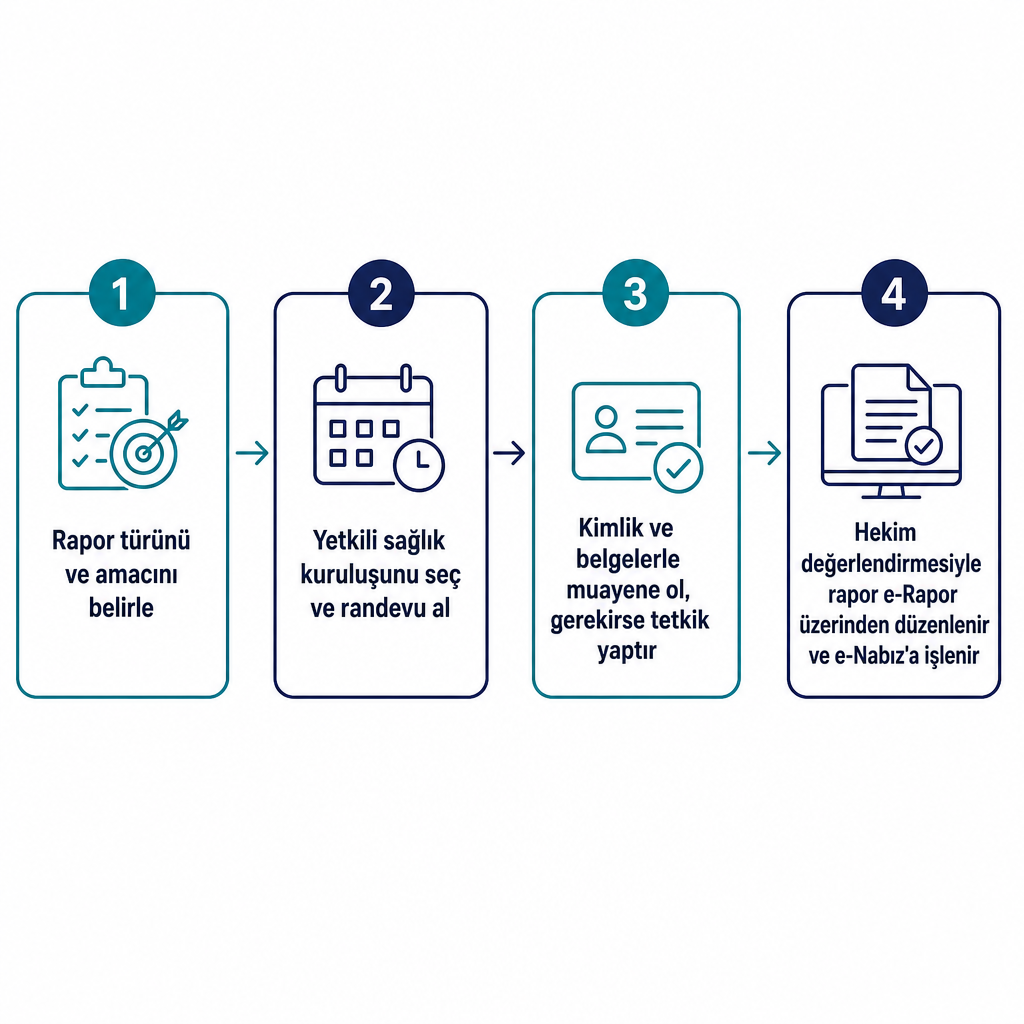 The four main steps of the medical report process
General steps to obtaining a medical report
Although the report process varies in detail from type to type, the basic steps are similar. Knowing the sequence clarifies what to expect at each stage.
1. Determine the report type and purpose. Clarify whether the report is requested for employment onboarding, a driver's license, a sports license, marriage, a firearm license, disability, or another purpose. Learning in advance the specific requirements of institutions (employers, government offices, schools), such as the report format and how many physician signatures are needed, makes the following steps easier.
2. Choose an authorized health institution. A medical report is issued by licensed and authorized health institutions and the physicians working at these institutions. Family health centers, public hospitals, university hospitals, private hospitals, and medical centers may be authorized depending on the report type. For employment onboarding reports, a workplace physician, a physician within an OHS (occupational health and safety) unit, or, under certain conditions, a family physician may be assigned.
3. Make an appointment and submit the application. An appointment is made along with an ID document through the institution's appointment channels (MHRS, telephone, online system, information desk). Some institutions may ask you to fill out a short petition or form regarding the purpose and requested scope of the report. Preparing the necessary documents before coming to the appointment speeds up the process.
4. Undergo the examination, have tests done if necessary, and receive the report. The physician listens to your history, performs the examination, and may request laboratory or imaging tests if deemed necessary. For board reports, you need to be examined by multiple specialties and go through a committee evaluation. Approved reports are confirmed through the e-Report system and processed into the e-Nabız account; the document can be received in printed or electronic form.
Details that vary by report type
Although the general framework remains the same, the authorized body, required specialties, and timeframe differ by type.
Employment onboarding medical report
The employment onboarding medical report is issued to assess the employee's suitability for work under Occupational Health and Safety Law No. 6331. The process usually begins with learning the hazard class of the job (low-hazard, hazardous, very hazardous) from the employer or the occupational safety specialist. Then, the authorized body is clarified according to the number of employees and the hazard class of the workplace; this may be a workplace physician, an OHS physician, or a family physician for some low-hazard jobs. During the examination, an assessment is made regarding occupational risks, and, in line with the physician's decision, a report is issued as fit for work, with restrictions, or unfit.
Driver's license report
In the "fit to drive" reports required for a driver's license, vision, hearing, neurological status, cardiovascular status, and certain chronic illnesses are assessed together. First, the driver's license class and the format requested by the institution are learned, and then an appointment is made at an authorized institution. It is important to go to the examination with eyeglasses or other assistive devices; if the physician deems it necessary, they may refer you for additional examinations in departments such as ophthalmology, cardiology, or neurology. Approved reports are issued through e-Report and processed into e-Nabız.
Sports, marriage, and firearm license reports
These reports are issued according to the content determined by the requesting institution. The steps are similar: learning the report format of the relevant institution (sports club, municipality, government office, course), making an appointment at an authorized institution, and completing the required specialty examination and laboratory tests. For example, screening for infectious diseases may be requested during the premarital process.
Disability and board reports
Reports requested for disability percentage or long-term health conditions are generally in the nature of medical board reports. In this process, a medical board appointment is made at authorized hospitals, examinations and tests are performed in different specialties, the percentage and definitions are decided in the committee meeting, and the report is issued in the official format. Due to the testing and committee stages, these reports may extend over several days.
Common mistakes and their solutions
Most of the setbacks that prolong the process stem from a few recurring points.
- Making an appointment without clarifying the report type: Since the authorized institution can vary for different report types, failing to learn in advance the purpose for which the report is requested leads to wasted time. The solution is to ask about the format and signature requirement of the institution requesting the report before the appointment.
- Bringing incomplete basic documents: A missing ID, photo, or petition may delay the same-day issuance of the report. Reviewing the checklist before the appointment prevents this.
- Requesting a single-physician report when a board report is required: In situations such as disability or long-term incapacity to work, a single-physician report is often not sufficient; the relevant legislation may require a medical board report. Verify from the start whether what you need is a board report.
- Not checking e-Nabız and e-Report records: Since some reports are issued electronically, checking the "My Medical Reports" section in your e-Nabız account makes it easier to access the document.
Process plan for people with limited mobility
For people with limited mobility, chronic illnesses, or those who are bedridden, the medical report process should be planned according to their ability to physically access institutions. Scheduling the appointment at times that suit the person's transportation options and care routine helps make the transfer stage safer to arrange.
For people receiving regular follow-up at home, during physician or nurse visits, the current health condition can be evaluated and a physician's opinion can be obtained on which report type is required. Follow-up within the scope of home private physician care and home private nursing care can contribute to monitoring the person's overall health condition and keeping the medical information to be presented to the physician during the report process up to date. Similarly, the home physiotherapy process helps in regularly recording functional status. Those curious about the general workings of home care services can review how home care service works in Istanbul.
Nevertheless, a physician's assessment at an authorized health institution is mandatory for the report to be issued and for its official validity. The content and outcome of the report are determined within the framework of the relevant physician's medical and legal responsibility. Since symptoms and situations vary from person to person, it is recommended that a physician assess which report and which application route are needed.
Frequently asked questions (FAQ)
Where can a medical report be obtained?
A medical report is issued by health institutions licensed by the Ministry of Health and the physicians working at these institutions. Depending on the report type, a family physician, a public or university hospital, a private hospital, or medical centers may be authorized.
How many days does it take to get a medical report?
Single-physician reports can, in most cases, be issued on the same day after the examination. Board reports, on the other hand, may extend over several days depending on appointment workload and the required tests.
Is there a fee for a medical report?
For some report types, a contribution fee, charge, or a fee determined by the institution may apply. The amount varies according to the report type and the institution applied to; pricing should be evaluated based on the current practices of the relevant institution.
How can a medical report be viewed on e-Nabız?
After logging into your e-Nabız account via e-Government, issued reports can be seen in the "My Medical Reports" section. For some documents, a report request can be created through the system, and the document can be accessed digitally once it is prepared.
Can every report be obtained from a family physician?
Family physicians can issue certain report types within the limits permitted by legislation. In situations tied to occupational health legislation, such as an employment onboarding report, a workplace physician or an OHS physician may be required depending on the job's hazard class and the number of employees.
What determines the validity period of a medical report?
The validity period depends on the purpose of the report, the relevant legislation, and the physician's medical assessment. Some reports are issued for a specific period, while others are issued on a one-time basis for a specific procedure. The specific requirements of the institution requesting the report regarding the validity period should also be taken into account.