The short answer to the question of how the home healthcare environment should be arranged after hospital-to-home transfer and discharge is this: the home should be arranged individually with regard to the patient's clinical safety, hygiene conditions, and medical monitoring, in line with the recommendations of the discharging physician and healthcare team. Rather than a standard template, a plan is created by evaluating together the type of illness, the patient's mobility, and the resources of those who will provide care at home. As the Private Dr. Emin Paçacı Home Care Center, in this article we address, in a neutral and informative manner, how the home can be prepared with a sound rationale during the post-discharge period in terms of safety, hygiene, device placement, vital sign monitoring, and the role of the family.
Contents
The discharge decision and planning of home monitoring
When making the discharge decision, the physician, nurse, and, if available, the social work team jointly evaluate the patient's home care needs. The national legislation in Türkiye defines a framework that allows examination, testing, analysis, treatment, medical care, and rehabilitation to be carried out at home and in the family environment. For this reason, the home monitoring plan is not something that closes at the moment of leaving the hospital, but rather the beginning of a process that continues at home.
Four main headings come to the fore when planning home monitoring: the suitability of the patient's medical condition for home monitoring, the level of required physician, nursing, physiotherapy, and rehabilitation support, the medical devices and materials to be used, as well as the care capacity and psychosocial needs of family members. Discussing these headings before discharge reduces the uncertainty that may arise upon arriving home.
The legal aspect of the process should not be neglected either. For patients for whom home healthcare is planned, the preparation and recording of information and consent forms and obtaining consent are required by legislation. The decision regarding which patient will be monitored at home, how frequently visits will be made, and which medical interventions will be carried out at home is made by the relevant clinical specialist physician.
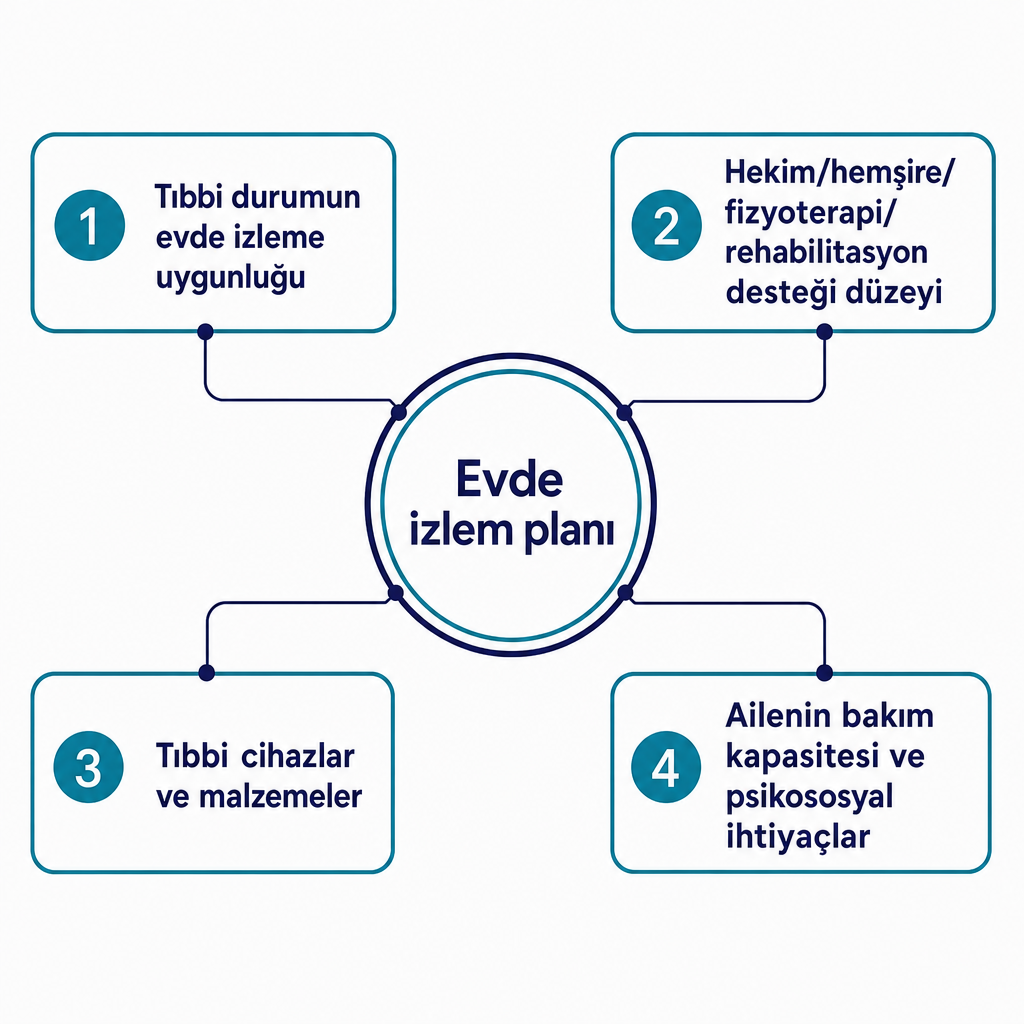 Components of the post-discharge home monitoring plan
Clinical safety: managing the risk of falls and pressure sores
In the first weeks after discharge, many patients may experience fatigue, balance disturbances, blood pressure changes, and dizziness due to the effects of medications. For this reason, reducing the risk of falls is one of the priority goals in arranging the home environment. Especially in the postoperative or post-intensive-care period, the route between the bed and the toilet and bathroom is the area that requires the most attention.
Removing cables, small side tables, and rugs on this route that could cause tripping; making the corridor and route to the toilet visible at night with low-intensity lighting; and keeping a chair or a seating area with armrests nearby where the patient can get close support when standing up all support safe mobility. For patients who feel balance disturbances, dizziness, chest pain, or significant shortness of breath, it is appropriate for the activity level to be reassessed by the physician.
In patients who remain bedridden for a long time, the risk of pressure sores (decubitus) comes to the fore. A suitable bed, regular position changes, and skin care help reduce this risk. The bed not being too low or too high ensures that the patient does not expend excessive effort when getting up; the safety of the bed edge helps prevent involuntary sliding. Position preference, however, should not be determined with a standard recommendation; it should be determined by the physician on an individual basis according to the patient's type of surgical procedure, respiratory status, and accompanying conditions.
Hygiene, infection control, and ventilation
Hygiene and ventilation are fundamental topics for reducing the risk of infection in the home care environment. This becomes even more decisive, especially in patients who require postoperative wound care, who are at high risk of respiratory tract infection, or who are immunosuppressed.
In practice, three habits make a difference: regularly ventilating the room where the patient stays; routinely cleaning surfaces, door handles, the bathroom, and the kitchen; and making handwashing after using the toilet and before preparing food a habit. This simple arrangement helps limit the burden of infection during the fragile post-discharge period.
In patients with a surgical wound area, observation is also important. In the event that signs such as redness, discharge, foul odor, or fever are noticed in the wound area, it is considered appropriate to consult a physician; and dressing and wound care procedures should be carried out under the guidance of healthcare professionals. For the continuity of wound monitoring, private home nursing services can support the process depending on the physician's plan.
Medical devices, medications, and nutrition regimen
Some patients may be monitored at home after discharge with medical devices such as oxygen concentrators, aspirators, nebulizers, in-bed positioning equipment, or enteral nutrition sets. The placement of these devices directly affects the safety of the home.
Three points stand out in device placement: electrical safety, meaning the use of grounded outlets and arranging cables so as not to cause tripping; positioning the devices at an appropriate distance from ventilation and heat sources; and complying with the usage instructions specified by the healthcare team. The installation and maintenance of the devices should be carried out in accordance with the instructions of the relevant healthcare professionals.
Medication management is also part of the environment. Storing the medications used at home in a cool, dry place out of children's reach; and recording medication names, doses, and times of use according to the physician's instructions reduces confusion. The decision regarding a medication's name, dose, and usage schedule should be determined by the physician who prescribes it, and a physician's opinion should again be obtained for any changes.
When applications such as enteral nutrition (feeding via PEG or nasogastric tube) are involved, the nutrition plan, adjustment of the feeding rate, replacement of sets, and signs of possible complications should be defined by the physician and nurse; and family members should convey their daily observations to the healthcare team. We address the details of this topic in our content home care considerations in feeding via tube and PEG.
Home monitoring of vital signs and clinical status
In patients with chronic illness, who have undergone major surgery, or who have a high cardiovascular risk, home monitoring of vital signs (blood pressure, pulse, temperature) enables early detection of possible clinical changes. After some surgical procedures, patients may be advised to take measurements for a certain period during the post-discharge period and to consult a healthcare facility in the event of unexpected rises or drops.
The critical distinction here is this: as much as taking the measurement, how it will be interpreted is also part of the plan. The intervals at which measurements will be taken and with which device, the value ranges to be considered normal, and when to contact the physician should be determined on an individual basis by the physician. We examine why regular monitoring is important in more detail in our article vital sign monitoring in chronic illnesses.
Some signs, however, fall outside of routine monitoring. Conditions such as shortness of breath, chest pain, change in consciousness, sudden weakness, uncontrollable pain, or unexpected bleeding may require emergency evaluation; when such signs are observed, recourse to emergency health services is carried out according to the general emergency health legislation. Defining in advance the warning signs appropriate to the patient's clinical condition facilitates making the right decision in a moment of panic.
Psychosocial environment and family roles
The home care process requires organization not only medically but also from a psychosocial perspective. The patient receiving care in their own home, being together with familiar items, personal belongings, and loved ones, can facilitate the adjustment process. On the other hand, the risk of burnout among caregivers, the emotional burden, and the role change are also realities that must be taken into account.
For this reason, it is beneficial to address certain topics within the family during pre-discharge discussions: who will take on which care task, the manner of communication and decision-making, and, if necessary, the need for professional psychosocial support. Clarifying tasks in advance prevents the care burden from accumulating on a single person.
In situations requiring long-term care, sharing the care burden and supporting it with professional home care services when necessary increases the sustainability of the process. When it comes to mobility and function goals, home physiotherapy practices can be part of this support in line with the physician's plan.
Home healthcare services and the regulatory framework
In Türkiye, home health and home care services are carried out by the Ministry of Health and its affiliated institutions, as well as by private institutions authorized by the Ministry, and are subject to the relevant regulations. Home health services cover the provision at home of the examination, testing, analysis, treatment, medical care, and rehabilitation carried out by the physician, as well as the provision of psychosocial support to the patient and family members.
The Regulation on the Provision and Coordination of Home Health and Palliative Care Services defines in detail the coordination and recording processes of these services. Within this framework, services such as home physician visits, nursing procedures, physiotherapy, palliative care, wound care, and vital sign monitoring can be planned and implemented by licensed teams. We also carry out the private home physician care practices within this scope based on the physician's decision and the regulatory framework.
There is one point the legislation keeps clear: the decision regarding which patient will be monitored at home, how frequently visits will be made, and which medical interventions will be carried out at home is made by the relevant clinical specialist physician. The arrangement of the environment is the practical reflection of this decision; it does not replace the decision itself.
What should be considered when making a decision?
When planning the hospital-to-home transfer and the post-discharge home healthcare environment, the following headings are evaluated together with the physician. This framework makes it easier to see along which axes the conversation should proceed.
| Evaluation heading |
Questions considered |
| Clinical condition |
Is it acute, chronic, or palliative; what is the risk of infection, cardiovascular, and respiratory issues? |
| Mobility |
Is the patient fully bedridden, restricted, or independent; is there a risk of falling? |
| Home conditions |
What are the room size, access to the bathroom and toilet, stairs, and ventilation possibilities? |
| Family and caregivers |
How many people can actually provide care, what is their health literacy and need for psychosocial support? |
| Professional support |
Is there a need for a home physician, nursing, physiotherapy, palliative care, and social services? |
Since symptoms and needs vary from person to person, the home care plan and environment arrangement should be created separately for each patient based on the physician's evaluation. To see which services can be planned together, you can review the headings on our services page, and you can contact our team for an evaluation appropriate to the patient's condition.
Frequently Asked Questions
With whom should I plan the home environment before discharge?
The arrangement of the home environment should be planned together with the recommendations of the discharging physician, the nurse, and, when necessary, the home healthcare team. Matters such as mobility, fall risk, the devices to be used, and vital sign monitoring can be addressed in detail during these discussions.
Which medical devices require special preparation at home?
For devices such as oxygen concentrators, aspirators, enteral nutrition systems, and in-bed positioning equipment, electrical safety, ventilation, placement, and cable arrangement should be specially planned. The instructions of the relevant healthcare professionals must be followed during installation and maintenance.
Why is vital sign monitoring important?
Vital signs such as blood pressure, pulse, and temperature enable early detection of changes in clinical condition, especially in people who are postoperative or who have a chronic illness. The intervals at which measurements will be taken and which values should be reported to the physician should be explained by the physician to the patient and their relatives.
How can the psychological adjustment of a patient receiving home care be supported?
Having the patient in a calm, well-ventilated room containing their personal belongings; arranging the daily routine in a way the patient can tolerate; and establishing open communication with caregivers support adjustment. In long-term care, task sharing and, when necessary, professional psychosocial support can be considered.
In which situations should emergency health services be contacted?
Signs such as sudden shortness of breath, chest pain, change in consciousness, uncontrollable severe pain, unexpected bleeding, or high fever may require emergency evaluation; in these cases, recourse is made according to the general emergency health legislation. Since symptoms can vary from person to person, the warning signs and criteria for seeking care should be explained in advance by the physician.