For individuals living in Üsküdar who have difficulty going to a facility due to their health condition, home health and care services refer to the planned execution of processes such as examination, follow-up, nursing, and rehabilitation in their living environment. When we speak of an Üsküdar home care center, it means a team consisting of a physician, nurse, and physiotherapist planning medically appropriate services within a documented and traceable framework at home. As Private Dr. Emin Paçacı Home Care Center, we are a licensed home health institution in Üsküdar, and in this article, we explain in an informative framework what home health and home care mean, the legal framework, operational mechanisms, and what is decisive in the decision-making process.
Contents
What does a home care center in Üsküdar mean
The phrase “Üsküdar home care center” describes authorized centers that provide home health and care services to individuals living in and around the district who have difficulty going to a health facility due to their health condition. The aim here is to sustain examination, care, follow-up, and rehabilitation processes deemed medically appropriate to be performed at home within a planned and documented framework.
Distinguishing two different concepts is important for setting the right expectations. Home health service is defined in the relevant regulation of the Ministry of Health as the provision of medical services that can be performed in the place where the person lives, at their location. The Ministry's implementation guideline states that these services cover the headings of examination, testing, analysis, treatment, medical care, follow-up, and rehabilitation. The concept of home care, on the other hand, is addressed through the regulations of the Ministry of Family and Social Services as a broader umbrella concept that also includes social components such as personal care, daily living support, and companionship. In short, medical home health and socially oriented home care are related but distinct areas defined by different legislation.
As Private Dr. Emin Paçacı Home Care Center, we plan home services in Üsküdar in the fields of medicine, nursing, and physiotherapy. Our approach is not a single treatment promise; it is the organization of appropriate services by a team according to the patient's clinical condition and the limits of the legislation.
The legal framework of home health and home care
In Türkiye, home health services are regulated by the Ministry of Health legislation. This framework broadly defines which individuals can receive home health services, the limits of medical procedures deemed appropriate to be performed at home, and the registration, follow-up, and coordination processes of the service. Home care services, on the other hand, are based on the regulations of the Ministry of Family and Social Services and mostly cover social care and companionship processes aimed at individuals who need support in daily living activities.
Within this structure, three components work together: home health units provided by the public, social service-oriented home care applications, and home health and care services provided by private health institutions. As different parts of the same ecosystem, these components are carried out with different financing and organization models.
Private Dr. Emin Paçacı Home Care Center, as a private home health institution with a Ministry of Health license, bases its activities on carrying them out in accordance with the relevant legislation. The details of the legislation can be accessed through the Regulation on the Provision of Home Health Services published in the Official Gazette and the home health implementation guideline of the General Directorate of Public Health.
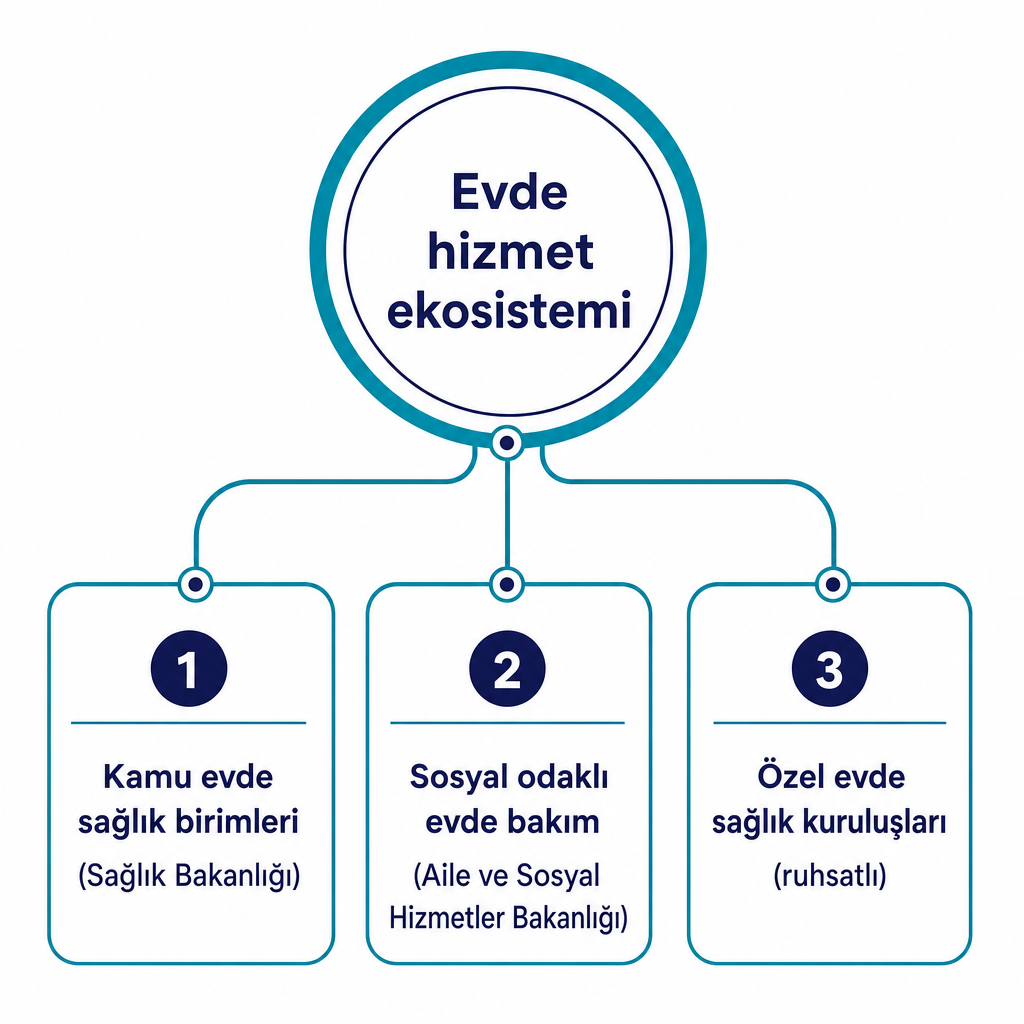 Home health and home care service ecosystem
Main service areas offered
Services deemed medically appropriate to be performed at home are shaped according to the patient's condition and the physician's plan. The following headings are general examples showing in which areas the service can be planned; each is not an individual treatment commitment, but a planning framework.
- Home physician visit: Medical evaluation, examination in the home environment, and, when necessary, planning of follow-up processes deemed appropriate to be performed at home. For details, you can review our home private medicine service.
- Home private nursing: Carrying out nursing interventions such as wound care, serum and intravenous applications, medication administration, and vital sign monitoring in the home environment within the framework of the physician's plan. We explain the scope on our home private nursing page.
- Home physiotherapy and rehabilitation: Application of exercise and rehabilitation programs accompanied by a physiotherapist for individuals who need physiotherapy due to limited mobility, musculoskeletal problems, or neurological conditions. We address the process under our home physiotherapy service.
- Home support within the scope of palliative care: Carrying out comfort, symptom control, and supportive care plans under physician and nurse supervision for individuals with advanced-stage chronic illness.
- Wound care and chronic wound follow-up: Monitoring of pressure ulcers, diabetic foot, or post-surgical wounds with nursing care in line with physician evaluation.
- Serum and intravenous applications: Planning of fluid therapy or certain applications intravenously in the home environment in cases deemed appropriate by the physician.
- Evaluation and organization support: When deemed necessary, medically evaluating the patient, replanning the care process, and coordinating the transfer process with a health facility.
Which services will be applied is determined by the patient's medical condition, the limits of the legislation, and the physician's evaluation. You can access a general framework regarding the scope of care in the post-operative period from our post-operative home nursing care guide.
How home health service works
The basic mechanisms of home health applications are based on similar principles in both the public and private sectors. These principles ensure that the service is carried out in a planned and traceable manner rather than randomly.
- Evaluation: First, the individual's medical condition, mobility, environmental conditions, and suitability for home service are evaluated; in this process, the physician's decision is essential.
- Planning: The intervals at which physician, nurse, or physiotherapist visits will be made, and the scope and duration of procedures deemed appropriate to be performed at home are planned.
- Documentation and monitoring: The services provided, materials used, procedures performed, and clinical observations are regularly documented. The legislation requires the structuring of documentation and monitoring processes.
- Coordination: When necessary, the team coordinates the process by communicating with the family physician, hospital, laboratory, or imaging units.
- Safety and ethics: Throughout the entire process, patient privacy, informed consent, medical confidentiality, and professional ethical principles are observed; the professional authority limits of the teams are also defined by legislation.
We apply these mechanisms with our team consisting of a physician, nurse, and physiotherapist within a documented and traceable structure based on scientific data. Thus, every stage of the process becomes traceable for both the patient and the family.
In which situations home service may come up
Home health or home care service may not automatically be suitable for every individual. Suitability evaluation is made by considering medical, social, and environmental factors together. The following examples give a general idea about in which situations the service can be planned:
- Individuals requiring long-term bed rest due to advanced age, chronic illness, or neurological conditions,
- Patients who have difficulty going to a health facility due to limited mobility,
- People who need short-term intensive nursing care, dressing, or serum therapy in the post-operative period,
- Patients who require long-term rehabilitation and need regular physiotherapy support,
- Individuals with advanced-stage chronic illness for whom palliative care support comes up.
These examples are for informational purposes. Even in two people with similar complaints, the suitability for home service may differ; therefore, the final decision is made by the physician who evaluates the individual's clinical condition. Symptoms vary from person to person; consulting a physician is recommended to determine the appropriate approach.
Public home health units and private centers
The Ministry of Health provides home health services through public home health units, and the organization of this service is regulated by the relevant regulation. This public service is carried out within a structured framework nationwide for patients who meet certain criteria.
Private home health and care centers, on the other hand, are private health institutions licensed and supervised by the Ministry. In these centers, the scope of service is limited by the center's license and its physical and human resource capacity; the content of the services to be provided is determined according to medical necessity and physician evaluation. Public service and private service operate within the same legal framework, but with different financing models.
The decision as to which option is suitable for individuals' situations is generally made by considering the physician's evaluation and existing social security regulations together. The public and private components are parts of the same ecosystem rather than alternatives to each other.
The physician's role in the decision-making process
Starting, stopping, or changing the scope of home health and home care services is a process under the physician's responsibility. The physician evaluates together the patient's current diagnoses, medications, vital signs, and general condition, the hygiene, safety, and care facilities of the home environment, the support of the family or caregiver, and the requirements for integration with the hospital for procedures that cannot be performed at home.
When emergency signs such as changes in consciousness, sudden shortness of breath, or chest pain develop in individuals for whom home service is planned, the option of applying to emergency health services is always on the agenda. The management of such situations is subject to separate emergency health legislation and is outside the routine of home health service.
Home health service is not a model that replaces hospital or outpatient clinic visits; it is a model that complements them in appropriate cases. The final decision regarding in which situations home service will be prioritized is made by the physician who performs the clinical evaluation. For planning specific to a particular person, you can request an evaluation by sharing information about the patient's condition.
Frequently Asked Questions
Are an Üsküdar home care center and home health service the same thing?
Home health service refers to the medical services defined in the Ministry of Health legislation; it covers headings such as examination, testing, treatment, follow-up, and rehabilitation. The concept of home care, on the other hand, is a broader umbrella concept that can also include personal care, daily living support, and social service components. Home care centers in Üsküdar can plan medical and care-oriented services together.
In which area does Private Dr. Emin Paçacı Home Care Center provide services?
Our center is a home care center operating in Üsküdar, Istanbul, licensed by the Ministry of Health. Which neighborhoods or areas the service will cover is determined according to our planning and team capacity.
What is the difference between a home physician visit and family medicine service?
Family medicine is part of the primary care health service model and provides services registered to certain population groups. A home physician visit, on the other hand, includes medical evaluations performed in the environment where the individual is located, planned within the scope of home health or home care. The two models do not exclude each other; they can be carried out in a coordinated manner when necessary.
Is home physiotherapy suitable for everyone?
Home physiotherapy may come up especially for individuals with limited mobility, requiring long-term rehabilitation, or who have difficulty leaving home. However, not every physiotherapy need can be met at home; some applications may require a clinical setting. The suitability decision is made together by the physician and physiotherapist evaluating the patient.
Can a person receiving home care service go to the hospital when necessary?
Receiving home health or home care service does not prevent applying to a hospital. In cases deemed necessary, the physician may recommend that the patient be evaluated in the hospital, and the transfer process can be planned together by the team and the family. In emergencies, general emergency health services (112, etc.) come into play; such situations are evaluated separately from the home care routine.