The first thing anyone seeking information about home physiotherapy services in Üsküdar needs to clarify is whether physiotherapy support is medically appropriate in the home setting and within what scope it will be planned. Home physiotherapy refers to carrying out assessment and rehabilitation work related to movement, balance, muscle strength, joint mobility, respiration, and daily living functions in the environment where the person lives. This service is not planned the same way for everyone; diagnosis, movement capacity, accompanying illnesses, the physical conditions of the home, and the physician-physiotherapist assessment are all considered together. In this article, we address the scope of the service, the circumstances in which it may come up, the assessment criteria, and its limits within an informative framework.
Table of Contents
For a person living in Üsküdar or in another district of Istanbul, home physiotherapy means the physiotherapist coming to the patient's home and carrying out the assessment and rehabilitation process in the home environment. The aim is to evaluate the current movement capacity, determine functional goals, and continue the deemed-appropriate physiotherapy practices in line with the health plan. The home environment may fall within the scope of assessment especially in situations that make it difficult for the person to go out or to regularly reach a center. That said, home physiotherapy does not replace emergency service; in cases of sudden and serious symptoms, emergency health services must be used.
In what situations might home physiotherapy come up?
Home physiotherapy may come up in various clinical situations through physician and physiotherapist assessment. Movement and balance problems arising after a stroke or other neurological diseases; functional losses associated with Parkinson's disease, multiple sclerosis, or cerebral palsy; and the need for rehabilitation after a fracture, prosthesis, or another orthopedic operation are among these headings. Age-related decline in muscle strength and balance, bed or chair dependency, restricted joint movements after prolonged immobility, and physiotherapy needs related to respiratory capacity and secretion management may also fall within the scope of assessment. Difficulty reaching a center due to the person's health condition or movement restriction is also among the reasons it may come up.
None of these headings alone is a sufficient eligibility criterion for home physiotherapy. Whether the practice is safe and medically appropriate is determined by evaluating the person's examination, current medical records, and home conditions together. Even for two people with a similar diagnosis, the plan may differ.
The distinction between home physiotherapy and home care
Home care is a broader field in which medical care, nursing, physiotherapy, rehabilitation, and, when needed, other health services can be provided within a plan. Home physiotherapy, on the other hand, is the movement- and function-focused health service within this structure. The physiotherapist's area of duty is to evaluate the person's musculoskeletal, neurological, balance, movement, and functional needs and to carry out appropriate rehabilitation practices.
For some people, in addition to physiotherapy, physician examination, nursing monitoring, wound care, or daily living support may be needed. Each of these services is evaluated within the duties and responsibilities of different health professionals and can be coordinated within the same care plan. For detailed differences between the concepts of home health and home care, the heading the difference between home health service and home care can be reviewed.
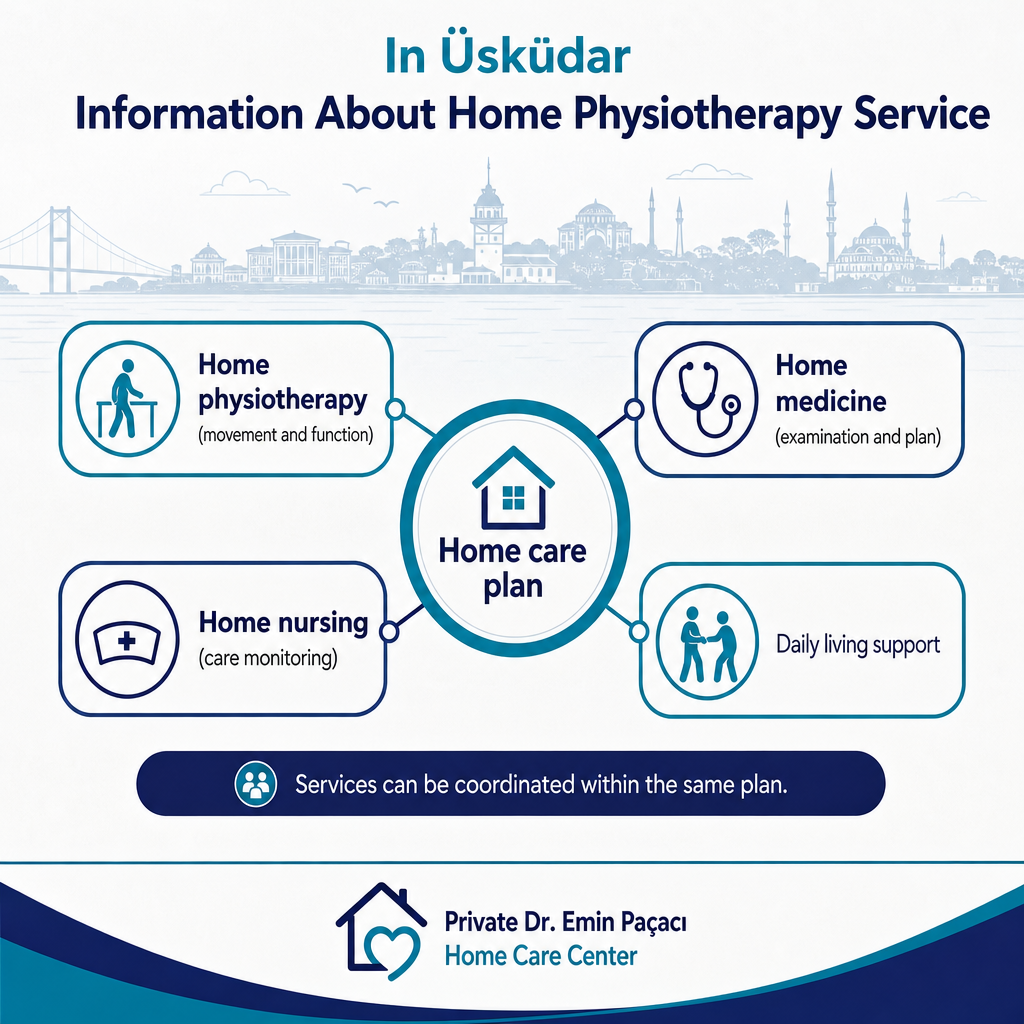 The role of physiotherapy in the home care plan
What criteria are considered in the assessment?
When planning home physiotherapy, several headings are addressed together. Each is aimed at carrying out the practice in a way appropriate to the person and the environment.
Diagnosis and current health status: The person's illness, any operation they have undergone, medical devices they use, and ongoing treatments are evaluated. Current medical reports, discharge documents, and physician recommendations can help with planning.
Movement and functional capacity: Muscle strength, joint mobility, balance, walking, in-bed movements, and daily living activities may be examined. The assessment is aimed at understanding which movements the person can perform safely and in which areas they need support.
Features of the home environment: Stairs, narrow passageways, bed and chair height, bathroom layout, and the use of assistive devices may be taken into account. The practices to be carried out at home must be compatible with the environment.
Participation of the patient and relatives: The physical support capacity of the patient's relative, their communication needs, and their level of understanding the care plan are also important. The information given to the relative is not for the person to carry out the program on their own, but for safely supporting the plan determined by the health team.
Medical suitability: In some cases, physiotherapy in the home environment may not be appropriate. According to the home care services regulations, if there is a medical contraindication or if the necessary equipment and trained personnel cannot be provided, the person may not be accepted into the home care service.
Areas of work that may be included in the scope
Practices vary according to the person's assessment and the determined plan. The following areas of work may be addressed within the scope of home physiotherapy:
- Assessment and support of joint range of motion
- Rehabilitation aimed at muscle strength and endurance
- Balance and coordination work
- Walking and transfer training
- In-bed movement and positioning support
- Neurological and orthopedic rehabilitation
- Functional movement work in elderly individuals
- Deemed-appropriate practices within the scope of respiratory physiotherapy
- Information about safe movement and the use of assistive devices in the home environment
The type, intensity, and frequency of the practice vary from person to person. A movement or practice deemed appropriate for one person may not be appropriate in a different health condition. For this reason, an exercise program, practice frequency, or technique should not be determined without a health professional's assessment. Our center's home physiotherapy information covers areas such as neurological, orthopedic, and geriatric rehabilitation, respiratory physiotherapy, mobilization in bed-dependent people, and family education; the scope may vary according to the person's clinical assessment.
How does process planning proceed?
The home care services regulations envisage determining the person's condition and the service to be provided after the application; conducting a home visit when needed; and creating treatment and care plans. In terms of physiotherapy, planning generally begins with reviewing the person's health history and current documents. Then movement and function capacity is assessed, physician recommendations and the discharge plan, if any, are taken into account, and the risks and physical constraints in the home environment are reviewed.
As a result of these assessments, physiotherapy goals are determined and the practice frequency and visit plan are created. The plan may be reassessed according to changes in the person's condition. Session duration and visit frequency differ according to diagnosis, endurance, and clinical need; a single standard duration does not apply to everyone. Physiotherapy may, when needed, be evaluated together with private home medical care and private home nursing services within the same care plan.
The limits of home physiotherapy and situations requiring physician assessment
Home physiotherapy aims to monitor the person's health condition in the home environment and to continue rehabilitation work; however, it does not mean that every medical problem can be managed at home. The following symptoms should not be considered as the subject of a physiotherapy plan, and emergency health services should be sought according to the person's condition.
| Symptom |
Why it is evaluated outside physiotherapy |
| Newly onset or rapidly increasing shortness of breath |
May require urgent medical evaluation |
| Altered consciousness, fainting, marked tendency to sleep |
May be a neurological or systemic emergency |
| Sudden speech disorder or one-sided loss of strength |
Symptoms requiring urgent evaluation |
| Chest pain or severe palpitations |
Possibility of a cardiac emergency |
| Severe pain or inability to move after a fall |
Injury evaluation takes priority |
| Deterioration of general condition with high fever |
May be an infection or systemic condition |
| New swelling, bruising, or circulatory change |
Circulatory evaluation may be needed |
When the situations in this table arise, the priority is emergency health services. The obligation of organizations providing home care services to arrange transfer by ambulance to an appropriate health institution in emergencies is also separately regulated in the legislation. Symptoms vary from person to person; for every new or worsening complaint, it is recommended to consult a physician.
Points that can be clarified while getting information
When getting information about home physiotherapy services, clarifying a few points helps the process to be planned correctly. You can ask through which health institution or unit the service is provided, the physiotherapist's professional competence and job description, who will carry out the initial assessment, and whether a physician recommendation or medical record is required.
In addition, it can be clarified in which situations the practice will be postponed or terminated, the scope of the assistive equipment to be used at home, the patient's relative's role in the process, how assessment and follow-up records are kept, and how communication with physicians, nurses, or other health professionals is carried out when necessary. The license and authorization information of the organization providing the service can also be reviewed; it is appropriate to evaluate the current document information together with the relevant institution's records.
Information that can be prepared before applying
Having certain information ready during the assessment helps the health team understand the situation. The following headings contribute to evaluating the content of the physiotherapy practice according to the person's condition; they do not by themselves create a diagnosis or treatment plan.
- Identity and contact information
- Diagnosis and discharge documents
- Physician reports regarding surgery or treatment, if any
- Information about the medical devices used
- Up-to-date list of regularly used medications
- Information on previously applied physical therapy and rehabilitation
- How long the movement restriction has existed
- Falls, loss of balance, or difficulties experienced in daily living activities
- Information regarding the stairs, bathroom, and bed layout at home
For channels to access home health services in Üsküdar and information that can be prepared for the application, the heading how to access home health services in Üsküdar can be reviewed. The suitability of the service for the person is determined in line with the health team's assessment and the relevant physician recommendations.
Frequently Asked Questions
For whom can home physiotherapy in Üsküdar be considered?
It can be considered for people who experience movement restriction, are bed- or chair-dependent, need rehabilitation after surgery or a neurological illness, and have difficulty reaching a center due to their health condition. The eligibility decision is made by examining the person's health condition and home conditions.
Is a physician assessment required for home physiotherapy?
Depending on the scope of the service and the person's health condition, a physician recommendation or assessment may be required. The home care services regulations envisage that the service be planned in line with physicians' recommendations.
How long does home physiotherapy last?
Session duration and visit frequency vary according to the person's diagnosis, endurance, goals, and clinical needs. A single standard duration does not apply to everyone; planning is done according to the person.
Does the physiotherapist provide a home exercise program?
The physiotherapist may provide information to the patient and their relative about supportive movements based on the assessment result. Which movements are to be done, how often, and within what limits is determined according to the person's health condition.
Are home physiotherapy and home nursing the same service?
No. Physiotherapy focuses on the area of movement, function, and rehabilitation; nursing focuses on nursing assessment, care monitoring, and nursing practices. When needed, different health services can be evaluated in a coordinated manner within the same care plan.