Methods for reducing balance loss and the risk of falling at home in the elderly become a concrete question that most families ask while living with an elderly relative at home: What disrupts balance, how can the home be made safe, and in which situations is a physician's evaluation necessary? Balance is an ability that requires coordination among the musculoskeletal system, the eyes, the balance organ in the inner ear, and the nervous system. With age, decreased muscle strength, limited joint mobility, vision and hearing problems, neurological diseases, and certain medications used can strain this system and increase the risk of falling. The good news is this: when arranging the home environment, appropriate movement and exercise programs, and medical evaluation are addressed together, the risk of falling can be significantly reduced in many people.
Contents
The importance of balance loss and falls in the elderly
Why should balance loss be taken seriously? Because its consequences are often not limited to a single fall. It is reported that a significant proportion of individuals aged 65 and over experience falls every year, and this rate rises even further in those over 75. Falls can lead to serious fractures such as hip fractures, head traumas, hospitalizations, and long-term mobility limitations.
Recurrent falls also have a more insidious effect. Once a person develops a fear of falling, the desire to go outside and move decreases; inactivity, in turn, can cause muscles to weaken further and balance problems to increase. Thus, the fear of falling itself can turn into a cycle that sets the stage for new falls. For this reason, recognizing balance loss and falls early is important both in terms of medical evaluation and in-home arrangements.
Main factors that increase balance loss and falling
A fall is usually not due to a single cause, but to several overlapping factors. Separating these into personal, medication-related, and environmental factors makes it easier to see which area to intervene in.
Personal factors. Geriatric studies count advanced age, a history of prior falls, lower extremity muscle weakness, walking and balance problems, sensory impairments, and cognitive involvement among the main factors that significantly increase the risk of falling. Vision and hearing problems, especially an incorrect eyeglass prescription, strain balance. Neurological diseases such as Parkinson's disease, stroke, peripheral neuropathy, and dementia; and chronic conditions such as low blood pressure episodes, cardiac rhythm disorders, and diabetes can also increase the risk.
Medication-related factors. Sleep medications, some sedatives, and blood pressure-lowering medications can contribute to dizziness and imbalance in some patients. Polypharmacy, the use of many medications together, can also increase this risk. Adjusting medications and evaluating their side effects is a personal matter; a physician's opinion is important for this evaluation.
Environmental (in-home) factors. Clutter in the home environment, slippery floors, poor lighting, unsuitable furniture placement, and the use of inappropriate footwear are among the common causes of falls. Slippery bathroom floors, small rugs and mats spread on the floor, cables running along the floor, steps, and stairs are the most frequently encountered risky areas. While personal factors often require medical follow-up, environmental factors can usually be reduced with arrangements that can be made at home.
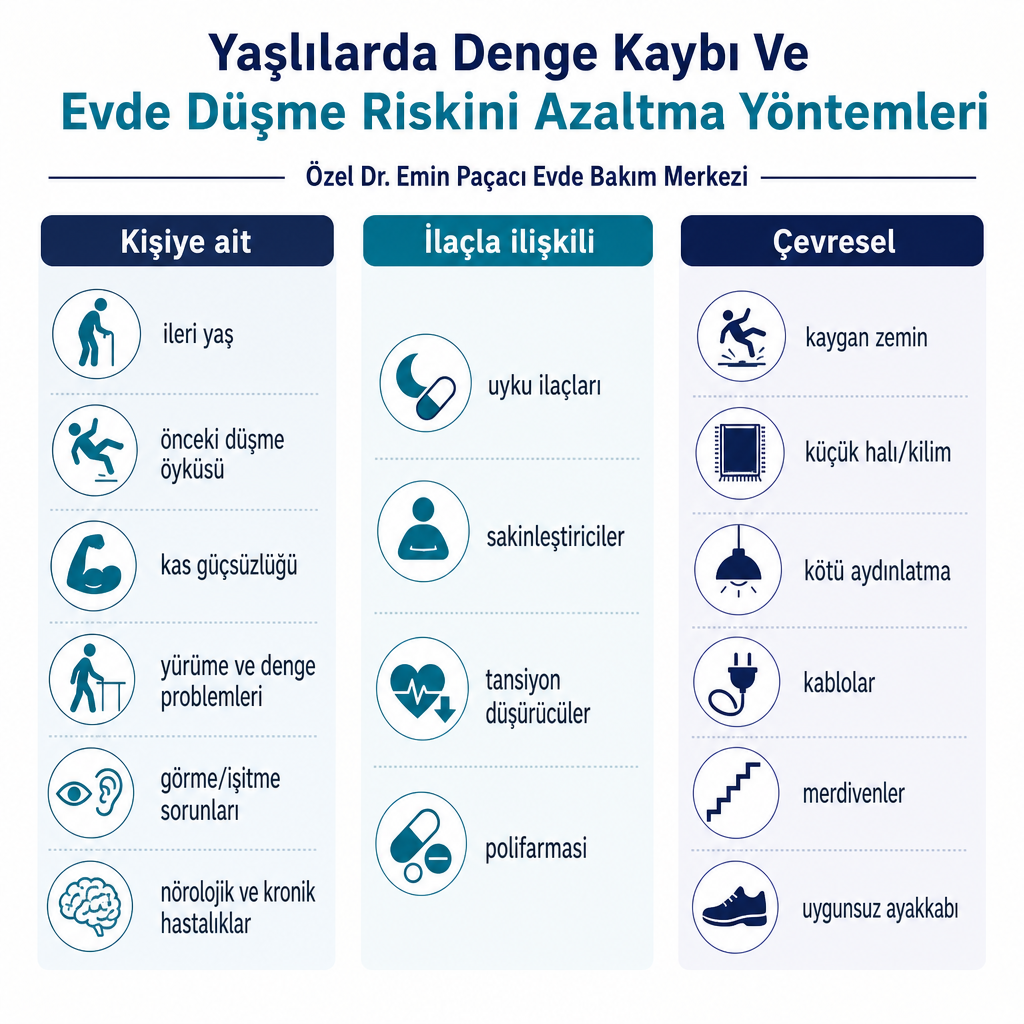 Main factors that increase the risk of falling at home
A safe home environment: risky areas and arrangements
Reducing the risk of falling in the home is often possible with small but systematic arrangements. The table below shows together the main risks in frequently used areas and the recommended arrangements.
| Area |
Common risk |
Recommended arrangement |
| Living room and hallway |
Small rugs/mats, cables on the floor, weak lighting |
Removing rugs or securing them with a non-slip backing; fixing cables to the wall; lighting transition areas well |
| Bathroom and toilet |
Wet and slippery floors |
Non-slip mat; grab bars fixed to the wall; drying wet areas quickly |
| Bedroom |
Getting up at night in the dark, unsuitable bed height |
An easily reachable lamp at the bedside; a bed height that does not make sitting down and getting up difficult |
| Stairs and entrance |
Slippery steps, lack of railing |
Sturdy handrails on both sides; non-slip step covering; adequate lighting |
The common logic of these arrangements is to make the routes the person moves along most during the day safe and well-lit. Keeping daily-used items (such as the phone, remote control, and water) at easily reachable heights reduces unnecessary bending and reaching movements. Having a night light in areas used at night minimizes the need to walk in the dark. Having furniture or wall handles that provide something to hold onto along the route between the bed and the toilet is also supportive, especially when getting up at night.
Footwear, assistive devices, and daily habits
Unsuitable shoes and slippers are a factor that facilitates balance loss but is often overlooked. Studies indicate that shoes or slippers with non-slip soles, that fit the foot well, and are heelless can help reduce the risk of falling. In contrast, loose slippers and high-heeled, hard-soled shoes are generally not recommended.
Assistive devices such as canes and walkers can support walking in some individuals experiencing balance problems. However, choosing a device appropriate for the person and using it correctly is decisive; the wrong device choice or incorrect use can create new fall risks. For this reason, a physician's and physiotherapist's evaluation is important for device selection and usage training.
Small changes in daily habits can also help maintain balance. When standing up from a sitting or lying position, waiting a few seconds while seated instead of moving suddenly is important, especially for people experiencing dizziness. Avoiding behaviors such as changing direction suddenly, moving quickly, or hurriedly going up and down stairs also reduces the risk.
The role of movement and exercise on balance
In balance loss, inactivity is not a solution but often a part of the problem. Research shows that balance training and muscle-strengthening exercises can reduce the risk of falling in elderly individuals. In particular, programs that strengthen the lower extremity muscles and improve postural control and walking patterns are frequently used in individuals with balance problems.
Balance exercises are generally grouped under three headings:
- Muscle strengthening, especially the leg and hip muscles
- Balance and postural control; standing balance, single-leg or narrow-base stance exercises
- Gait training; step length, tempo, and changing direction
The type, duration, and intensity of exercise are determined according to the individual. In people with chronic illness, cardiovascular problems, advanced osteoporosis, or serious joint problems, a physician's evaluation before starting the program and, if possible, planning under the guidance of a physiotherapist is recommended. For individuals with limited mobility or who have difficulty going to a clinical setting, balance and gait programs adapted to the home environment are defined as an option; appropriate patient selection and follow-up are carried out according to physician and physiotherapist evaluation. On this subject, our guide explaining how post-operative home physiotherapy works offers a general framework for how programs in the home environment are planned.
The place of physician, nursing, and physiotherapy support at home
Balance loss and falls are often situations that need to be addressed not only with environmental arrangements but together with medical evaluation and follow-up. As Private Dr. Emin Paçacı Home Care Center operating in Üsküdar, we plan the services that can be offered in the home environment according to the patient's medical condition, mobility, and living environment. The suitability of these services is decided through a physician's evaluation.
The main areas of support offered at home can be summarized as follows:
- Private home physician services can contribute to medical history, examination, review of medications, and planning of necessary tests in individuals with balance loss or who have experienced falls.
- Private home nursing can play a role in follow-up and education for individuals with chronic illness, requiring medication and vital sign monitoring, and needing support during the recovery process after a fall.
- Home physiotherapy can offer support with exercise and education programs adapted to the home environment for individuals with balance and gait problems who have difficulty attending sessions in a clinical setting.
Which service is appropriate is determined by the patient's history, examination findings, and, when necessary, team evaluation. For readers curious about the general functioning of the home health process, our guide explaining how Üsküdar home care services work can be a helpful guide.
In which situations is it recommended to consult a physician?
Some symptoms indicate that balance loss cannot be addressed with home arrangements alone and may require medical evaluation. It is recommended to consult a physician in the following situations:
- Experiencing one or more falls in recent months
- Frequent imbalance while walking, swaying to the left and right, or hesitation when taking steps
- Newly starting or increasing dizziness, blurred vision, or sudden vision changes
- A feeling of imbalance accompanied by palpitations, chest pain, or shortness of breath
- Balance problems seen together with confusion, forgetfulness, or distraction
Symptoms may vary from person to person; therefore, it is appropriate for individuals experiencing balance loss or falls to be evaluated by a physician. The decision on evaluation and treatment belongs to the physician.
Frequently Asked Questions
Is every balance problem normal with aging?
Some changes affecting balance can be expected during the aging process; however, sudden-onset or progressively increasing imbalance should not always be considered age-related. In such situations, it is important to be evaluated by a physician.
Do small arrangements at home really reduce falls?
Geriatric studies show that fall rates can be reduced with in-home arrangements such as securing rugs, increasing lighting, and using grab bars in bathrooms and on stairs.
Is using a cane alone sufficient?
A cane or walker can support balance in some people; however, the wrong device choice or incorrect use can create new fall risks. For this reason, it is appropriate for assistive devices to be selected with the recommendation of a physician and physiotherapist.
Do elderly people who have not experienced falls also need to exercise?
It is reported that balance and muscle-strengthening exercises can provide a protective effect even in elderly people who have not experienced falls but carry risk factors. The exercise program should be planned taking the person's health status into account.
For which elderly people do home care and home physiotherapy come into consideration?
For individuals with limited mobility, who experience frequent falls, who have difficulty leaving the house due to chronic illnesses, or who require follow-up in the home environment, home physician services, nursing, and physiotherapy can be considered as an option. Which service is appropriate is decided through a physician's examination and, if necessary, team evaluation.