The return home of a loved one discharged from intensive care creates both joy and uncertainty in most families. Adapting to the Home Care Process After Intensive Care: A Guide for Patients' Relatives addresses both the patient's medical needs and the reestablishment of the household order in this transitional period within an understandable framework. Following long hospitalizations, patients may experience physical, cognitive, and emotional changes; during the same period, family members providing care may also experience intense stress and difficulty adapting. Considering these two dimensions together contributes to a more predictable progression of home care.
Table of Contents
The post-intensive care period: What changes for the patient and the family?
Physical problems such as muscle weakness, decreased endurance, fatigue, and shortness of breath are common in patients who stay in intensive care for a long time. These may be accompanied by cognitive effects such as attention and memory problems and difficulty organizing thoughts. In the literature, this condition is referred to as "post-intensive care syndrome (PICS)" and may make it harder for the patient to return to daily life activities. Being aware of these changes helps set realistic expectations at home.
The process does not affect only the patient. Depression, anxiety, post-traumatic stress symptoms, and sleep disorders can be observed in relatives. This condition has been defined as "PICS-family (PICS-F)," and some studies have reported significant care burden and psychological impact in approximately one-third of primary caregivers during the first months after intensive care. Therefore, when planning adaptation to the home care process, the psychological and social support needs of family members should be taken into account as much as the patient's medical needs.
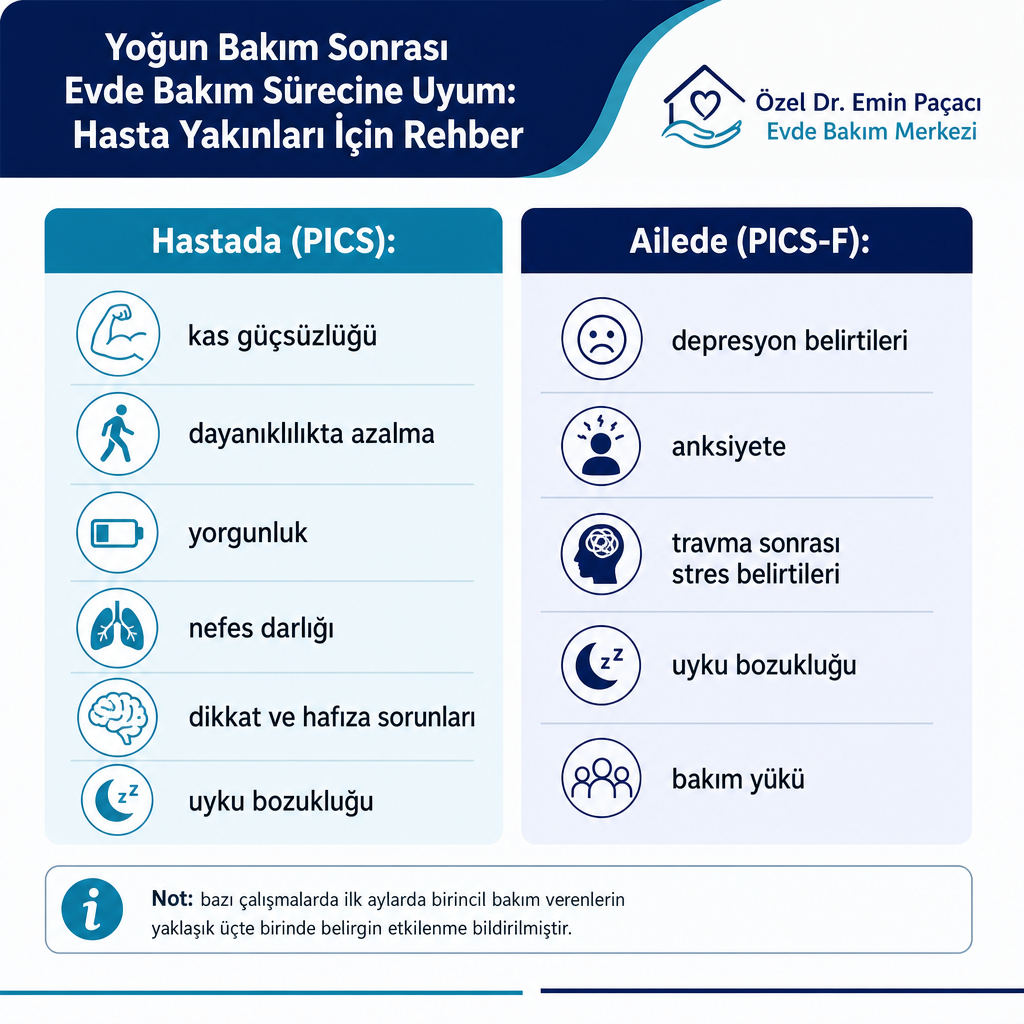 Areas affecting the patient and the family in the post-intensive care period
The framework for transitioning to the home care process
In Turkey, home health services aim to conduct examination, testing, analysis, treatment, medical care, and rehabilitation at home and in the family environment, as well as to provide social and psychological support to the patient and family members. The relevant regulations aim for these services to be provided by public institutions in an accessible and effective manner consistent with the social state understanding. Regulations regarding the provision of home care services define care standards for individuals with long-term care needs and the conditions that institutions must meet.
When planning discharge after intensive care, the physician following the patient and the hospital team evaluate the patient's medical condition. Whether home health service is needed, whether outpatient check-ups will be sufficient, or whether additional professional care is required is determined in line with this clinical evaluation. Patients' relatives can jointly consider the possibilities of the home environment, the family's care capacity, and the level of professional support needed within the framework recommended by the physician. You can find the general functioning of this process in more detail in our guide explaining how home health and care services work in Üsküdar.
The main components of the home care process
Home care is not just a single service; different areas come together depending on the patient's condition. The following topics are components that complement each other within the plan determined by the physician.
Medical monitoring and physician support
In the post-intensive care period, the physician's regular evaluation is important for monitoring the patient's general condition. The scope of home medical services may include physical examination and general evaluation, diagnosis and treatment planning, medication adjustments, basic tests such as ECG with portable devices, and applications such as serum-fluid therapy. The physician decides which interventions should be continued at home and which should be continued in hospital conditions according to the patient's clinical picture. The scope of our home private physician service is also based on this evaluation logic.
Nursing care
In the post-intensive care period, many patients may require monitoring of vital signs, regulation of medication administration, wound care, nutritional support, and monitoring of medical materials such as catheters or tubes. The home private nursing service we provide plays a role in administering medical treatment, supporting daily care, and early recognition of signs of complications. Our nurses can make the care process more understandable by answering the questions of family caregivers within the limits determined by the physician.
Physiotherapy and rehabilitation
In patients who remain immobile for a long time in intensive care, a decrease in muscle and joint functions, difficulty walking, and balance problems may develop. This situation may bring home physiotherapy and rehabilitation to the agenda. Home physiotherapy is a form of service in which the patient is evaluated by a physiotherapist in the home environment, and exercise and mobilization programs suitable for their functional capacity are planned. The home physiotherapy service we provide may include applications to support mobilization, breathing exercises, and the process of returning to daily life in the post-intensive care or post-surgery period. You can examine the logic of physiotherapy during this period more closely in our article addressing the importance of home physiotherapy after surgery.
Psychosocial support
Depression, anxiety, and post-traumatic stress symptoms associated with PICS and PICS-F can reduce quality of life in both the patient and the caregiver. Research reveals that a significant portion of family members experience care burden, sleep disorders, and emotional strain in the post-intensive care period. Therefore, psychological counseling, social service support, or other appropriate professional support can be considered as part of adaptation to the home care process.
Adaptation for patients' relatives: Reestablishing the home and care routine
Adaptation to the home care process requires reorganizing the daily life routine and roles. The patient's sleep pattern, meal times, medication administration, exercise, and personal care activities, along with the family members' work, social life, and rest times, should be planned in a balanced manner. Due to the increased risk of burnout in people who provide care for a long time, sharing care responsibilities within the family and evaluating professional support options when necessary can be beneficial.
Establishing open communication with the physician and nurse facilitates the adaptation process by reducing uncertainties. Obtaining information from the healthcare team before and after discharge on topics such as the patient's repositioning, mobilization, nutritional approach, and warning signs to watch for contributes to making home care more predictable. Since symptoms and risks vary from person to person, the physician's evaluation is important when newly emerging or worsening complaints are noticed.
Decision-making process: Which topics should be considered?
When establishing the home care routine, a few topics provide a basic framework for families to evaluate together with the physician's recommendations.
- The patient's medical condition: Post-intensive care clinical stability, respiratory functions, nutritional status, comorbidities, and complication risk are evaluated by the physician. This clinical picture plays a fundamental role in determining the frequency of home monitoring, nursing needs, and rehabilitation requirements.
- Functional independence and safety: The extent to which the patient can perform activities such as getting out of bed, sitting, walking, using the toilet, and personal care affects the care routine. In patients with balance disorders or weakness, physiotherapy and environmental adjustments may come to the agenda to address the risk of falls at home.
- Home environment and logistical possibilities: Physical conditions such as stairs, narrow doors, and slippery floors, as well as assistive equipment that may be available at home, shape the care plan. When necessary, reviewing the home environment together with the healthcare team and planning appropriate adjustments can be considered.
- Family care capacity and psychological resilience: The caregiver's physical health, time, other responsibilities, and psychological resilience are decisive in the long-term process. Since research emphasizes that burden and psychological symptoms are common among caregivers, discussing support resources early can be beneficial.
- Legislation and service access: Home health services provided by the public are accessed through procedures defined in the regulations; applications are received through provincial coordination centers and national call lines. In addition, private home care institutions licensed by the Ministry of Health can also provide services such as home medical care, nursing, physiotherapy, and palliative care.
As the Private Dr. Emin Paçacı Home Care Center, we are a Ministry of Health-licensed center that enables patients to receive medical evaluation and care in their own living spaces through services such as home private physician care, home private nursing, home physiotherapy, home palliative care, and IV/serum applications. You can see all of the services we provide under a single heading. These topics, when evaluated together with the physician's clinical recommendations, can provide families with a basic framework when making decisions.
Home care options in the context of Üsküdar and Istanbul
The relevant regulations state that home health and palliative care services are provided in health facilities of the Ministry of Health, universities, municipalities, and other public institutions. In the Üsküdar region, public home health applications such as home oral and dental health services in ministry-affiliated oral and dental health centers are available. Various support programs for elderly and disabled individuals may also be found within the social service headings of local governments.
Through our central office located in Üsküdar, we provide home health and care services such as home private physician care, nursing, physiotherapy, palliative care, and IV/serum applications. Families can determine options suitable for their own conditions in line with the patient's medical needs and physician recommendations by evaluating public home health services and licensed private home care services together. If you would like to discuss what kind of plan can be created according to your patient's condition, care needs, and home environment, you can share the current situation with us and review the appropriate evaluation framework together.
Frequently Asked Questions
What symptoms are common after intensive care?
After long intensive care hospitalizations, fatigue, muscle weakness, shortness of breath, attention and memory problems, sleep disorders, and mood fluctuations are frequently reported complaints in patients. Since these symptoms are evaluated within the scope of PICS, the physician's re-evaluation is important in case of an increase in their severity or significant limitation of daily life.
Are the psychological effects seen in patients' relatives an expected situation?
Research shows that depression, anxiety, post-traumatic stress, and sleep problems are common in the primary caregivers of intensive care patients, and that this is addressed within the scope of PICS-F. Intense stress and feelings of burnout are common; when they reach a level that disrupts daily life, consulting a physician or mental health professional is recommended.
When can professional support at home be considered?
Home medical care, nursing, and physiotherapy services may come to the agenda when the patient's medical condition is complex, when medications and interventions require professional application, when the need for mobilization and rehabilitation becomes apparent, or when the family's care capacity remains limited. This decision is shaped as a result of the clinical evaluation of the physician following the patient and their discussions with the family.
What is the fundamental difference between public home health services and private home care services?
Public home health services cover examination, testing, analysis, treatment, medical care, and rehabilitation services provided with the social state principle within the scope defined by the regulations. Private home care institutions, on the other hand, are healthcare businesses that comply with certain standards through a Ministry of Health license and provide services such as home medical care, nursing, physiotherapy, and palliative care through their own staff.
In the home care process, who has the final say on medical decisions?
Treatment and medical care decisions are made by the physician evaluating the patient in light of clinical findings and current guidelines. The patient and their relatives can jointly participate in the decision-making process among the recommended options by conveying their own living conditions and expectations to the physician.